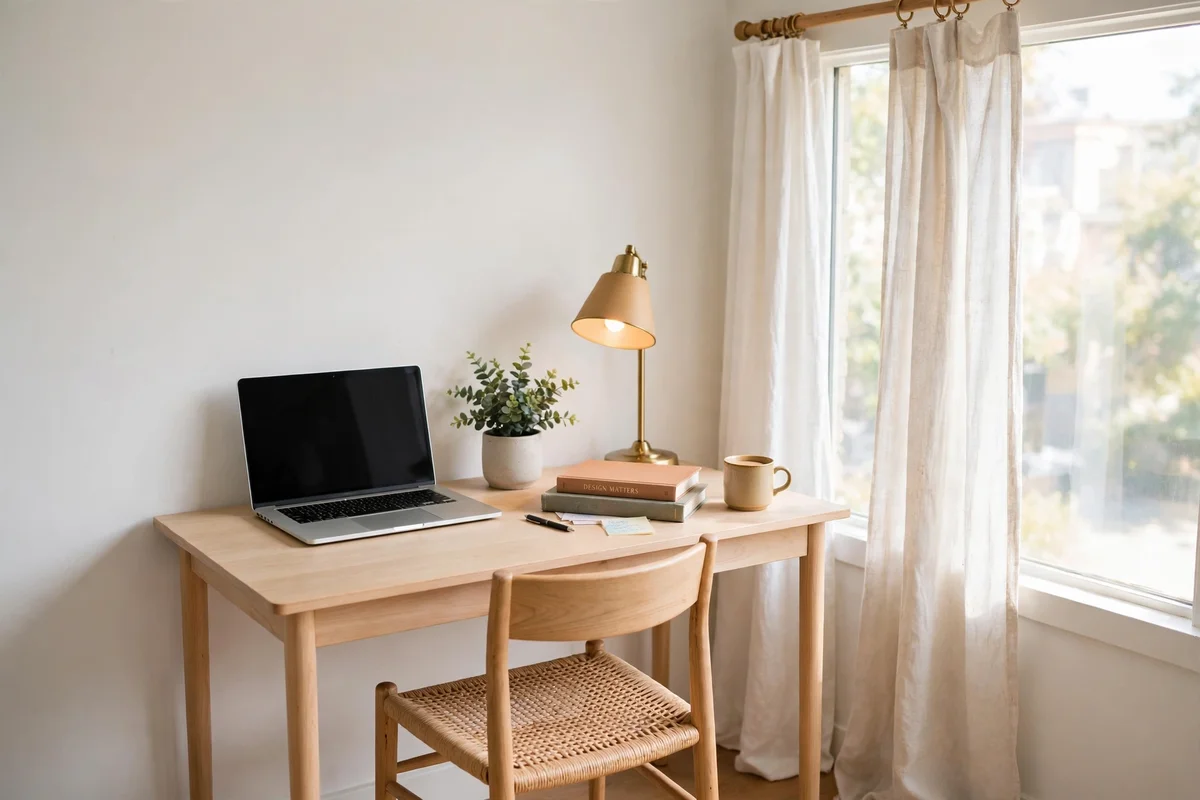
14 Small Apartment Desk Ideas That Actually Fit (and Get Used)
My first desk in my first apartment was an ironing board. Not a joke, not a quirky life hack — an actual ironing board with my laptop on it, wobbling every time I typed too hard. It lasted about three weeks before I admitted that “working from the sofa” was destroying my back and my focus in equal measure. The problem wasn’t that I needed a big office. It was that every desk I looked at seemed designed for a house with a spare room, and I had a corner. One corner, about a metre wide, next to the radiator.
Here’s what I figured out eventually: a desk for a small apartment isn’t a smaller version of a big desk. It’s a different animal entirely. It folds, it floats, it hides, it does two jobs at once. These are the 14 small apartment desk ideas that actually worked — in my flat and in friends’ flats I’ve helped set up — for real work, real laptops, and real rooms that also have to be living rooms.
Quick Answers
- What’s the best desk for a small apartment? A slim wall-mounted or floating desk, 80–100 cm wide — it gives you a real work surface without taking any floor space at all.
- Can I fit a desk in a studio apartment? Yes — a fold-down desk, a desk in an unused closet, or a narrow console-style desk behind the sofa all work without a dedicated room.
- How do I keep a small desk from becoming a dumping ground? One rule: nothing lives on the desk except what you use daily. Everything else gets a drawer, a shelf, or a basket.
1. The Floating Desk (My Number One Pick)
If you take one idea from this list, take this one. A wall-mounted floating desk is just a sturdy shelf at desk height with brackets that can hold your weight leaning on it — and it changes everything, because your floor stays completely clear. I put one up in my bedroom corner with two brackets and a plank of oak, and suddenly I had a workspace that took up zero square metres of floor. The chair tucks underneath, the space below stays open, and cleaning under it takes ten seconds. If your landlord allows two screw holes, this is the move. My small home office ideas have a few more floating setups if you want the full corner treatment.
2. The Fold-Down Desk That Vanishes After Work
I love this one for people whose apartment is also their office, their dining room, and their cinema. A fold-down desk mounts to the wall, flips down when you work, and folds flat against the wall when you don’t. Closed, it looks like a shallow cabinet. Open, it’s a proper desk. The trick is buying one deep enough — at least 45 cm — or your laptop hangs off the edge like it’s about to jump. Mine has a little lip that stops pens rolling off, which sounds minor until you’ve chased a pen under the sofa for the fourth time.
3. The Closet Desk (a.k.a. the “Cloffice”)
This sounds ridiculous until you see it done well. Take a closet you barely use — the one full of coats you never wear and a vacuum cleaner — clear it out, put a desk surface across it at the right height, add a shelf above, and you’ve got an office with a door you can close. I mean literally close: when work ends, you shut the doors and your apartment is a home again, not an office with a bed in it. It also hides the mess, which is honestly half the appeal.
4. The Slim Console Desk Behind the Sofa
Here’s one nobody thinks of: the back of your sofa is dead space. A narrow console table — 30 cm deep, the length of your sofa — pushed against its back makes a surprisingly good desk. You sit on the sofa side facing the wall, laptop on the console, and when you’re done, it just looks like a sofa table with a lamp on it. It works best if your sofa isn’t shoved against a wall already. I did this in a friend’s flat and she still thinks it’s the cleverest thing in her home. Probably because it is.
5. The Corner Desk That Uses the Angle Nobody Wants
Every apartment has that one corner where nothing fits — too awkward for a bookshelf, too small for a chair. That’s your desk spot. A triangular or L-shaped corner desk slides right in and uses space that was doing absolutely nothing. The diagonal position actually feels good to work at, too: you’re tucked in, focused, with wall on both sides instead of the whole room distracting you. Just measure the angle first. Corners in old buildings are rarely the perfect 90 degrees the listing promised.
6. The Secretary Desk With Doors That Hide the Chaos
Old-fashioned? Yes. Brilliant for a small flat? Also yes. A secretary desk has a drop-down front that becomes your work surface, and when you fold it back up, the whole mess — papers, cables, that mug from Tuesday — disappears behind a door. It looks like a nice cabinet and works like an office. Charity shops are full of them for next to nothing, and the proportions were made for small rooms because, well, rooms used to be small. If you’re short on storage generally, my 20 clever storage solutions for small apartments pair nicely with this one.
7. A Desk That Doubles as a Dressing Table
If you work from home and you also need somewhere to get ready in the morning, stop buying two pieces of furniture. A desk with a mirror above it is a dressing table before 9am and a workspace after. Keep a small tray for jewellery and a drawer for chargers, and the switch takes ten seconds. I did this for a year in a flat with one bedroom and no space for a vanity, and it worked so well I still do it — the mirror makes the corner feel bigger, too. My small apartment dresser ideas cover the storage half of this setup if your drawers need backup.
8. The Windowsill Desk (Use the Light You’re Already Paying For)
This one’s for the romantics: if your window has a deep sill, or you can mount a narrow shelf right under it, you’ve got a desk with the best view in the flat and free daylight all day. Natural light is genuinely better for working than a lamp — fewer headaches, better mood — and a windowsill desk costs almost nothing to set up. The catch: you need a sill or shelf at least 40 cm deep, and you’ll want a curtain or blind for the afternoons when the sun turns your screen into a mirror.
9. The Ladder Desk (Shelves Above, Work Below)
A ladder desk leans against the wall — shelves that get narrower as they go up, with a desk surface at the bottom. It holds your books, your plant, your printer, and your laptop in one vertical strip about 60 cm wide. It looks light because it is light: all that open space between the shelves stops it feeling like a big block of furniture. Fair warning, though — it only works if you’re honest about what goes on those shelves. The moment they become a dumping ground for random boxes, the whole thing looks like a storage unit. My small apartment bookshelf ideas have rules for keeping open shelves from turning into chaos.
10. The Rolling Desk You Can Push Away
Some days you want to work by the window. Some days you want to work facing the room. A small desk on castors lets you do both, and when guests come over, you roll it into a corner and it’s gone. Look for one with locking wheels — a desk that drifts while you type is funny exactly once. This is also the best option if you rent and can’t put holes in the wall, because it needs zero installation and leaves zero marks. Landlord-friendly and commitment-free, which is more than I can say for most of my furniture decisions.
11. The Dining Table Desk (One Surface, Two Lives)
Be honest: how often do you actually eat at your dining table? If the answer is “rarely,” that table is a desk waiting to happen. Set up one end as your permanent work spot — a monitor arm, a cable tray underneath, a chair that works for both meals and work — and the rest stays a table. The trick is the cable tray and a drawer or basket for work stuff, so dinner doesn’t involve clearing a laptop, three chargers, and a notebook off the table every single night. My rule: work stuff lives in one basket. Basket on the table, you’re working. Basket away, you’re eating.
12. The Built-In Desk Under the Bed (Loft Life)
If your bed is raised — a loft bed, or even a bed on risers — the space underneath is a free office. A desk surface, a chair, a light, and you’ve got a workspace that takes up literally no extra floor. It sounds cramped, but with decent lighting it feels cosy rather than cramped, like a little cabin. Measure your sitting headroom before you commit, though. I helped a friend build one and we discovered — after assembly — that she couldn’t sit up straight under it. Measure twice, assemble once, as my dad would say if he were the measuring type.
13. The Standing Desk Converter on a Tiny Table
You don’t need a full standing desk. A converter — the little riser that sits on your existing desk and lifts your laptop and keyboard up — turns any small table into a sit-stand setup for a fraction of the price and space. I use mine for an hour a day, standing, and my back genuinely thanks me for it. It folds flat when you’re sitting, so the desk stays a desk. If your table is already small, this is how you get a standing desk without buying a whole new piece of furniture or finding floor space you don’t have.
14. The “One Drawer” Rule That Makes Any Desk Work
Okay, this one isn’t furniture — it’s the rule that saved my desk from becoming a junk pile. Every desk gets exactly one drawer (or one box, or one shelf) for the random stuff: cables, notebooks, that adapter you need twice a year. Everything else either lives on the desk because you use it daily, or it lives somewhere else entirely. The day I enforced this, my desk went from a cluttered shelf with a laptop on it to an actual workspace. And if the rest of the bedroom needs the same treatment, my small bedroom decor ideas cover the room around the desk — because a tidy desk in a messy room still feels messy.
FAQ
What size desk fits in a small apartment?
Aim for 80–100 cm wide and 45–60 cm deep. That’s enough for a laptop, a notebook, and a mug without crowding the room. If you’re under 80 cm wide, go wall-mounted so you don’t lose floor space to legs.
Can I put a desk in my bedroom without it feeling like an office?
Yes — pick a desk that looks like furniture, not office equipment: wood instead of metal, a chair that matches the room, and a rule that work stuff gets put away at the end of the day. A fold-down or secretary desk hides completely when closed.
Is a floating desk strong enough for a monitor and laptop?
Yes, if it’s mounted into wall studs or with proper heavy-duty fixings — not just plasterboard plugs. A good floating desk holds 20–30 kg easily. If you’re renting and can’t drill, use a leaning ladder desk or a rolling desk instead.
Where should I put a desk in a studio apartment?
In a corner, in an unused closet, or behind the sofa. Avoid putting it right next to the bed if you can — keeping work and sleep zones separate, even by a metre, helps you switch off at the end of the day.
Do I need a special chair for a small desk?
You need a chair that fits under the desk when you’re done. Armless chairs, folding chairs, or a simple stool tuck away neatly and keep the corner looking tidy instead of permanently occupied.
Bottom Line
A desk in a small apartment isn’t about finding room for an office — it’s about stealing a corner, a closet, or the back of a sofa and making it work harder than it has any right to. My ironing-board days taught me that any flat surface technically holds a laptop, but a real desk — one that’s the right size, in the right spot, with a rule about what lives on it — is what turns “working from home” from a backache into an actual setup. Start with the floating desk if you can drill two holes. Start with the fold-down if you can’t. Either way, stop working from the sofa. Your back will notice the difference within a week. Mine did.