14 Small Apartment Kitchen Lighting Ideas That Make a Tiny Kitchen Feel Bright
My kitchen had one light when I moved in. One. A single fluorescent tube in the middle of the ceiling that buzzed, flickered when it rained, and made everything I cooked look slightly grey. I chopped onions under that light for a year. A whole year of squinting at the cutting board, holding my phone flashlight in my teeth because the counter was in shadow. Honestly, I don’t know how I put up with it.
Then I stuck a ten-dollar LED strip under my top cabinet, plugged it in, and stood there staring at my counter like I’d discovered fire. I could see what I was doing. The tomatoes were red. The cutting board was bright. My kitchen — the same tiny kitchen — suddenly looked like a place where someone who knows how to cook lives. Ten dollars. Five minutes. No tools.
Here’s the thing about small kitchens: the ceiling light is almost never where you need it. It’s in the middle of the room, and you stand at the counter, so your own body blocks the light and throws your work surface into shadow. That’s not a design flaw you have to live with. It’s a lighting problem, and lighting problems have cheap fixes. These 14 small apartment kitchen lighting ideas are the ones that actually work in real tiny kitchens — most of them renter-friendly, none of them needing an electrician, and all of them cheaper than a single takeaway order a week.
Quick Answers
- What is the best lighting for a small apartment kitchen? Layered light: a warm ceiling light for the room, under-cabinet strips for the counter, and one small pendant or plug-in light for warmth. One light is never enough in a kitchen — you need light where your hands actually are.
- How can I add kitchen lighting without rewiring? Stick-on LED strips, battery puck lights, plug-in pendants, and clip-on lights all need zero wiring. Command strips and hooks hold most of them, so they’re renter-friendly and come down cleanly on moving day.
- What color temperature is best for kitchen lighting? 3000K to 3500K — warm white, not daylight. It makes food look appetizing and the room feel welcoming. Save 4000K-plus daylight bulbs for a garage, not a kitchen.
- How do I make a dark rental kitchen feel brighter? Add under-cabinet lights first — they do more than anything else — then a bright bulb in the ceiling fixture, and a light-colored backsplash or a mirror to bounce the light around.
1. Under-cabinet LED strips (the ten-dollar miracle)
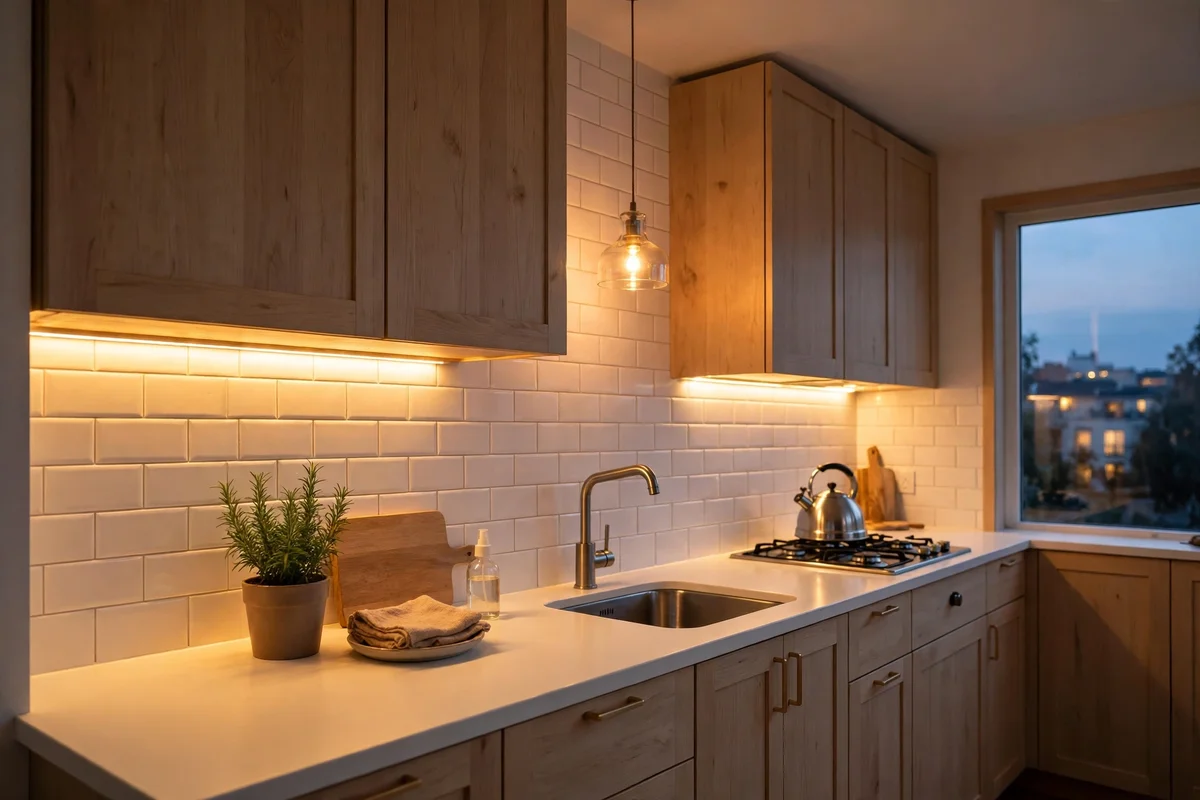
I’m starting here because this is the single best thing on the whole list, and it costs less than lunch. A strip of warm-white LEDs stuck to the underside of your top cabinets, and suddenly your counter is lit like a cooking show. No more chopping in your own shadow. No more guessing whether the chicken is cooked.
Mine are the plug-in kind — one strip, one plug, stuck on with the adhesive that came in the box. They’ve been up for two years and haven’t budged. If your cabinets have no plug nearby, get the battery ones. Either way, the effect is the same: your kitchen goes from cave to kitchen.
- Warm white, 3000K — not the blue-white ones, they make food look weird
- Stick the strip toward the front edge of the cabinet so the light falls on the counter, not the wall
- A plug-in strip with a remote dimmer is worth the extra few dollars
- Works on any counter — see also our small kitchen ideas for making the whole room work harder
2. The battery puck lights for the cabinet with no outlet
Some cabinets have no plug anywhere near them. Mine didn’t — the one outlet in my kitchen is behind the fridge, which is helpful to exactly no one. Battery puck lights are the answer. They’re little round discs, about the size of a biscuit, that stick to the underside of a cabinet with a magnet or adhesive. Tap to turn on, tap again to turn off.
I have three of them in the darkest corner of my kitchen, over the spot where the coffee stuff lives. They run on AA batteries and last months. Are they as bright as a wired strip? No. Do they turn a black hole into a usable corner? Absolutely. And when you move, you peel them off and take them with you.
- Put two or three in a row — one puck alone leaves dark patches
- Rechargeable ones exist now and save you buying batteries forever
- The tap-to-turn-on kind is easier than the remote kind when your hands are wet
- Perfect for inside a dark pantry cupboard too
3. One small pendant over the sink (yes, just one)
A pendant light in a kitchen sounds fancy. It’s not, not if it’s one small one. My sink sits under a window with no light above it, and washing dishes in the dark was my normal for a while. Then I hung a single plug-in pendant — a small glass shade on a cord, hooked over a ceiling hook, plugged into the outlet by the counter. It took twenty minutes and changed the whole room.
One small pendant over the sink does two things: it lights the one spot you stand at every single day, and it makes the kitchen look designed instead of assembled. The trick is keeping it small. A big pendant in a tiny kitchen looks like a chandelier crashed into a cupboard. A small one looks intentional.
- A shade 8 to 10 inches wide is the sweet spot for a small kitchen
- Hang it 30 to 36 inches above the counter, not higher
- Plug-in pendants with a swag hook need no electrician and no holes in the ceiling that matter
- For the pendant rules that apply anywhere, see our small apartment pendant light ideas
4. Swap the ceiling bulb (the zero-effort upgrade)
This is so obvious it feels silly writing it, but nobody does it. The bulb your landlord put in is probably a cold, dim, cheap thing that makes your kitchen look like a storage room. Unscrew it. Put in a bright warm-white LED, the highest wattage-equivalent the fixture allows. Done. Thirty seconds.
I swapped mine and the kitchen got brighter by what felt like double. Same fixture, same room, just a bulb that actually does its job. If the fixture has a frosted cover, take it off and wash it — years of kitchen grease on that cover can block a shocking amount of light. Mine was yellow. I had no idea until I cleaned it.
- A 100-watt-equivalent LED in 3000K is the safe pick for most kitchen fixtures
- If your fixture takes a bulb with a dimmer, get a dimmable LED so you can soften it at night
- Clean the fixture cover with dish soap — grease dims light more than you’d think
- This is the cheapest brightness upgrade that exists, and it takes less time than making tea
5. A clip-on light on the open shelf
Open shelves are great until you realize the shelf itself blocks the light from the ceiling, and everything underneath it sits in shadow. A clip-on light fixes it. It’s a small LED light with a clamp that clips onto the edge of the shelf and points down at the counter or the shelf below.
I clipped one under my top shelf where the mugs live, and now I can actually see which mug I’m grabbing at 6 a.m. without turning the big light on. Some clip-ons are battery powered, some are USB rechargeable. Either way, no holes, no wiring, and you can move it in two seconds when you rearrange the shelf.
- Aim it at the work surface, not at your eyes — glare is the enemy
- Warm white again, 3000K, for the same reason as everywhere else in the kitchen
- A USB-rechargeable one means no battery runs to the shop
- Also brilliant clipped to a shelf in a pantry or a dark cupboard
6. LED strip behind the backsplash (the glow you see in magazines)
You know those kitchens in magazines where the backsplash seems to glow from behind? That’s an LED strip tucked behind a shelf or along the top edge of the backsplash, and it is embarrassingly easy to copy. A strip of LEDs stuck along the top of the backsplash, or under a floating shelf, throws a soft wash of light down the wall. It makes the whole kitchen look expensive.
I did this with a ten-dollar strip and a roll of double-sided tape, along the shelf above my stove. At night, with just that strip on, my kitchen looks like a restaurant. During the day it’s invisible. It’s the most compliments-per-dollar thing in my entire apartment.
- Put the strip where it’s hidden from eye level — under a shelf lip or behind a trim piece
- A dimmable strip lets you drop it to a soft glow for evenings
- It shows off your backsplash, so if yours is worth showing, this is the move — see our small apartment kitchen backsplash ideas for what pairs well
- Warm white, always. A cool-white strip behind a backsplash makes the kitchen look like a lab
7. A plug-in wall sconce beside the stove
A wall sconce in a kitchen sounds wrong until you try it. Mine sits on the wall beside the stove, plugged into the counter outlet, and it’s the light I use most. It lights the stove, it lights the counter next to it, and it throws a warm glow across the room in the evenings when I don’t want the ceiling light on.
The plug-in kind is the key — no wiring, just a cord and a hook or two screws into a wall plug. In a rental, a small sconce on a Command hook or a single screw hole is about as permanent as a picture frame. And unlike a picture frame, it actually does something.
- Pick one with a shade that points the light down at the counter, not out into the room
- A swing-arm sconce lets you aim the light exactly where you’re cooking
- Keep it away from direct steam over the stove or it’ll get greasy fast
- Two matching sconces on either side of a window look like you hired someone
8. Motion-sensor light inside the pantry (or the cupboard you can never see into)
Every small kitchen has one cupboard that is a black hole. You open it, you squint, you wave your phone torch around, you give up and buy another bag of rice because you couldn’t see the one you already have. A motion-sensor LED bar inside that cupboard ends this forever.
It’s a stick of light with a sensor — open the door, the light comes on. Close it, it goes off. Battery powered, sticks on with adhesive, costs less than a sandwich. I have one in my pantry and one in the cupboard under the sink, and I genuinely don’t know how I lived without them. My rice inventory is now accurate.
- Measure the inside of the cupboard before you buy — too long and it won’t fit
- The sensor needs a clear line to the door, so don’t mount it behind tall boxes
- Rechargeable bars beat battery ones for a cupboard you open ten times a day
- Also perfect inside a deep drawer if you can find a slim one
9. A small lamp on the kitchen counter (yes, a lamp in the kitchen)
I know. A lamp in the kitchen sounds mad. Then you try it and your kitchen becomes the warmest room in the apartment. A small table lamp on the counter — not on the work surface where you chop, but on the far end, or on a shelf, or on the windowsill — gives the kitchen a glow that no overhead light can match.
Mine is a tiny ceramic lamp I found for eight dollars, sitting on the counter by the kettle. In the evenings I turn off the ceiling light, switch on the lamp and the under-cabinet strip, and the kitchen feels like a cafe. It also means I can see the kettle without flooding the whole room with light at 6 a.m.
- Keep it small — a 12 to 14-inch lamp, not a big living-room one
- Put it where it won’t get splashed: away from the sink and the stove
- A warm bulb, 2700K, for maximum cosiness
- If the counter is tight, a lamp on the windowsill does the same job — see our small apartment kitchen counter decor ideas for fitting it in
10. Fairy lights along the top of the cabinets
This is the cheapest idea on the list and possibly the prettiest. A string of warm-white fairy lights draped along the top of the kitchen cabinets, where the gap meets the ceiling, throws a soft glow upward that makes the whole kitchen feel taller and warmer. It’s the same trick as the backsplash strip, but softer, cheaper, and easier.
Mine are battery powered with a little remote, so I can turn them on from the sofa. They cost six dollars. Six. And every person who has come to my apartment has commented on them. Are they practical task lighting? No. Do they make a tiny kitchen feel like a place you’d want to sit in? Completely.
- Warm white only — cool white fairy lights make a kitchen look like a Christmas display in July
- Hide the battery pack behind something so you don’t see the wires
- A timer function means they come on at dusk by themselves
- Keep them away from the stove — heat and fairy lights are not friends
11. A bright bulb in the range hood (the light you forgot exists)
Your range hood has a light. I bet you forgot about it. I did — for two years, I cooked under a dead bulb and never once thought to check. The range hood light is designed to light the stove, which is exactly where you need light, and it’s already wired in. All it needs is a bulb.
Unscrew the cover, put in a warm-white LED, and suddenly you can see what’s in the pan. It’s a five-minute job and it costs two dollars. While you’re at it, clean the grease filter — a clogged filter blocks light and makes the hood work harder. Mine was horrifying. I’m not going to describe it. Just clean yours.
- Check the bulb type before you shop — range hoods often take a small GU10 or an appliance bulb
- A bright warm-white LED, not daylight, so your food still looks like food
- Clean the metal grease filter in hot soapy water while you’re at it
- If your hood light has two settings, use the low one for evenings and the high one for cooking
12. A mirror or a light backsplash to bounce the light around
This one isn’t a light at all, and that’s the point. In a tiny kitchen, the surfaces decide how bright the room feels. A dark backsplash swallows light. A light one — white tile, pale glass, even a peel-and-stick white tile — bounces it back into the room. Same with a mirror: a small mirror on the wall opposite the window doubles the daylight in the room.
I put a cheap peel-and-stick white tile backsplash up in my kitchen last year, and the room got visibly brighter without adding a single bulb. The under-cabinet light I already had suddenly had something to bounce off. It cost twenty dollars and a Saturday afternoon, and it changed the light in the room more than any lamp could.
- White or pale subway tile, real or peel-and-stick, is the brightest choice
- A mirror opposite the window or the door bounces daylight deepest into the room
- Glossy finishes reflect more light than matte ones
- If you rent, peel-and-stick tile comes off cleanly — check our small kitchen decor ideas for renter-safe swaps
13. A dimmer on the ceiling light (so evenings aren’t an interrogation)
A small kitchen with one bright ceiling light has exactly two settings: off, and interrogation room. A plug-in dimmer or a dimmable smart bulb gives you everything in between. I put a smart bulb in my ceiling fixture and now I can drop the kitchen light to a soft warm glow in the evening, or crank it up to full brightness when I’m actually cooking.
You don’t need a smart home. A dimmable LED bulb and a cheap remote dimmer switch do the same job with no app, no wifi, no fuss. The point is control: bright when you’re chopping, soft when you’re eating, off when the under-cabinet lights are doing the work.
- A dimmable LED bulb in the existing fixture is the simplest version
- A plug-in dimmer switch works with a lamp-style ceiling fixture and needs no wiring
- Keep the dimmed light warm — 2700K to 3000K feels best in the evening
- This pairs perfectly with the under-cabinet strip: bright strip for cooking, dim ceiling for eating
14. Layer them: three lights, not one big one
Here’s the thing I learned after a year of fighting my kitchen’s one sad bulb: the goal was never one perfect light. It’s three small ones. The under-cabinet strip for the counter. The pendant or sconce for warmth. The ceiling light, dimmed, for the room. Three small pools of warm light instead of one big blast from above. That’s what makes a tiny kitchen feel like a real kitchen instead of a cupboard with a stove in it.
Three lights, all warm white, all on in the evening, and the kitchen stops feeling like a place you endure and starts feeling like a place you cook in. Try it for one evening. Chop something under the strip light, eat under the dim ceiling light, and tell me your kitchen doesn’t feel twice as big.
- Start with the under-cabinet strip — it’s the highest-impact, lowest-cost first step
- Add the second light (pendant, sconce, or counter lamp) when the budget allows
- Keep every light the same color temperature so the room feels consistent
- For the rest of the room — storage, layout, and the works — see our small apartment kitchen island ideas and small kitchen ideas
FAQ
What is the best lighting for a small apartment kitchen?
Layered light: a warm ceiling light for the room, under-cabinet LED strips for the counter, and one small pendant or plug-in sconce for warmth. No single light can do all three jobs in a small kitchen — the layers are the whole trick.
Can I add kitchen lighting in a rental without an electrician?
Yes. Stick-on LED strips, battery puck lights, plug-in pendants, clip-on shelf lights, and motion-sensor cupboard bars all need zero wiring and come down cleanly. Avoid anything that needs hardwiring or drilling into the ceiling.
What color temperature should kitchen lights be?
3000K to 3500K — warm white. It makes food look appetizing and the room feel welcoming. Avoid cool daylight bulbs above 4000K in a kitchen; they make the room feel clinical and food look grey.
How do I light a kitchen with no windows?
Under-cabinet strips first — they light the counter where you work. Then a bright warm bulb in the ceiling fixture, a light-colored backsplash or mirror to bounce light around, and a small lamp or sconce for warmth. A windowless kitchen can feel bright with the right layers.
Are LED strips safe under kitchen cabinets?
Yes, as long as you use low-voltage LED strips (12V or 24V) and keep them away from direct heat over the stove. They run cool, use very little power, and the adhesive versions need no screws or wiring.
Bottom Line
A small kitchen doesn’t need a renovation to feel bright. It needs light in the right places: under the cabinets where your hands are, over the sink where you stand, and a little warmth somewhere for the evenings. Start with a ten-dollar LED strip and a better bulb in the ceiling fixture. That’s it. That’s the whole starting point, and it takes less time than ordering takeaway.
Once you’ve got the strip on and the bulb swapped, you’ll wonder why you spent a year chopping onions in the dark. I know I did. And when your kitchen finally feels bright, you might find yourself actually cooking in it — which, honestly, is the best return on ten dollars I’ve ever had.