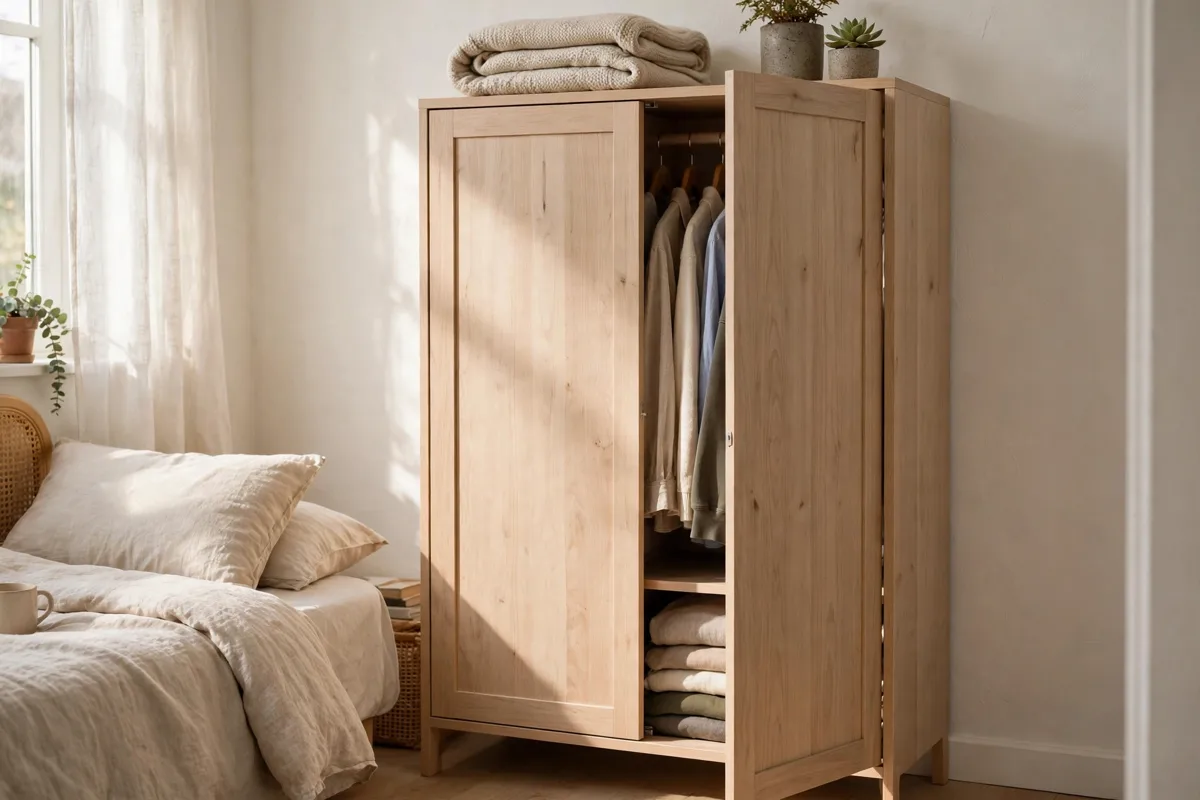
14 Small Apartment Wardrobe Ideas That Give You a Closet You Don’t Actually Have
My first flat had no closet. None. Not a tiny one, not a broken one — just a bedroom wall where a closet should have been and wasn’t. So my clothes lived the way clothes live when they have no home: a chair that disappeared under jeans, a suitcase that never got unpacked, and a rail in the corner that leaned a little more every month like it was tired of my choices. The morning I finally bought a proper wardrobe — a narrow, secondhand thing that barely fit through the door — I stood there hanging shirts like a person in a film montage. It sounds dramatic. It felt dramatic.
Here’s what I learned the hard way: in a small apartment, a wardrobe isn’t furniture. It’s the difference between a bedroom and a storage unit you sleep in. But the wrong wardrobe is worse than none, because now you’ve spent money and floor space on a big wooden box that doesn’t actually hold your life. These are the 14 moves that work, including the mistakes — I made most of them so you don’t have to.
Quick Answers
- What size wardrobe fits a small apartment? For most people, 80–120 cm wide, 55–60 cm deep, and as tall as your ceiling allows. Depth matters most: below 55 cm, hangers sit at an angle and doors won’t close properly. Measure the door swing too, not just the box.
- Sliding doors or hinged doors for a small bedroom? Sliding, if the room is tight — hinged doors need about 50–60 cm of clear floor in front of them. Sliding doors need none. The trade-off is you can only see half the wardrobe at once.
- Where should a wardrobe go in a small apartment? Against the longest flat wall, ideally in the bedroom near where you get dressed. Avoid blocking a window or the door swing, and leave the top reachable — that space above it is storage, not decoration.
1. The Tall, Narrow Wardrobe (Use the Ceiling, Not the Floor)
Floor space is the expensive part of your flat. Ceiling height is free. A wardrobe that’s 200–240 cm tall and only 80 cm wide holds a shocking amount — hanging space below, a shelf stack above for the stuff you touch twice a year. Mine goes nearly to the ceiling and the top shelf holds winter coats in July without apologising. If you’re choosing between wider and taller, go taller every single time. My small closet organization ideas run on exactly this logic: vertical first, always.
2. Sliding Doors (The Doors That Don’t Need a Room of Their Own)
Hinged doors are a lie in small bedrooms. You measure the wardrobe, it fits, you feel clever — then you open the door and it eats half the room and hits the bed. Sliding doors fix that completely. They need zero clearance, so the wardrobe can sit a metre from your bed and still work. The honest downside: you only ever see half your clothes at once, and cheap sliding tracks get gritty and jump. Spend on the track, not the door finish. Your future self, half-asleep at 7 a.m., will be grateful.
3. The Open Rail, Done Properly (Not the Leaning One I Had)
An open clothing rail gets a bad name because most of us buy the cheapest one and overload it until it leans. A good heavy-duty rail — wall-mounted or a solid freestanding frame — is genuinely great in a small flat: no doors, no depth problem, and you can see everything you own, which quietly stops you buying a fifth black t-shirt. Keep it honest, though. A rail only looks good if you edit. If your wardrobe style is “everything I have ever owned,” a rail will make your bedroom look like a shop having a closing-down sale.
4. The Wardrobe With Drawers Inside (Skip the Extra Dresser)
This is the move I’d make first if I started again. A wardrobe with drawers built into one side means you don’t need a separate dresser — and in a small bedroom, deleting one whole piece of furniture is huge. Folded stuff goes in the drawers, hanging stuff on the rail, shoes at the bottom. One box, everything in it. I compared setups endlessly when I wrote my small apartment dresser ideas, and the pattern was clear: the happiest small bedrooms had fewer, harder-working pieces, not more clever little ones.
5. Mirror Doors (Storage and a Bigger-Looking Room)
Mirrored wardrobe doors are an old trick because they work. They bounce light around a dark bedroom, they give you a full-length mirror without giving up wall space, and they make the biggest piece of furniture in the room visually disappear a bit. Two warnings from experience: you’ll see yourself, unfiltered, at 6 a.m. — be emotionally prepared — and fingerprints show. A microfibre cloth lives in my top drawer now. Small price for a room that feels twice as bright.
6. The Corner Wardrobe (For the Corner That’s Doing Nothing)
Every small bedroom has one corner that’s too awkward for anything and ends up holding a laundry basket and regrets. A corner wardrobe — L-shaped inside, with the deep corner given to long hanging — turns that dead angle into the hardest-working spot in the room. The deep corner is perfect for coats and dresses, the things that don’t fit anywhere else. Measure obsessively before ordering one of these. Corners in old flats are rarely the neat 90 degrees the catalogue assumes.
7. The Alcove Wardrobe (Build Into the Weird Bit)
Old apartments are full of alcoves, chimney breasts, and walls that jog for no reason. That recess next to the chimney breast is a wardrobe waiting to happen: a rail, some shelves, and a curtain or a pair of simple doors across the front. It costs a fraction of a fitted wardrobe, it uses space nothing else fits into, and because it’s built into the wall’s oddness, it takes zero floor space you were actually using. Renters: a tension rod and a curtain do 80% of this without a single screw.
8. The Wardrobe Curtain (Soft Front, Tiny Budget)
Speaking of curtains — replacing wardrobe doors with a curtain is the cheapest small-space fix on this whole list. No door swing, no track, no hinges, and if the curtain is a heavy linen or a colour that matches the wall, the whole thing reads as a soft wall, not storage. It also forgives an overstuffed wardrobe in a way doors never will. The one rule: hang it from as high as you can. A curtain that starts at wardrobe-top height looks like a shower. Ceiling height looks like a design decision.
9. Half Hanging, Half Shelves (Match the Wardrobe to Your Actual Clothes)
Most wardrobes come with one long rail and one lonely shelf, as if we all own forty dresses and nothing else. Look at your real clothes first. Mine are mostly folded — jumpers, t-shirts, gym stuff — with maybe eight things that truly need hanging. So my wardrobe is one short rail and a tower of shelves, and it holds roughly double what the standard layout did. Ten minutes with a notebook before you buy will save you from a wardrobe that’s beautifully organised for a person you are not. My small bedroom storage ideas start with the same unfashionable advice: count your stuff, then buy the box.
10. The Under-£200 Flat-Pack, Upgraded (Spend on Handles and Hinges)
You do not need an expensive wardrobe. You need a flat-pack wardrobe with three cheap upgrades: soft-close hinges if it’s hinged, decent handles instead of the plastic ones in the box, and — this is the one nobody does — actually fixing it to the wall. A tall, narrow wardrobe that isn’t anchored is a hazard and also, somehow, a wobble machine. Anchored, with real handles, a budget wardrobe feels twice its price. Put the saved money into matching hangers. Thirty identical slim hangers hold more and look calmer than the wire-and-plastic museum most of us own.
11. The Space on Top (It’s a Shelf, Treat It Like One)
That gap between the top of the wardrobe and the ceiling is where small flats hide a whole season. Matching boxes or baskets up there — same colour, same size, labelled on the end nobody photographs but everybody needs — hold winter bedding, spare towels, the suitcase’s smaller cousins. The rule that keeps it from looking like a junk shelf: containers must match, and nothing loose goes up. The day a single trainer sits up there alone, the whole system is finished. I keep my out-of-season stuff up there and swap it twice a year, and it’s covered in my 20 clever storage solutions for small apartments because it genuinely doubles what a wardrobe holds.
12. The Wardrobe as a Room Divider (In a Studio, It Earns Twice)
Studio flat? Your wardrobe can be your bedroom wall. A solid-backed wardrobe placed back-to-back with a bookshelf, or simply standing between the bed zone and the living zone, gives you privacy, storage, and a room that finally has rooms. This only works with a wardrobe that’s finished on the back — most cheap ones have a thin hardboard back that looks awful, so either pick one with a proper back panel or fix a sheet of painted board to it. Done right, it’s the single best studio purchase I know of.
13. The Vintage Wardrobe (Character, and Usually Better Made)
Secondhand wardrobes are the best value in furniture and it isn’t close. A solid-wood vintage wardrobe costs less than a new flat-pack, the doors actually hang straight, and it’s already survived forty years, so your house moves won’t kill it. Check three things and check them in person: the rail is solid, the doors close without a shove, and there’s no musty smell soaked into the wood — that smell does not leave, whatever the internet promises. Measure your doorways before falling in love. Vintage wardrobes were built in houses with bigger doors than ours.
14. No Wardrobe at All (The Honest Capsule Option)
And finally, the option nobody in the furniture business will suggest: if your clothes genuinely fit on one rail and two shelves — a real capsule wardrobe, not an aspirational one — skip the wardrobe entirely. A rail, a small chest, and the space under your bed can be your whole system, and the bedroom gets its floor back. This only works if you’re honest about how much you own. When I picked my setup, my small apartment bed ideas mattered as much as the wardrobe, because under-bed storage is where the overflow honestly lives. If the overflow is three suitcases and a chair full of jeans, friend, you need idea number 1, not this one.
FAQ
How deep does a wardrobe need to be for hanging clothes?
Around 55–60 cm. A standard hanger is about 45 cm wide, and you need clearance so clothes don’t press against the doors. Shallower wardrobes exist (40–45 cm) with front-to-back rails, and they work for shirts and trousers, but coats will fight you.
Can a wardrobe fit in a very small bedroom?
Yes — a tall 80 cm-wide wardrobe takes less floor than a chest of drawers and holds far more. Sliding doors or a curtain front remove the door-swing problem, which is usually the real blocker, not the box itself.
Is an open rail cheaper than a wardrobe?
Much cheaper to buy, slightly more expensive in discipline. A rail shows everything, gathers dust on shoulders, and demands you keep it tidy. A closed wardrobe hides a multitude of sins. Pick based on which person you actually are at 11 p.m. on a Sunday.
How do I stop a tall wardrobe from wobbling or tipping?
Fix it to the wall with the strap or brackets it came with — tall, narrow furniture must be anchored, full stop. Check the floor is level too; a folded card under one corner fixes most wobbles in old flats with sloping floors.
What is the best wardrobe layout for small apartments?
The one that matches your clothes: a short hanging rail, a stack of shelves or drawers for folded things, and one high shelf for out-of-season storage. Most people fold far more than they hang, so shelving usually deserves more space than the rail.
The Bottom Line
A good small-apartment wardrobe isn’t the biggest one you can squeeze in — it’s the one that matches your actual clothes, uses your ceiling instead of your floor, and doesn’t need the rest of the room to move out of its way every time you open it. Start tall and narrow, be honest about hanging versus folding, and anchor the thing to the wall. My clothes have a home now, the chair in my bedroom is just a chair again, and I can’t tell you how much that small thing changed my mornings.