15 Small Living Room Decor Ideas to Make Tiny Spaces Look Bigger
The living room is the hardest room in a small home. It’s where you relax, work, eat, entertain, and occasionally hide from your own life — all in maybe 150 square feet. No wonder it ends up as a furniture traffic jam with a TV.
But I’ve seen tiny living rooms that feel incredible, and the secret was never expensive furniture. It was a series of small, smart decisions that added up. Here’s the full playbook.
1. Light Colors, Warm Undertones
Light walls reflect light and push the room outward — but choose warm lights. Stark white in a small living room can feel like a waiting room. Warm white, greige, pale warm gray — colors with a little life in them. And if you’re feeling brave, one accent wall in a deep tone (navy, forest, terracotta) adds depth and drama without shrinking the room, as long as the other walls stay light.
2. Every Seat Should Store Something
This is the golden rule of small living rooms. Storage ottoman instead of a regular one. Coffee table with a lift-top (dining, working, and storage in one). A bench under the window with blankets inside. A sofa with a chaise that opens. When your seating is secretly your storage, clutter has nowhere to live — because it all has a hidden home.
3. Look Up: The Walls Are Free Real Estate
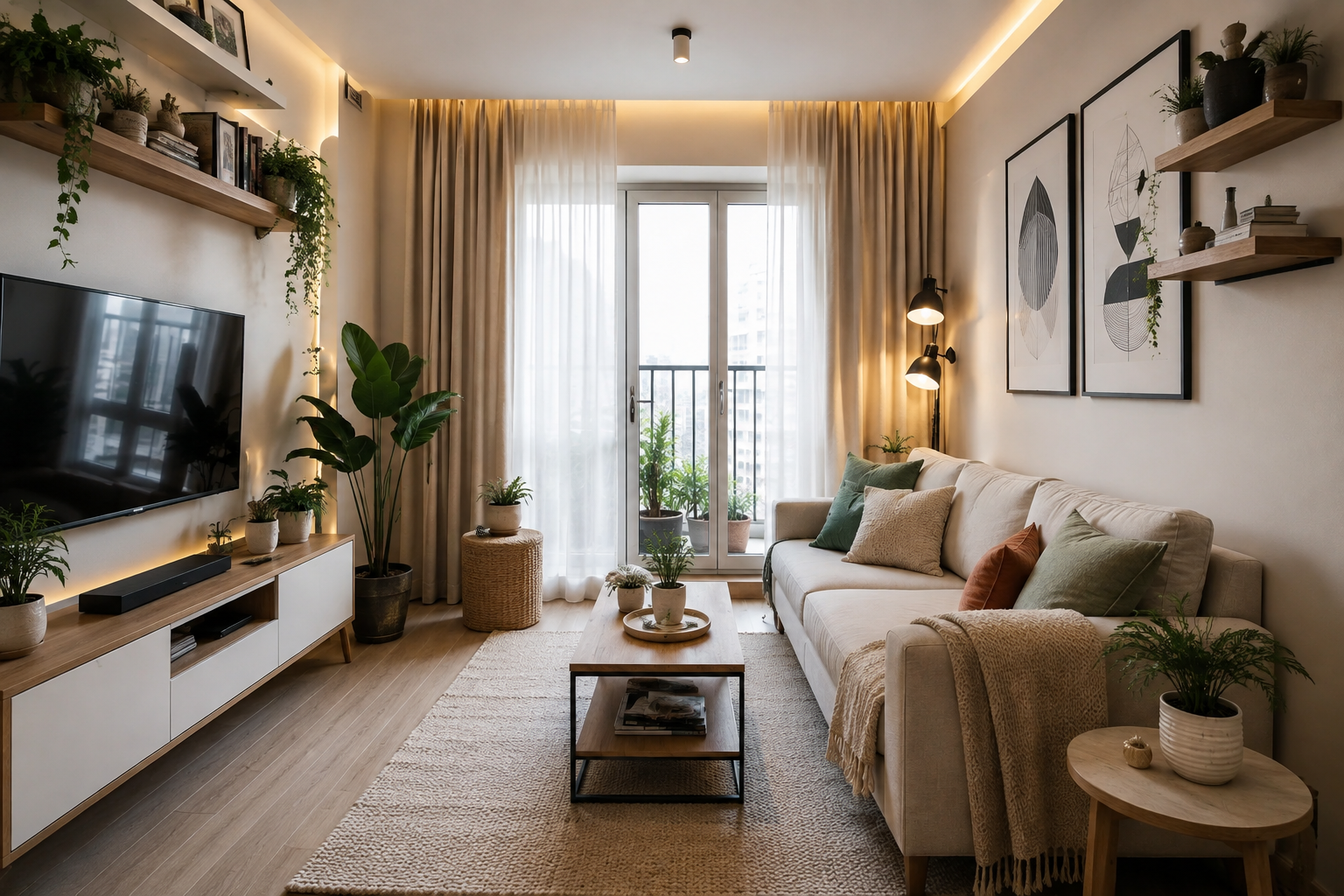
Floating shelves for books and decor. A tall, narrow bookcase instead of a wide short one. Wall-mounted lighting instead of floor lamps that eat square footage. Hanging planters that add green without touching the floor. In a small living room, the floor is precious and the walls are begging to be used — act accordingly.
4. Mirror With Intent
A large mirror opposite the window is the oldest small-room trick because it genuinely works: more light, more depth, the illusion of a second window. A leaning floor mirror makes a narrow room feel wider. Mirrored or glass coffee tables visually disappear. Just aim mirrors at things worth doubling — windows, plants, art — not at the messy corner.
5. Scale Down, Don’t Dumb Down
A full-size three-seater sofa designed for a suburban living room will eat a small apartment alive. Look for apartment-scale furniture: loveseats instead of sofas, slim-profile designs, chairs instead of a second sofa. A well-chosen loveseat with two good chairs seats the same number of people as a bulky sectional — in half the visual weight. Measure your room, tape out furniture footprints on the floor, and be honest about what fits.
6. Hide Everything (Beautifully)
Small living rooms show everything, so the stuff you don’t want to see needs invisible homes. Remotes in a lidded box. Cables in a cord cover or behind the console. The printer in a cabinet. Throw blankets in the ottoman. When surfaces are clear, the room reads as calm and twice its size. Our guide to hidden storage ideas for small apartments maps every secret spot.
7. Protect Your Natural Light Like It’s Gold
Natural light is the most flattering, most spacious-making thing in any room — and it’s free. Don’t block windows with tall furniture. Swap heavy curtains for sheers or light-filtering blinds. Keep the glass clean (seriously, it matters more than you’d think). If your living room has one good window, design the whole room around it: seating facing it, mirror opposite it, nothing in front of it.
8. Give the Eye Somewhere to Land
Rooms without a focal point feel restless — your eye wanders and finds clutter. Give it a destination: a gallery wall, a bold piece of art, an accent wall, a styled bookshelf, even the TV done well (mounted, with a console and some styling around it). One confident focal point organizes the entire room visually. Everything else becomes supporting cast.
9. Rugs: Bigger Than You Think
The number one rug mistake in small living rooms: too small. A tiny rug floating in the middle of the floor chops the room into pieces and makes it feel smaller. Go big enough that the front legs of all seating sit on it — 5×8 minimum for most living rooms, 8×10 if you can. One large rug unifies the space; a small one fragments it. Counterintuitive, but true.
10. Plants: The Cheapest Renovation
A large plant in an empty corner does more for a living room than a $500 decor purchase. Snake plants, fiddle leaf figs, monsteras — pick based on your light and your commitment level. Plants add height, texture, life, and color that no object can replicate. Even one dramatic plant changes the room’s entire energy. Two, and it feels like a different apartment.
11. Curate, Don’t Accumulate
Small surfaces punish clutter. That means every decorative object needs to earn its spot. Three beautiful things on a shelf beat fifteen random ones. One great coffee table book beats a stack of magazines. Rotate seasonal decor instead of adding to it. Editing isn’t deprivation — it’s what makes the things you keep actually shine.
12. Let the Floor Breathe
Furniture with visible legs — sofas, chairs, consoles, media units — lets your eye travel underneath, which reads as more floor and more space. Compare a boxy sofa sitting flat on the ground with a mid-century one on tapered legs: same footprint, completely different feeling. When shopping, crouch down. If you can’t see under it, think twice.
13. Light in Layers, Not Overheads
The single ceiling light is the enemy of atmosphere. Build layers: a floor lamp for reading, a table lamp for warmth, LED strips behind the TV or under shelves for glow, maybe wall sconces if you can. Three small warm sources beat one harsh overhead every time. And dimmers — on everything possible. A small living room at full brightness feels like an office; dimmed, it feels like a cocoon.
14. Pick a Style and Commit
Scandinavian, japandi, modern organic, mid-century — pick one and let it guide you. Mixing five styles in 150 square feet doesn’t look eclectic; it looks chaotic. Consistency creates visual calm, and calm reads as spacious. You don’t need to be rigid — just have a direction. When every new purchase passes through the same filter, the room pulls together almost by itself.
15. The One-Question Test
Before anything enters your living room — furniture, decor, the free chair from your cousin — ask: does this earn its square footage? If it’s beautiful but useless, it better be truly beautiful. If it’s useful but ugly, hide it or replace it. Small rooms are meritocracies. Everything in them should be working, delighting, or both.
Mistakes That Shrink Living Rooms
Pushing all furniture against the walls (floating the sofa even a few inches creates breathing room). A rug that’s too small. Blocking the window. One harsh overhead light. Too many small decor items instead of a few confident ones. And buying furniture for the home you wish you had instead of the one you live in.
Related reading: the living room connects to everything — explore our apartment decor ideas for small spaces, small bedroom decor ideas, small kitchen ideas, and clever storage solutions for small apartments.
Frequently Asked Questions
What color makes a small living room look bigger?
Light, warm neutrals — warm white, greige, pale beige — reflect light and recede visually. One dark accent wall can add depth without shrinking the room if the other walls stay light.
Are sectional sofas good for small living rooms?
Only compact, apartment-scale sectionals — and only if the room’s shape suits an L. In most small living rooms, a loveseat plus chairs is more flexible and visually lighter.
How can I add storage to a small living room?
Storage ottomans, lift-top coffee tables, floating shelves, and furniture with hidden compartments. Move storage to the walls and inside furniture so the floor stays clear.
The Bottom Line
A small living room isn’t a lesser living room. It’s a more edited one — and edited usually means better. Right-sized furniture, hidden storage, layered light, one confident focal point, and the discipline to let the floor breathe.
Do that, and your tiny living room won’t just look bigger. It’ll feel like the best room in the house — because it is.