20 Small Kitchen Ideas to Maximize Space and Style in Compact Homes
I’ll be honest with you: my first apartment kitchen was so small I could touch both walls standing in the middle. Two steps from stove to sink. One sad drawer that never closed properly. And yet — it became my favorite room in the apartment. Not because it was beautiful, but because I figured out how to make every inch work.
That’s what this guide is about. Not fantasy renovations. Just 20 real, tested ideas for making a small kitchen feel bigger, work harder, and honestly — look better than kitchens three times its size.
1. Paint It Light — But Not Boring White
Yes, light colors make small kitchens feel bigger. Everyone says it because it’s true. But “light” doesn’t have to mean sterile hospital white. Warm cream, soft sage, pale greige — these bounce light around just as well and actually have some personality. I painted my tiny kitchen a warm off-white and it felt like someone turned on a light I didn’t know was off.
2. Ditch Some Upper Cabinets for Open Shelves
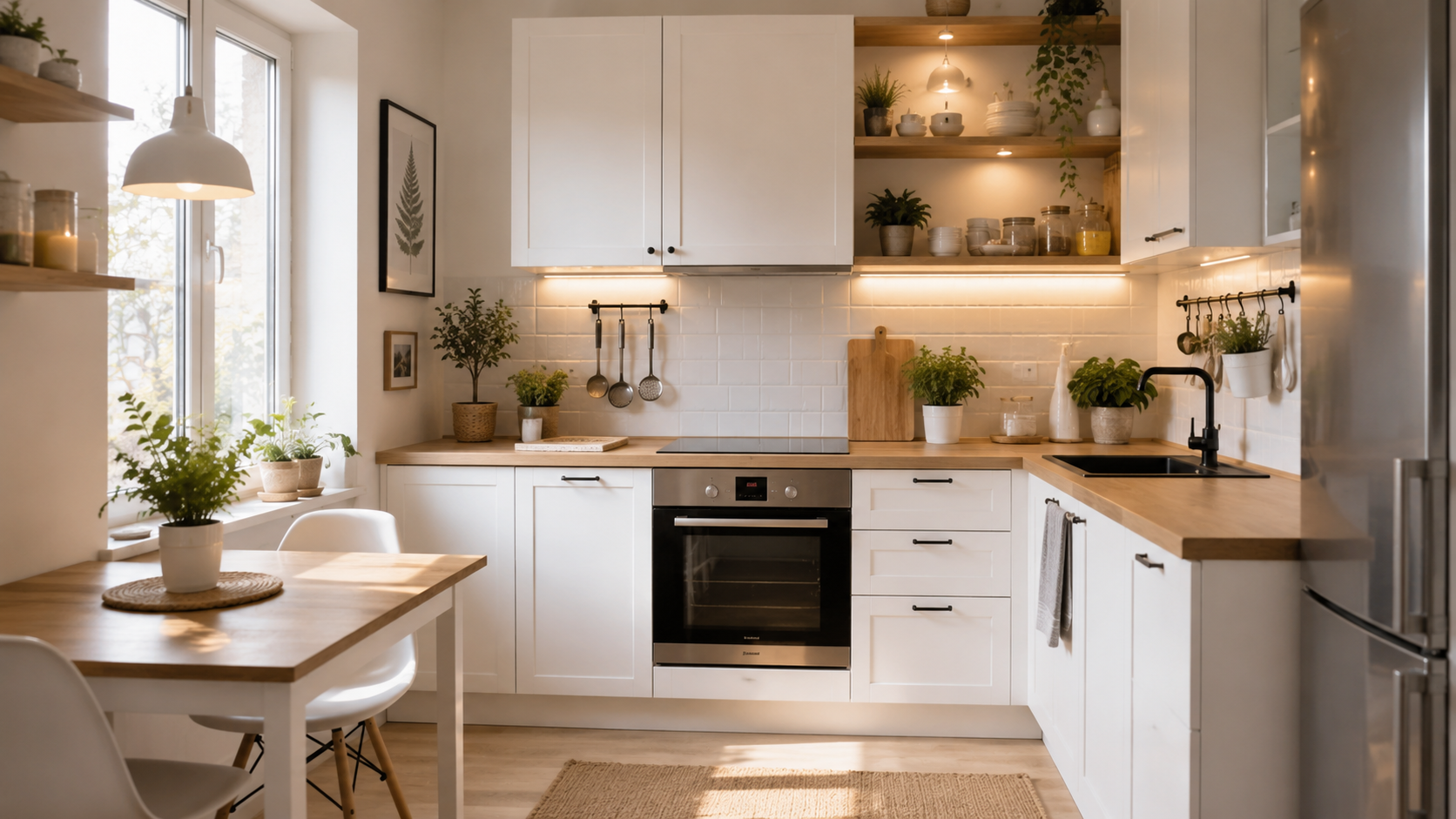
Upper cabinets are the fastest way to make a small kitchen feel like a cave. Swap even one run of them for open shelving and the whole room breathes. Fair warning: open shelves demand discipline. If your dishes are mismatched chaos, it’ll show. But a row of simple white plates and a trailing pothos? That’s decor and storage in one.
3. Go Vertical — Your Walls Are Free Real Estate
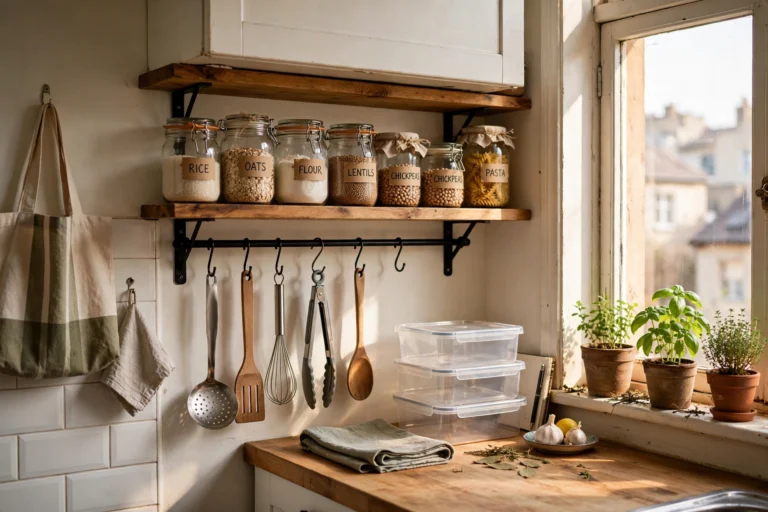
Most people decorate out, not up. In a small kitchen, the wall space above your counters and beside your fridge is pure gold. Tall pantry cabinets, a hanging rail for utensils, magnetic knife strips, spice racks on the inside of cabinet doors — once you start looking up, you’ll wonder where all this space was hiding. These are some of the most effective clever storage solutions for small apartments, and the kitchen is where they shine brightest.
4. Add Under-Cabinet Lighting (The $30 Game-Changer)
If you do one thing from this list, make it this. A strip of LED lights under your upper cabinets costs almost nothing, takes 20 minutes to install, and transforms how your kitchen looks at night. Dark corners disappear. Counters look bigger. Food prep gets easier. It’s the highest-impact upgrade per dollar I’ve ever seen.
5. Make Every Piece of Furniture Do Two Jobs
In a small kitchen, single-purpose furniture is a luxury you can’t afford. Your dining table should have storage underneath. Your kitchen cart should roll away when you need floor space. A fold-down table mounted to the wall gives you a breakfast spot that vanishes when you’re done. If it only does one thing, it needs to earn its footprint.
6. Size Down Your Appliances
Here’s something nobody tells you: full-size appliances are designed for full-size kitchens. An 18-inch dishwasher, a 24-inch range, a counter-depth fridge — these exist, they work great, and they can free up shocking amounts of room. Measure your actual needs before assuming you need the standard sizes.
7. Install Pull-Out Everything
Deep cabinets are where kitchen items go to die. You know the one — the cabinet where you have to practically climb inside to reach the blender at the back. Pull-out drawers, sliding shelves, and tiered organizers fix this completely. Yes, they cost a bit upfront. No, you’ll never regret it. For more ideas on squeezing storage from unlikely places, check out these smart hidden storage ideas.
8. Embrace Minimalism (Even If It’s Not Your Style)
Look, you don’t have to become a minimalist. But in a 60-square-foot kitchen, visual noise is the enemy. Pick a simple color scheme, hide the small appliances you don’t use daily, and let a few nice things breathe instead of crowding every surface. Less stuff on display = a kitchen that feels twice as big.
9. Use Reflective Surfaces Strategically
Glossy backsplash tiles, glass cabinet fronts, a stainless steel fridge — anything that bounces light makes the room feel larger. You don’t need to go full chrome. Even switching one cabinet bank to glass fronts creates depth where there was none.
10. Conquer the Corners
Kitchen corners are the Bermuda Triangle of small kitchens — things go in and never come out. A lazy Susan, pull-out corner drawers, or even just a well-placed basket can reclaim this dead zone. Corners are awkward, but they’re also some of the deepest storage you have. Don’t waste them.
11. Decant Into Matching Containers
This sounds fussy, but hear me out: transferring flour, rice, pasta, and snacks into uniform clear containers does three things at once. It looks dramatically tidier, you can actually see what you have (no more buying duplicate cumin), and square containers waste zero shelf space unlike round bags and boxes.
12. Shelve the Space Above Your Window
That strip of wall above the kitchen window? Almost everyone ignores it. A single floating shelf there holds plants, pretty bowls, or the dishes you reach for daily. It’s free storage hiding in plain sight.
13. Squeeze In a Slim Island
“Island” sounds like a big-kitchen word, but narrow rolling islands (some are just 15 inches deep) fit in surprisingly tight spaces. You get extra prep area, extra storage, and a casual spot to eat — and you can roll it against the wall when you need the floor. If your kitchen connects to a small living area, this trick borrows well from small living room layouts too.
14. Clear the Counters — Ruthlessly
Walk into your kitchen right now and count what’s on the counters. Now ask: what did I actually use this week? Everything else goes in a cabinet. Clear counters are the single fastest way to make a kitchen feel bigger, and it costs exactly nothing. The toaster you use twice a month does not need permanent counter residency.
15. Try Glass-Front Cabinets
Similar to open shelving but more forgiving — glass fronts give you the airy feel without demanding magazine-level organization. Frosted or seeded glass is even better if your cabinet interiors aren’t display-worthy. Light passes through, the room feels deeper, and you still get to close the door on the mess.
16. Add Plants (The Edible Kind)
A pot of basil on the windowsill does double duty: it looks alive and fresh, and you stop paying $4 for those sad plastic herb packets. Mint, rosemary, and thyme are nearly unkillable. Even if you have the opposite of a green thumb, a pothos will survive your neglect and trail beautifully off a shelf.
17. Hang a Pegboard
Julia Child was onto something. A pegboard on one kitchen wall holds pots, pans, utensils, and measuring cups in full view — no digging through drawers. Paint it a fun color and it becomes art. Rearrange the hooks whenever your needs change. It’s the most flexible storage system ever invented for about $20.
18. Stick to Three Colors, Max
Small kitchens get visually chaotic fast. Pick one main color, one secondary, one accent — and stop there. This doesn’t mean boring. Navy + white + brass is three colors. Sage + cream + black is three colors. Restraint reads as calm, and calm reads as spacious.
19. Choose Big Floor Tiles
Counterintuitive, but true: large tiles with minimal grout lines make a small floor look bigger, while tiny tiles chop it into visual confetti. If you’re retiling (or using peel-and-stick), go big and go light.
20. Design Around Your Actual Life
Here’s the thing all the Pinterest kitchens get wrong: the “best” small kitchen isn’t the prettiest one. It’s the one that fits how you cook. If you order takeout five nights a week, you don’t need a six-burner range — you need a great coffee station. If you meal-prep every Sunday, invest in prep space, not display shelves. Start from your habits, not someone else’s photos.
Mistakes That Shrink Your Kitchen
A few things to actively avoid: cramming in furniture meant for bigger rooms, relying on a single dim ceiling light, painting everything dark “for drama” (it’ll just feel like a cave), buying oversized appliances “just in case,” and — the big one — adding storage without a plan, which just gives clutter more places to hide.
Frequently Asked Questions
How can I make my small kitchen look bigger without renovating?
Paint it light, add under-cabinet LEDs, clear your counters completely, swap a cabinet bank for open shelves, and hang a mirror or use glossy surfaces. None of these require a contractor, and together they’re transformative.
What’s the best color for a tiny kitchen?
Warm whites, soft creams, pale sage, and light greige. They reflect light without feeling cold. If you want drama, put it in one accent — a navy island, brass hardware — not on all four walls.
Can a small kitchen have an island?
Yes, if it’s slim and ideally on wheels. Look for islands under 20 inches deep. You get prep space and storage that can roll away when you need the floor back.
Open shelving or cabinets — which is better?
Honestly? A mix. Open shelves where you want airiness and display, closed cabinets where you stash the ugly-but-necessary stuff. All-open looks great in photos and stressful in real life unless you’re naturally tidy.
The Bottom Line
A small kitchen isn’t a problem to solve — it’s a design constraint that forces you to be smarter. The kitchens I remember most fondly were never the biggest ones. They were the ones where everything had a place, the light was good, and cooking felt easy instead of frustrating.
Start with the free stuff: clear the counters, look up at your walls, change a lightbulb. Then pick one or two upgrades that match how you actually live. And if your kitchen opens into the rest of a compact home, these storage solutions for small homes will help the whole place work together.