14 Small Apartment Entryway Lighting Ideas That Make a Tiny Hallway Feel Welcoming
For two years, my entryway had no light at all. Not a bad light — no light. You opened the front door and stepped into a little cave, fumbling for your keys, tripping over shoes you couldn’t see, squinting at the coat hooks like a burglar in your own flat. The hallway light switch controlled a bulb in the corridor three metres away, which is to say it controlled nothing useful.
Here’s the thing: the entryway is the first thing you see when you come home and the last thing you see when you leave. Mine was a dark, joyless tunnel, and I put up with it because I thought lighting an entryway meant wiring and electricians and landlord permission slips. It doesn’t. One Saturday, a plug-in sconce and a ten-pound bulb later, and I actually paused in the doorway. It felt like coming home instead of arriving at a storage cupboard.
These 14 small apartment entryway lighting ideas are the ones that work in a hallway the size of a wardrobe — most of them renter-friendly, none of them needing an electrician, and all of them cheap enough that you’ll wonder why you waited.
Quick Answers
- What’s the best lighting for a small apartment entryway? A warm light at face height, near the door — a plug-in sconce or a small lamp on a console table. Overhead light alone makes a narrow hallway feel like a corridor in a budget hotel.
- How do I light an entryway with no ceiling light? Plug-in wall sconces, battery puck lights, or a small table lamp on a console. You don’t need a ceiling fixture at all — the best entryway light is usually at eye level, not above your head.
- What colour temperature works in a hallway? Warm white, 2700K. Cool white in a windowless hallway feels like a hospital waiting room. Warm light makes the same space feel like a home.
- Can I add entryway lighting without drilling holes? Yes. Command strips hold plug-in sconces, battery lights stick anywhere, and a lamp just sits on a table. Most of this list needs zero holes and zero landlord conversations.
1. Change the Bulb First (Seriously, Start Here)
I know, I know — every lighting article says this. But there’s a reason. My hallway bulb was a cold white “daylight” one, and it turned a six-foot stretch of wall into a morgue. I swapped it for a warm 2700K bulb and the same hallway suddenly looked like a place people live.
Two minutes, a couple of pounds, no tools. If your entryway has a ceiling fixture at all, do this tonight before you buy anything else. Half the time this is the entire problem, and you’ve been living with the solution sitting in a supermarket aisle. The rest of my small apartment lighting ideas all build on this one rule: warm light, layered low.
- Look for 2700K on the box — that’s warm white.
- If the fitting takes a smart bulb, even better: set it to turn on when you get home.
- Keep a spare in the drawer. Hallway bulbs always die on the darkest, rainiest night.
2. A Plug-In Wall Sconce (The Renter’s Best Friend)
This is the single best entryway light for a small apartment, and I will die on this hill. A plug-in sconce hangs on a hook or a command strip, the cord drops to the nearest socket, and suddenly you have warm light at exactly face height right where you take your coat off.
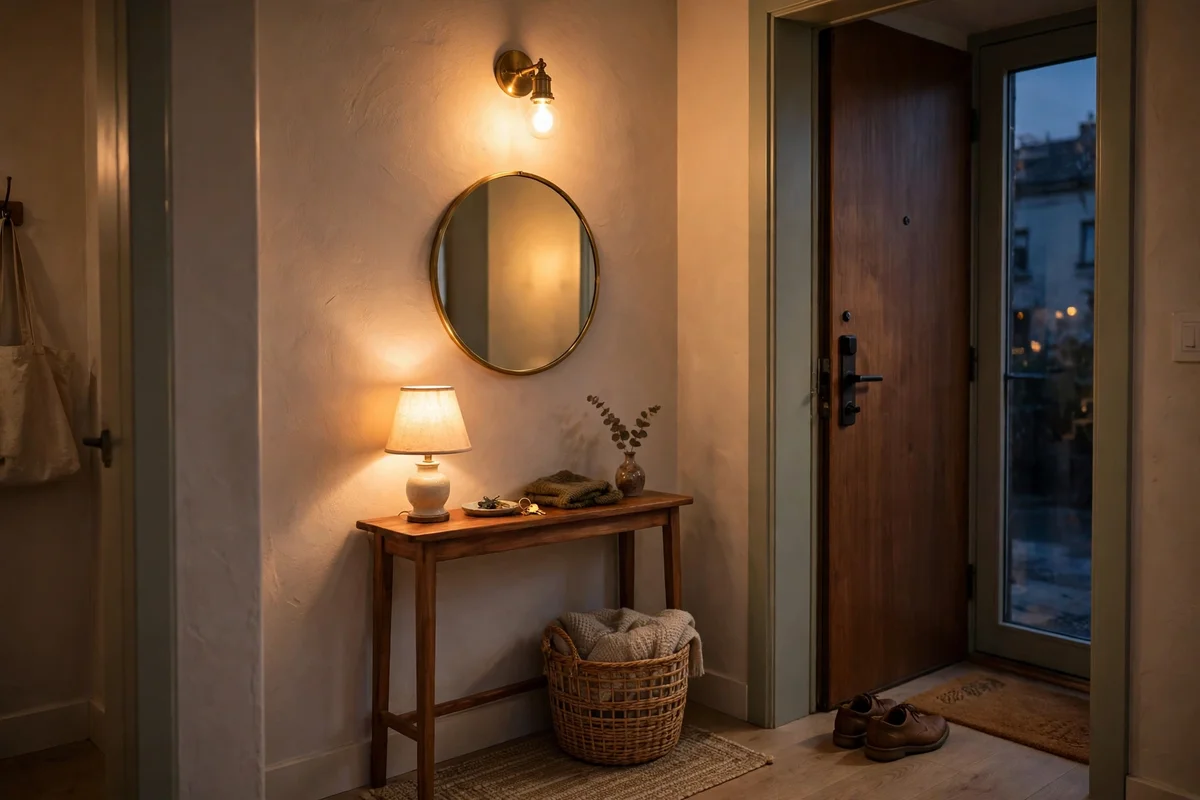
Mine sits above the console table, and it’s the first thing that greets me. The light bounces off the wall instead of blasting down from the ceiling, so the whole entryway feels soft instead of interrogated. No electrician, no holes, no landlord email. My wall sconce ideas for tiny rooms have the mounting tricks that won’t cost you your deposit.
- Pick one with a switch on the cord — fumbling behind the shade every night gets old.
- Hide the cord with a cheap cord cover, or run it behind the console table.
- One sconce on each side of the mirror beats one big light in the middle.
3. A Small Lamp on the Console Table
If you’ve got a console table — even a narrow one — you’ve got a lamp spot. A small lamp in the entryway does two jobs at once: it lights the space at the exact height where you need it, and it makes the whole hallway look finished, like a room instead of a passage.
I found mine in a charity shop for a fiver, a little ceramic thing with a linen shade. It’s not fancy. But the moment it goes on in the evening, my flat smells like a home and not a corridor. A lamp also gives you a surface for your keys, which means no more patting your pockets in a panic at 8 a.m. My table lamp ideas cover the slim ones that fit a console without knocking your post over.
- A shade that’s light on the inside throws the glow around; a dark shade just sulks.
- Put the lamp on a timer plug so it’s already on when you get home.
- If the console is very narrow, a slim candlestick-style lamp beats a wide base every time.
4. A Mirror That Does Double Duty
A mirror in a small entryway is already a must — last check before you leave, and it makes the hallway look twice as wide. But a mirror opposite or beside a light source is a lighting trick in itself: it bounces the glow around and doubles whatever light you’ve got.
I hung mine opposite the sconce, and the effect was ridiculous for the effort involved. The hallway felt twice as bright with no extra electricity. It’s the cheapest lighting upgrade that isn’t actually a light. My mirror ideas for small apartments cover the sizes that work in a hallway without making you feel like you’re in a funhouse.
- Hang the mirror so it catches the sconce or lamp, not the ceiling bulb.
- A round mirror softens a boxy hallway better than a rectangular one.
- Keep it at face height — a mirror hung too high is just wall decoration.
5. Motion-Sensor Lights (For When Your Hands Are Full)
You know the moment: arms full of shopping, rain on your coat, and the light switch is three steps away in the dark. Motion-sensor lights were made for this exact second of your life.
I stuck a battery motion-sensor light under the console table and another on the skirting board by the shoe rack. They cost less than a takeaway, they switch themselves on the moment I open the door, and they switch themselves off when I leave. Honestly, they feel like magic the first week. After that they just feel like how a home should work.
- Put one low down — it lights the floor where your shoes are, which is what you’re actually looking at.
- Rechargeable ones beat battery ones if you hate buying batteries as much as I do.
- Warm white only. A motion sensor in cold white feels like a security camera, not a welcome.
6. Battery Puck Lights in the Awkward Corners
Every small entryway has a dead corner: the bit under the stairs, the inside of the coat cupboard, the shelf above the hooks where the light never reaches. Battery puck lights exist for exactly these spots. Stick them on, tap them, done.
I put three inside my coat cupboard and suddenly I could see which jacket was which instead of grabbing blindly and hoping. It’s a small thing, but “small thing” is the entire job in a tiny flat. They last months on one set of batteries, and when they die you just swap them.
- Put them inside cupboards and under shelves, not on the main wall — they’re helpers, not the star.
- The remote-controlled sets are worth the extra pound or two.
- Stick them with the adhesive pads they come with; save your command strips for heavier things.
7. A Pendant Light (If Your Ceiling Allows It)
Okay, this one depends on your ceiling. If your entryway already has a ceiling fitting — even a sad one — swapping the shade for a small pendant is the fastest way to make the space look deliberate instead of accidental.
I hung a little rattan pendant in mine, and the hallway went from “corridor” to “entrance” in about twenty minutes. The shade throws warm light down and a soft pattern on the walls, and because it hangs low it fills the space instead of washing it out. It also hides the fact that the ceiling itself is, frankly, nothing to look at. My ceiling ideas for small apartments have more ways to make a low ceiling work for you instead of against you.
- Hang it low enough to matter — about head height plus a handspan — but not so low you walk into it.
- Rattan, linen or frosted glass shades all soften the light; bare metal just glares.
- If you’re renting, a plug-in pendant that hangs from a hook is a real thing, and it works.
8. Fairy Lights Along the Mirror or the Door Frame
Fairy lights in an entryway sound like a student flat, and done badly they are. Done properly — tucked along the top of the mirror, or wrapped once around the door frame, or coiled in a glass jar on the console — they give the hallway the softest glow of anything on this list.
I ran a warm-white string along the top edge of my mirror, and the whole entryway picked up this gentle halo in the evenings. It’s not your main light — don’t pretend it is, you’ll strain your eyes looking for your keys — but as a second layer it makes the space feel like someone actually lives here and likes it.
- Warm white only. Cool white fairy lights look like a shop window in January.
- Battery ones with a timer are the lazy person’s best friend — they turn themselves on at 6 p.m.
- One string, placed neatly, beats three strings draped in a sad zigzag.
9. LED Strip Under the Console (The Invisible Upgrade)
This is the trick that makes people ask what you did to your hallway, because they can’t quite tell. An LED strip stuck under the console table, or along the skirting board, throws a soft wash of light across the floor. No visible fixture, no glare, just a warm glow that makes the entryway feel designed.
Mine is on a timer, so it comes on at dusk and I walk into a lit hallway every single evening. It cost less than a pizza, took ten minutes to stick on, and it is — I will say this with my whole chest — the best value lighting upgrade in my entire flat.
- Warm white, 2700K, same as everything else. Consistency is what makes it look expensive.
- Run it under the console, not along the top — you want the glow, not the strip itself.
- Cut-to-length strips exist, so measure first and don’t guess like I did the first time.
10. A Picture Light Over Your Entryway Art
A picture light sounds posh. It’s not — battery picture lights cost less than a decent takeaway, they stick or screw onto the wall above a frame, and they turn one piece of art into the focal point of the whole hallway.
I have one above a framed print by the door, and it does something strange: the hallway stops being a passage and starts being a room with a point of view. The light pools on the art and spills softly onto the wall, and the whole entryway feels intentional. It’s the kind of detail guests notice without knowing why.
- Battery ones with a remote are the renter-friendly pick — no wiring, no holes in the wrong place.
- Hang the art at eye level first, then centre the light above it.
- One lit piece beats a whole gallery wall in a hallway this size.
11. A Lantern on the Floor (Or on a Stool)
A lantern is the lowest-effort, highest-charm light you can put in an entryway. Battery candles inside a glass lantern, sitting on the floor beside the shoe rack or on a little stool by the door, give you a warm flicker that no bulb can imitate.
I keep one by the door, and on dark winter evenings it’s the light that makes me exhale when I get home. No wires, no installation, and if you move flat you just pick it up and take it with you. It also hides the shoes, which is a bonus I did not plan but will absolutely take credit for.
- LED candles inside, always — real candles by a coat rack full of jackets is a fire safety talk nobody wants.
- A lantern with a timer saves you remembering to switch it off.
- Group it with a plant or a basket so it looks styled, not stranded.
12. A Dimmer Plug (The Two-Pound Miracle)
Here’s a confession: my entryway lamp used to be too bright. It was a small hallway and the lamp was doing its best, but it blasted the walls like a spotlight. Then someone told me about dimmer plugs — a little plug you put between the socket and the lamp, with a slider or a remote, and suddenly your lamp has a dimmer switch.
Two pounds. Two minutes. My entryway went from interrogation room to warm welcome, and I could finally have the lamp on in the evening without the hallway shouting at me. If you only buy one thing from this list, honestly, make it this — it makes every other light on the list better.
- Check your bulb is dimmable first — a non-dimmable LED will flicker and buzz.
- The remote ones live on the console table, right where your hand lands when you walk in.
- Dim it low in the evening, bright in the morning when you’re hunting for your keys.
13. Light the Shoe Area (Because That’s Where You Actually Look)
Think about what you do in the entryway. You don’t stand in the middle admiring the ceiling. You look down — at your shoes, at the mat, at the bag you’re grabbing. So the light should be down there too.
A low light by the shoe rack — a puck light, a strip under the bench, a small lantern on the floor — means you can actually see which shoes you’re putting on instead of guessing in the dark. It’s practical in a way that sounds boring and feels wonderful at 7 a.m. on a Monday. Pair it with the rest of your entryway storage and the whole corner starts working like a system instead of a pile. My entryway organization ideas cover the storage side of this corner.
- One low light beats one bright ceiling light for finding shoes.
- Put it on the same timer as your other entryway lights so the whole corner wakes up together.
- If the shoe area is a closed cupboard, a puck light inside it is non-negotiable.
14. Make It Turn Itself On
The best entryway light is the one that’s already on when you open the door. A smart plug, a timer plug, or a motion sensor — pick your flavour — means you never walk into a dark hallway again, and you never leave a light burning all day because you forgot.
Mine runs on a timer: on at dusk, off at midnight. I haven’t touched the switch in months. It’s a small thing, but coming home to a lit hallway after a long day changes the whole feeling of arriving. The entryway stops being the bit you rush through and becomes the bit that says, right, you’re home now. And honestly, after two years of fumbling in the dark, I earned that.
- Smart plugs are the easiest start — no hub needed for most of them now.
- Set the timer to your actual routine, not a guess: dusk in winter is a different hour than dusk in summer.
- Combine it with the dimmer plug from idea 12 and you’ve got a hallway that behaves like a grown-up’s house.
FAQ
How bright should entryway lighting be?
Bright enough to find your keys and see your face in the mirror, soft enough that it doesn’t feel like a corridor. In a small entryway, one warm light at face height plus one low light does more than a single bright ceiling bulb ever will.
What if my entryway has no power socket?
Battery lights are your answer: puck lights, battery sconces, battery lanterns and LED strips all exist now, and the good ones last months on a charge. A rechargeable motion-sensor light by the door covers the basics with zero wiring.
Can I put a chandelier in a small entryway?
A small one, yes — if your ceiling is high enough that you won’t walk into it. In a standard small apartment hallway, a compact pendant or a flush-mount fitting usually works better than anything that hangs low and eats headroom.
Should entryway lighting match the rest of the flat?
Roughly, yes. Keep the colour temperature the same warm white throughout and the entryway will feel connected to the rest of your home instead of like a different building. My hallway decor ideas cover making the whole passage feel like one space.
What’s the cheapest way to light a dark entryway?
A warm bulb in the existing fitting, plus a battery motion-sensor light by the door. Under ten pounds total, ten minutes of effort, and the difference is honestly embarrassing for how long I waited to do it.
Bottom Line
My entryway went from a dark cave to the warmest corner of my flat for about the price of a takeaway and one Saturday afternoon. I didn’t rewire anything, I didn’t ask the landlord for anything, and I didn’t buy a single expensive fixture. I just put warm light at face height, added a low light where my shoes live, and set it all to turn itself on.
Start with the bulb. Then the sconce or the lamp. Then make it automatic. Your hallway will stop being the bit you rush through and start being the bit that welcomes you home — and if your hallway is as small as mine, that’s a big job for such a small space.