14 Small Apartment Living Room Lighting Ideas That Make a Tiny Living Room Feel Warm
For the first year in my flat, my living room had exactly one light: a bare bulb hanging from the ceiling, the kind that makes everyone look like they’re being interrogated. I’d come home, flick it on, and the whole room lit up flat and harsh — every scuff on the wall, every dusty shelf, all of it on full display. It was bright. It was also horrible. I’d sit there under that single bulb and wonder why the room never felt like the cosy little living rooms I kept seeing in photos.
Here’s what I eventually figured out: a small living room doesn’t need more light, it needs more lights. Plural. Little ones. Warm ones. One bulb in the middle of the ceiling is the worst possible way to light a small room — it flattens everything and leaves the corners in shadow, so the room actually looks smaller than it is. The fix isn’t a fancy fitting or an electrician. It’s three or four cheap lights at different heights, all warm, all doing a different job.
These 14 small apartment living room lighting ideas are the ones that actually worked in my living room — most of them renter-friendly, none of them needing a drill or a landlord’s signature, and all of them cheaper than one mediocre floor lamp from a high-street shop.
Quick Answers
- How many lights does a small living room need? At least three, at three different heights — something overhead, something at eye level (a lamp or sconce), and something low (a strip or a candle). One light is what makes small rooms feel like waiting rooms.
- What colour temperature is best for a living room? Warm white, 2700K. Cool white in a living room feels like an office after hours. Warm light is the single fastest way to make a small room feel cosy.
- Can I light a living room with no ceiling light? Yes, easily. Floor lamps, table lamps, plug-in sconces and LED strips do the whole job — plenty of small flats have no ceiling fitting in the living room at all, and honestly, the rooms lit without one often look better.
- What’s the best renter-friendly living room lighting? Plug-in anything. Plug-in sconces, plug-in pendant lights with a hook, floor and table lamps, battery LED strips. Nothing that needs wiring, drilling, or a conversation with your landlord.
1. Change the Bulb First (Seriously, Start Here)
I know — every lighting article says this, and it’s boring advice. But my living room bulb was a cold white “daylight” one, and it turned my sofa, my rug, my bookshelves into a dentist’s waiting room. I swapped it for a warm 2700K bulb and the exact same room, the exact same furniture, suddenly looked like a place you’d want to sit in for an evening.
Two minutes. A couple of pounds. It’s the highest return-on-effort change in this entire list, and if you do nothing else here, do this. While you’re at it, check the wattage — a dim 40W-equivalent bulb in a small room feels gloomy, but a 60W warm bulb with a dimmer (we’ll get to that) is about right. My general small apartment lighting ideas start with the same trick, because it works in every room.
2. Put a Floor Lamp in the Dark Corner
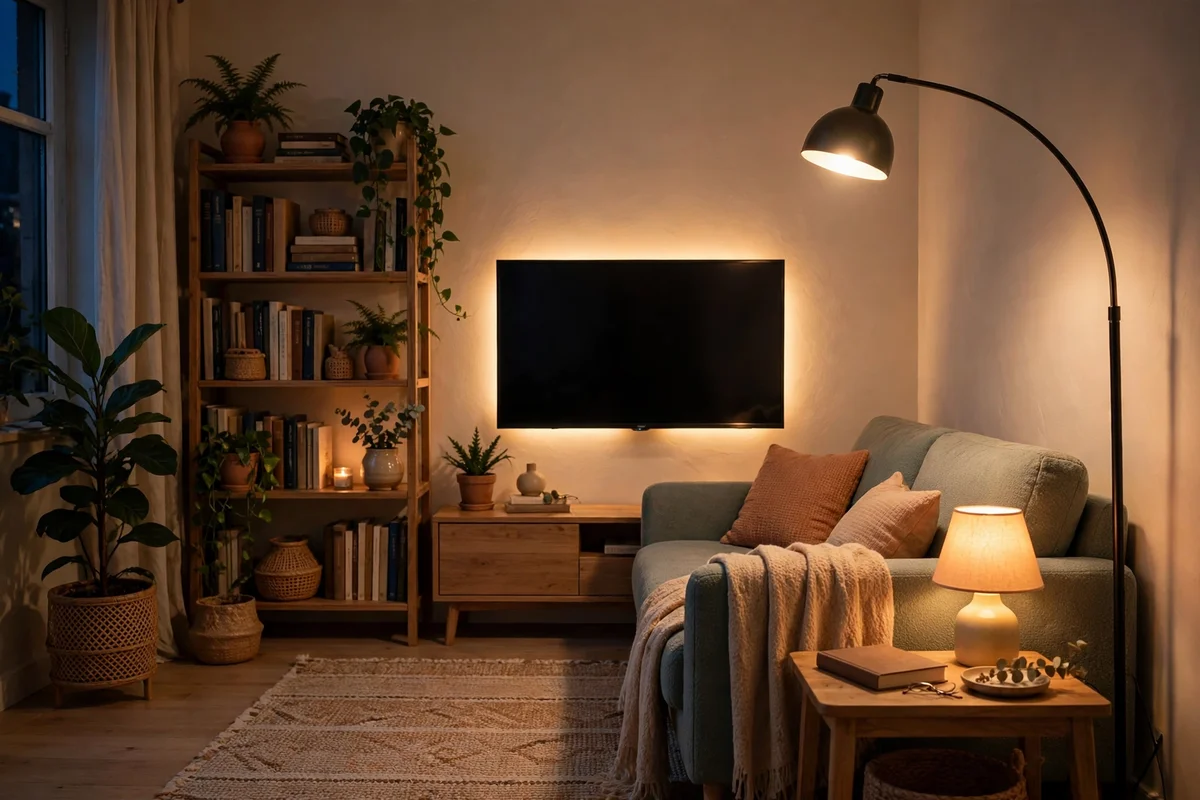
Every small living room has one: the corner where the light goes to die. Mine was behind the sofa, and it just sat there being a black hole. I put a tall, slim floor lamp there — an arc one, actually, that curves over the sofa — and suddenly the room had a second source of light and the corner stopped existing as a problem.
The trick is picking a lamp that doesn’t eat floor space. A slim base, a shade that throws light up and down, and a warm bulb. Mine doubles as my reading light, which means it earns its floor space twice over. If you’re choosing between a big statement lamp and a slim one, pick the slim one — your small room will thank you. My floor lamp ideas have the full rundown on arc lamps, torchiere uplights, and the ones that actually fit behind a sofa.
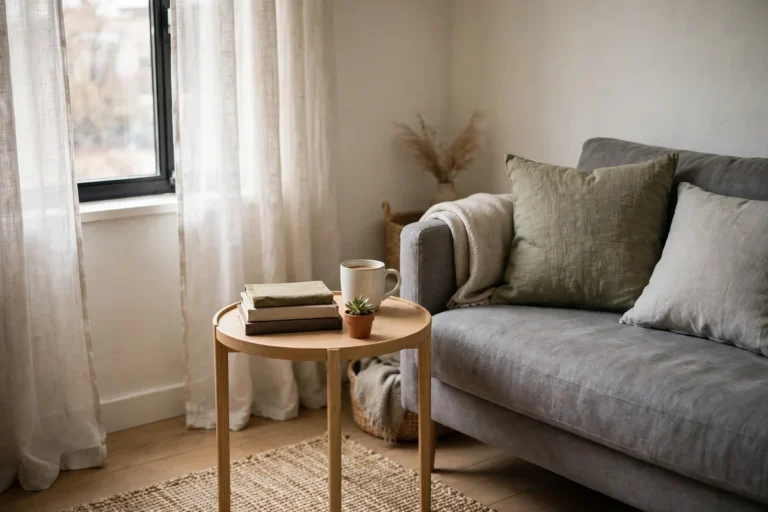
3. A Table Lamp on the Side Table (or the Windowsill)
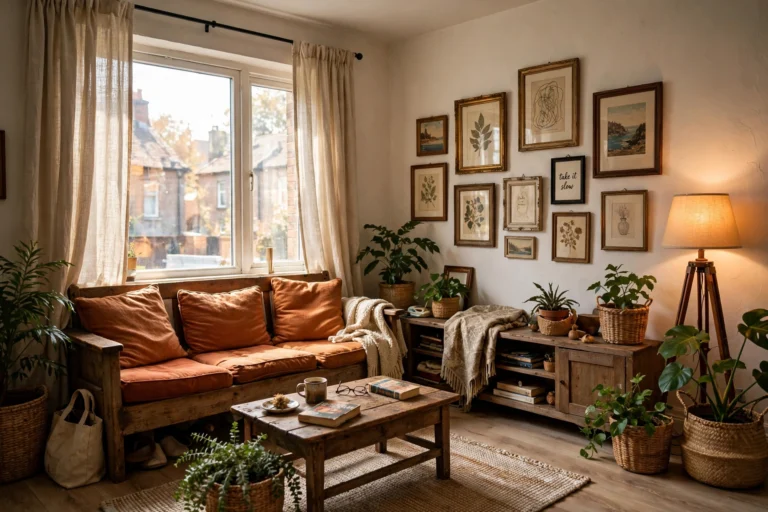
I resisted table lamps for ages because I thought they were decorative, not functional — something for show homes. Then I put a small one on the side table next to the sofa, and it changed how the whole room feels at night. A low, warm glow at sitting height is the single cosiest light a living room can have. It makes the sofa the centre of the room instead of the ceiling.
No side table? A small lamp on the windowsill does the same job, and it looks lovely from outside too. Keep the shade small and the bulb warm. And honestly, if you’re only going to buy one lamp from this whole list, make it this one. My table lamp ideas cover the small shades and low-wattage bulbs that work in tiny rooms without overwhelming them.
4. Layer Three Heights of Light
This is the actual secret, and once you see it you can’t unsee it. Good living rooms have light at three heights: something up high (ceiling or uplight), something at eye level (lamp or sconce), and something low (an LED strip, a candle, a light under a shelf). Bad living rooms have one light at one height. That’s it. That’s the whole difference between a room that feels designed and a room that feels like a corridor.
You don’t need to buy anything fancy to do this. Ceiling bulb (high), table lamp (eye level), LED strip behind the TV stand (low). Three heights, three pounds of effort, completely different room. When I finally did this, a friend asked if I’d redecorated. I hadn’t moved a single piece of furniture.
5. Plug-In Wall Sconces Beside the Sofa
Wall sconces sound like something for big houses with electricians on call. Plug-in sconces are the renter’s version, and they’re brilliant in a small living room because they put warm light exactly where you sit — at face height, beside the sofa — without taking up a single inch of floor or table space.
I put one on each side of the sofa, plugged into the same socket the lamp used to hog, and the wall behind the sofa stopped being a blank expanse and became the warmest part of the room. Command strips hold the lighter ones; a small screw holds the heavier ones, and honestly, one tiny screw hole is the least of what a landlord has seen. My wall sconce ideas have the plug-in picks that actually look good and don’t dangle a visible cord everywhere.
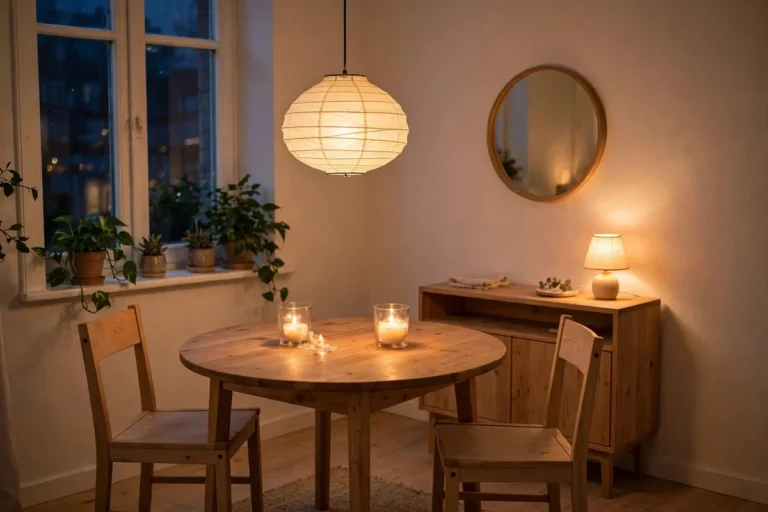
6. A Pendant That Doesn’t Hang Too Low
Small living rooms and low-hanging pendants are a bad combination — you end up ducking under your own light, and the room feels smaller because the light is sitting in the middle of your sightline. But a pendant hung high, close to the ceiling, with a wide shade that throws light up and out, is one of the best things you can do for a small room.
I swapped my bare bulb for a simple paper lantern pendant — the kind that costs less than a takeaway — and the light went from a harsh spotlight to a soft glow that fills the whole room. The rule is simple: the bottom of the pendant should be well above head height, and the shade should be wide, not narrow. My pendant light ideas cover the shades that work in low-ceiling flats without eating your headroom.
7. Dimmers — the Ten-Pound Upgrade That Changes Everything
Here’s a confession: I used to think dimmers were a luxury, something for people with dining rooms. Then I bought a plug-in dimmer for my floor lamp — ten pounds, no wiring, plugs into the wall like an adapter — and I finally understood. A living room at full brightness at 9pm feels like a showroom. The same room at half brightness feels like an evening.
Smart bulbs do the same job (and more), but a plug-in dimmer is cheaper and works with the lamp you already own. If your living room only has one mood — “on” — a dimmer gives it five. Film night, reading, having friends over, winding down: all different lights, all from the same lamp.
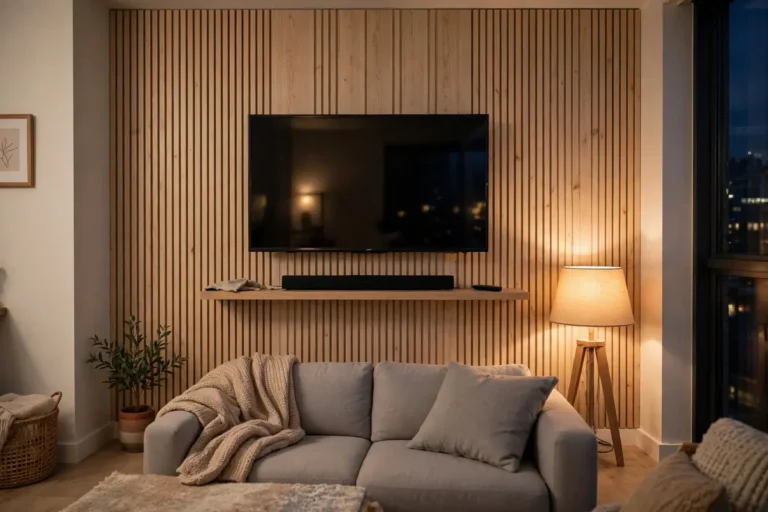
8. LED Strips Behind the TV (Bias Lighting, and Yes, It Matters)
I thought bias lighting — the glow behind the TV — was a gamer thing, and I am not a gamer. Then I stuck a cheap LED strip to the back of my TV and watched a film that evening, and the difference was genuinely silly for how cheap it was. No more eye strain, no more black rectangle floating in a dark room, and the TV area stopped looking like a void.
Set the strip to warm white, not rainbow mode (please, not rainbow mode, this is a living room, not a nightclub). The glow on the wall behind the TV makes the whole wall look intentional. It costs less than a pizza, it sticks on with adhesive, and it peels off cleanly when you move out.
9. Fairy Lights, Done Properly (Not Student Halls)
I know what you’re thinking, and I was wrong about this too. Fairy lights in a living room can look like a student flat — or they can look like the nicest thing in the room. The difference is discipline: one strand, warm white, draped once along a shelf or around a window frame, not zigzagged across the ceiling like a marquee.
I have one strand along the top of my bookshelf and it does more for the room’s evening mood than any lamp I own. Battery-powered ones mean no trailing wire and no socket hunt. Just keep it to one strand, warm white only, and put it somewhere it frames something — a shelf, a mirror, a window — instead of floating in the middle of nowhere.
10. Light the Ceiling, Not the Floor
Small rooms with dark ceilings feel like caves. An uplighter — a torchiere floor lamp or a small uplight on top of a bookshelf — bounces light off the ceiling and makes the whole room feel taller and brighter without a single harsh bulb in your eyeline. It’s the cheapest way to fake a higher ceiling.
I put a slim uplighter behind the armchair, and the ceiling, which I’d never once thought about, suddenly became the thing making the room feel spacious. If your ceiling is white or pale, this trick works even better — the ceiling becomes a giant, soft reflector. If it’s dark, a lighter shade or a coat of white paint on just the ceiling does more than any lamp ever will.
11. Pair a Mirror with a Light
A mirror on its own bounces light around a small room. A mirror with a light next to it doubles the light in the room — or at least, it looks like it does, which is what counts. I hung a round mirror on the wall opposite my floor lamp, and the room genuinely looks like it has two lamps instead of one.
The best spot is opposite a window (daylight) or beside your main lamp (evenings). Don’t put a mirror opposite the TV, unless you enjoy watching yourself watch TV. Keep it simple: one good mirror, one warm light, and the room does the rest. My gallery wall ideas cover mirror arrangements if you want to go further than one.
12. Smart Bulbs and Routines (Set It and Forget It)
I was sceptical about smart bulbs — they sounded like a solution looking for a problem. Then I set a routine: lights come on warm and dim at sunset, brighten slightly at 7pm, dim down at 10pm. Now I never touch a switch, and the living room always looks like someone who knows about lighting lives there. (Me. Apparently.)
You don’t need a whole smart home. One or two smart bulbs in the lamps you already own is enough, and the app control means you can turn the lights down from the sofa instead of getting up, which is honestly the main benefit. Start with the floor lamp bulb; if you like it, add the table lamp.
13. A Reading Light That Doesn’t Blind Everyone Else
Here’s a small domestic truth: one person reading in a small living room can ruin the light for everyone else. A bright overhead light for one reader, or a lamp angled straight at the other person’s eyes — we’ve all been there. The fix is a small, focused reading light: a clip-on book light, a lamp with a directional shade, or a floor lamp with an adjustable arm.
Mine is a little swing-arm lamp clamped to the side of the bookshelf, aimed at my book and nowhere else. The rest of the room stays dim and warm, I can read, and nobody else has to squint. It’s the least glamorous item on this list and the one I’d replace first if it broke.
14. Candlelight for Evenings (Real or LED, No Judgement)
Some evenings, no electric light is right. A couple of candles on the coffee table — real ones if your building allows them, LED ones if it doesn’t — and the living room drops into the kind of low, warm glow that no bulb can quite copy. I use LED pillar candles in glass holders most nights, because my building has rules and because I am not responsible enough for open flames near a bookshelf.
Keep it to a cluster, not a shrine: two or three candles together on a tray, on the coffee table or a shelf. It costs almost nothing, it takes thirty seconds, and it’s the difference between “the lights are on” and “the evening has started.” My small living room decor ideas have more on styling the coffee table around a glow like this.
Frequently Asked Questions
How many lights does a small living room need?
Three is the minimum that actually works: one overhead or uplight, one lamp at eye level, and one low light like an LED strip or candle. One light flattens a small room; three at different heights make it feel layered and bigger.
What colour temperature is best for a living room?
Warm white, 2700K, for everything — ceiling bulb, lamps, strips, the lot. Mixed colour temperatures (a cool ceiling bulb with warm lamps) make a room feel off in a way you can’t quite place. Keep them all the same and the room feels intentional.
Can I light a small living room with no ceiling light?
Yes. Floor lamps, table lamps, plug-in sconces and LED strips cover the whole job — and many small flats have no ceiling fitting in the living room at all. Start with a floor lamp in the dark corner and a table lamp by the sofa, and add a strip behind the TV. That’s a complete lighting plan with zero wiring.
How do I stop glare on the TV?
Don’t put a bright light directly opposite the screen, and keep lamps to the side of the TV rather than behind your seating. An LED strip behind the TV (bias lighting) actually reduces perceived glare by softening the contrast between the bright screen and a dark wall.
What’s the cheapest way to improve living room lighting?
A warm 2700K bulb in the existing fitting, plus a battery LED strip behind the TV. Under fifteen pounds total, ten minutes of effort, and the difference is honestly embarrassing for how long I waited to do it. If your ceiling fitting also has a fan, a warm bulb in it does double duty.
Bottom Line
My living room went from a single interrogation bulb to a room with three warm lights at three heights for about the price of a decent takeaway, and I didn’t rewire anything, drill anything, or ask the landlord for anything. I changed the bulb, added a floor lamp in the dead corner, put a small lamp by the sofa, and stuck a strip behind the TV. That was the whole renovation.
Start with the bulb. Then the lamp by the sofa. Then make it dim. Your living room will stop being the room you sit in under protest and start being the room you actually want to spend your evenings in — and if your living room is as small as mine, that’s a big job for such a small space.