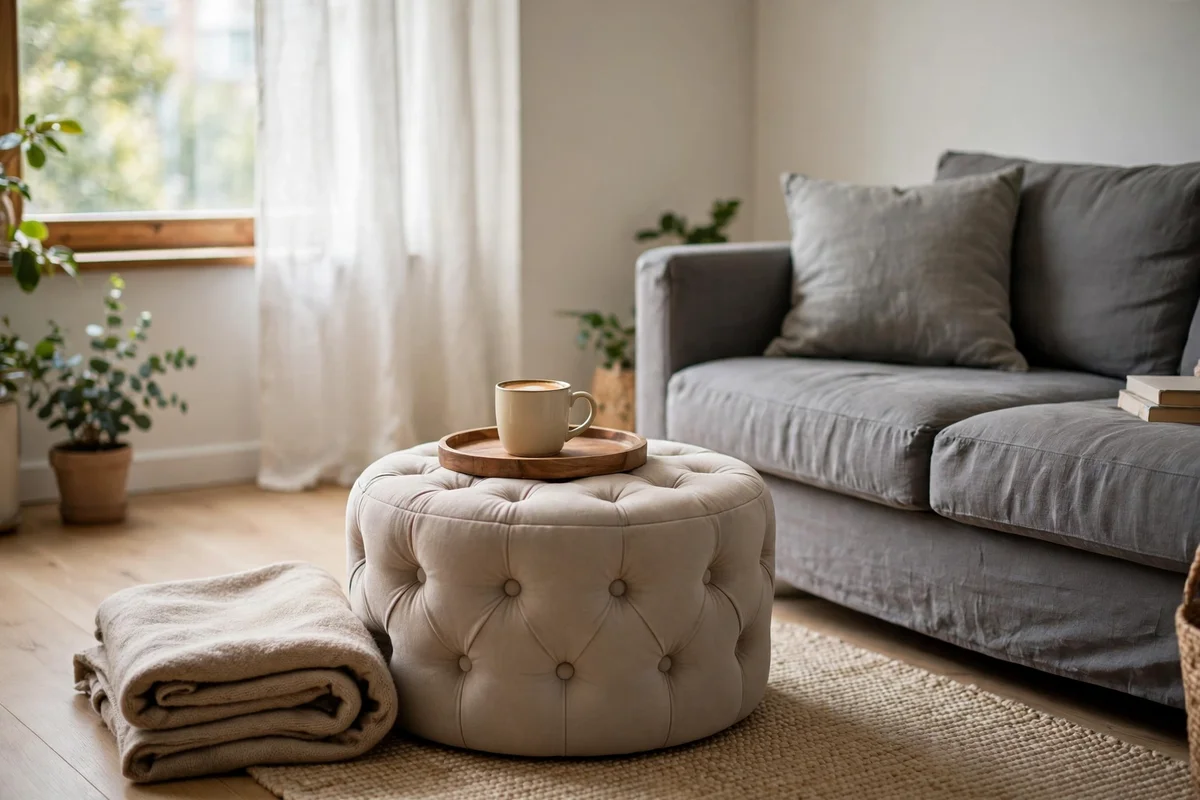
14 Small Apartment Ottoman Ideas That Do More Than Just Sit There
Here’s my hot take: the ottoman is the most underrated piece of furniture in a small apartment, and I will die on this hill. Everyone obsesses over the sofa, the coffee table, the perfect rug — and then the ottoman gets treated like an afterthought, a squishy box you put your feet on. But in a flat where every square centimetre has to earn its keep, the ottoman is the only piece of furniture that can be four things at once: a footrest, a seat, a table, and a storage box. Mine currently holds two spare blankets, a board game, and the charger I keep losing. It has never once been “just” a footrest.
The trick is picking the right one — and I mean right for your actual life, not for a showroom. A storage ottoman that’s too heavy to move is a storage ottoman you never open. A pouf that’s too soft collapses under a coffee mug. These 14 ideas are the ones that actually pulled their weight in my place and in friends’ flats I’ve helped furnish, where the living room is also the dining room, the office, and occasionally the guest bedroom.
Quick Answers
- What size ottoman works in a small apartment? Around 40–50 cm across and 40–45 cm tall — roughly knee height when you’re sitting on the sofa, and small enough to tuck under a console or slide beside the sofa when guests come over.
- Can an ottoman replace a coffee table? Yes — a firm, flat-topped ottoman with a tray on top works brilliantly as a coffee table, and it’s softer on shins and easier to move than a wooden table.
- What should I store inside a storage ottoman? The things you use weekly but don’t want to see daily: spare throws, board games, chargers, kids’ toys, out-of-season scarves — not the stuff you need every morning.
1. The Storage Ottoman (Start Here, Honestly)
If you buy one thing from this list, make it this one. A storage ottoman looks like a plain footrest, but lift the lid and there’s a whole hidden compartment inside — mine holds two blankets, a board game, and the remote controls that used to live on the sofa arm. It’s the easiest decluttering win in a small flat because the storage is invisible and the lid closes in one second. My small living room storage ideas lean on this exact trick: if the storage looks like furniture, you’ll actually use it. Just check the lid hinge before you buy — a cheap one slams shut on fingers, and you only learn that once.
2. The Ottoman as a Coffee Table (With a Tray)
This is the move that changed my living room. A firm-topped ottoman with a wooden tray on top becomes your coffee table — drinks, books, phone, all within reach — and when you want to put your feet up, you lift the tray off. No sharp corners to walk into at 2am, no heavy table to drag when you need floor space for a yoga mat. If your coffee table is currently the thing everything crashes into, my small apartment coffee table ideas have a few more soft-edged alternatives, but honestly this one might be all you need.
3. The Cube Ottoman That Doubles as Extra Seating
Small apartment, friends coming over, nowhere to sit — the cube ottoman is the answer. It’s a firm little cube that lives beside the sofa as a footrest most days, then becomes a proper seat when someone visits. I keep two of them, and they’ve seated everyone from my mum to a mate who stayed for dinner. The trick is buying one firm enough to actually sit on — press the top before you buy, and if your hand sinks straight through, keep walking. A good one should feel like a stool, not a marshmallow.
4. The Round Pouf (For Rooms That Feel Too Boxy)
Here’s a visual trick I learned the hard way: small rooms full of rectangles — sofa, TV, bookshelf, rug — start feeling like a box. A round pouf breaks all those straight lines and the whole room softens. It weighs almost nothing, so you can kick it wherever you need it: by the reading chair, under the window, in front of the TV for the kids. Mine is a woven cotton one that has survived three flats and two cats. It holds no storage, does no tricks, and I love it anyway — sometimes a piece of furniture just needs to be soft, round, and in the right place.
5. The Ottoman With a Reversible Tray Top
This one is clever and I wish I’d found it sooner. The lid flips over: one side is upholstered fabric for your feet, the other side is a hard wooden surface for drinks and laptops. It’s a footrest and a side table in one object, and flipping it takes two seconds. I use the hard side when I’m working from the sofa and the soft side when I’m watching TV — which is to say it earns its footprint twice a day. It’s the same thinking behind my multifunctional furniture picks: in a small flat, one object doing two jobs beats two objects doing one job each.
6. The Nesting Ottomans (Two for the Footprint of One)
Nesting ottomans are the closest thing to cheating. You get two — sometimes three — that stack or slide inside each other into the footprint of one, then pull apart when you need them: one for your feet, one for a guest, one as a side table with a tray on top. When they’re nested they look like a single tidy cube. The only rule is the same one as nesting tables — actually use the inner one, or it becomes a permanent dust collector. I pull mine apart every Friday when friends come over and nest them again on Sunday. It takes ten seconds and it feels like the flat doubles in size.
7. The Long Bench Ottoman (The Sofa’s Best Friend)
A long, low bench ottoman parked in front of the sofa is a footrest for two people at once — and when guests arrive, it’s a bench seat for two more. Ours is the piece of furniture that made the living room feel like it could actually host people. It also hides a surprising amount of storage if you get the hollow kind: board games, spare cushions, the yoga mat you keep meaning to use. Measure your sofa first, though — the bench should be about two-thirds the sofa’s width, or it starts looking like it’s trying to be a second sofa and failing.
8. The Ottoman on Wheels (Yes, Really)
I was wrong about this one. I thought wheels on an ottoman were a gimmick — something for offices, not homes. Then a friend rolled hers across the room with one foot to make space for a drying rack, and I was converted. A storage ottoman on castors moves with a nudge: to the window for reading, to the corner when guests arrive, out of the way for vacuuming. In a flat where you rearrange constantly, that’s not a gimmick, it’s a superpower. Just make sure the wheels lock, or you’ll be chasing it across the room every time you put your feet down with enthusiasm.
9. The Faux-Leather Ottoman That Wipes Clean
If you’ve got kids, pets, or a personal habit of eating curry on the sofa (no judgement — same), a faux-leather ottoman is your friend. Spills wipe off with a damp cloth, it doesn’t hold smells the way fabric does, and it looks far more expensive than it is. Mine has survived red wine, a knocked-over coffee, and a cat who thinks it’s a scratching post. It still looks decent. Fabric ottomans are softer and cosier, sure — but the wipe-clean one is the one you don’t have to think about, and in a small flat, that’s worth a lot.
10. The Ottoman That Hides in Plain Sight (Under the Console)
This is my favourite sneaky one. A small cube ottoman that slides completely under a console table, a desk, or a wall shelf is invisible storage and invisible seating until you need it. Guests arrive, you pull it out. They leave, it slides back. It takes up literally zero visible floor space. I keep one under my desk — it’s my footrest while I work and an extra seat when someone visits. If your flat has one of those awkward gaps under a table that currently holds dust and a lost sock, that’s where your ottoman belongs.
11. The Tufted Ottoman (The One That Makes the Room Look Finished)
Okay, this one is pure looks, and I’m not going to pretend otherwise. A tufted ottoman — buttons, soft folds, the works — makes a small living room look like someone actually designed it rather than just moved boxes in. It’s the piece guests comment on. It doesn’t store anything, it doesn’t fold, it just sits there looking expensive. And you know what? That’s fine. Not every piece of furniture has to be a Swiss Army knife. Sometimes the job is just to make the room feel finished. If the rest of your flat is working hard, one pretty piece is allowed.
12. The Ottoman as a Bedside Table (Don’t Knock It Till You’ve Tried It)
A small cube ottoman beside the bed works as a nightstand in a bedroom too tight for a real one — flat top for your phone and a glass of water, storage inside for the book you’re reading and the charger you keep losing. I did this in my old flat where the bed barely left room for a bedside table, and it was better than the wobbly little table it replaced: softer to bump into at night, and it doubled as a seat when I was putting shoes on. If your bedroom is fighting you on furniture, my small apartment side table ideas have more small-space swaps, but the ottoman version is the softest and the most forgiving.
13. The Outdoor Ottoman (For Balcony People)
If you’ve got a balcony — even a tiny one — a weather-resistant ottoman earns its place out there. It holds the cushions when it rains, seats a second person when a friend comes for coffee, and props your feet up when you’re reading outside. Get one in outdoor fabric or rattan-look resin, not indoor fabric, or one rainy week will ruin it. Mine lives on the balcony all summer and comes inside in winter, where it does a second shift as a living room footrest. Two rooms, one ottoman — that’s the small-apartment way.
14. The “Wrong” Ottoman That Works Anyway
Last one, and it’s permission rather than a product: the best ottoman for your apartment might not be labelled an ottoman at all. A sturdy floor cushion. A low storage bench. A big woven basket with a cushion on top. A vintage trunk with a folded blanket over it. I’ve seen all of these work beautifully, because what matters isn’t the label — it’s the height, the firmness, and whether it fits the gap. Measure the gap, sit on it before you commit, and if it holds your weight and your coffee, it’s an ottoman. Don’t overthink it.
FAQ
How tall should an ottoman be next to a sofa?
About the same height as the sofa seat, or 2–5 cm lower — roughly 40–45 cm for most sofas. Too tall and your knees point up like you’re sitting in a go-kart; too low and it’s not a footrest, it’s a floor cushion.
Can I use an ottoman instead of a coffee table?
Yes — a firm, flat-topped ottoman with a tray works brilliantly, and it’s softer on shins and easier to move than a wooden table. Just make sure the top is genuinely firm: press it with both hands, and if it sinks, it’s a footrest, not a table.
What size ottoman is best for a small apartment?
Around 40–50 cm across for a single, or 90–100 cm long for a bench ottoman in front of a two-seater sofa. Anything bigger starts competing with the sofa for floor space, and the sofa always wins that fight.
How do I keep a storage ottoman from becoming a junk drawer?
One rule: if you haven’t opened it in a month, empty it. Storage ottomans are great for things you use weekly — throws, games, chargers — and terrible for things you’re avoiding dealing with. Check it once a season and it stays useful instead of becoming a hidden landfill.
Are round or square ottomans better for small apartments?
Round, usually — no corners in a walkway, easier to squeeze into a gap, and they soften a boxy room. Square works better when the ottoman has to slide under a table or sit flush against a sofa. If your books are piling up beside it, my small apartment bookshelf ideas will help keep them off the floor.
Bottom Line
An ottoman in a small apartment isn’t a luxury — it’s the hardest-working piece of furniture you own, if you let it be. Pick one that does at least two jobs, match it to your sofa’s height, and keep the storage inside honest. The best one isn’t the prettiest in the shop. It’s the one you reach for every single evening without thinking about it — feet up, blanket out, clutter gone.