14 Small Apartment Dining Room Lighting Ideas That Make a Tiny Dining Spot Feel Warm
Here’s the thing about eating dinner in a small apartment: the food can be great, the table can be lovely, and the whole meal can still feel like you’re eating in a hospital corridor. That was my dining corner for the first year. One bare bulb overhead, a fold-out table shoved against the wall, and light so flat and white that even a candlelit dinner looked like a job interview.
I spent ages blaming the table. Wrong size, wrong shape, wrong chairs — I tried all of it. Then one evening I swapped the bulb above the table for a warm one, hung a cheap paper pendant low over the middle of it, and lit two candles. Same table, same chairs, same takeaway noodles. Completely different meal. My flatmate walked in and asked if I’d bought a new table. I hadn’t touched the table.
That’s the secret nobody tells you about small dining spaces: the light does more work than the furniture. These 14 small apartment dining room lighting ideas are the ones that actually worked in my tiny dining corner — most of them renter-friendly, none of them needing an electrician, and all of them cheaper than one “proper” dining room light from a furniture shop.
Quick Answers
- How high should a light hang over a dining table? About 75–90 cm (30–36 inches) above the tabletop. Lower feels intimate and makes a small table look intentional; higher and the light just washes the ceiling. In a small flat with low ceilings, aim for the higher end so nobody stands up into it.
- What colour temperature is best for a dining area? Warm white, 2700K — the same as the rest of the flat, but it matters most here. Warm light makes food look appetising and faces look friendly. Cool white over a dinner table makes everyone look tired and the food look grey.
- Can I light a dining table with no ceiling fitting? Yes. A plug-in pendant on a hook, a floor lamp pulled close, a table lamp on a sideboard, or even a cluster of candles — plenty of small flats have no ceiling light over the table at all, and some of the nicest dining corners I’ve seen were lit without one.
- What’s the best renter-friendly dining light? Anything plug-in or battery-powered: a plug-in pendant with a ceiling hook, a battery puck light under a shelf, candles, a small lamp on the sideboard. Nothing that needs wiring or a landlord’s permission slip.
1. Hang One Pendant Low Over the Table (The Single Best Move)
If you do one thing from this list, do this. A single pendant hung low over the centre of the table is the fastest way to turn “eating area” into “dining room.” It pulls the eye down to the table, pools warm light exactly where the food is, and makes the rest of the room fall away into a soft background. It’s the oldest restaurant trick in the book, and restaurants use it because it works.
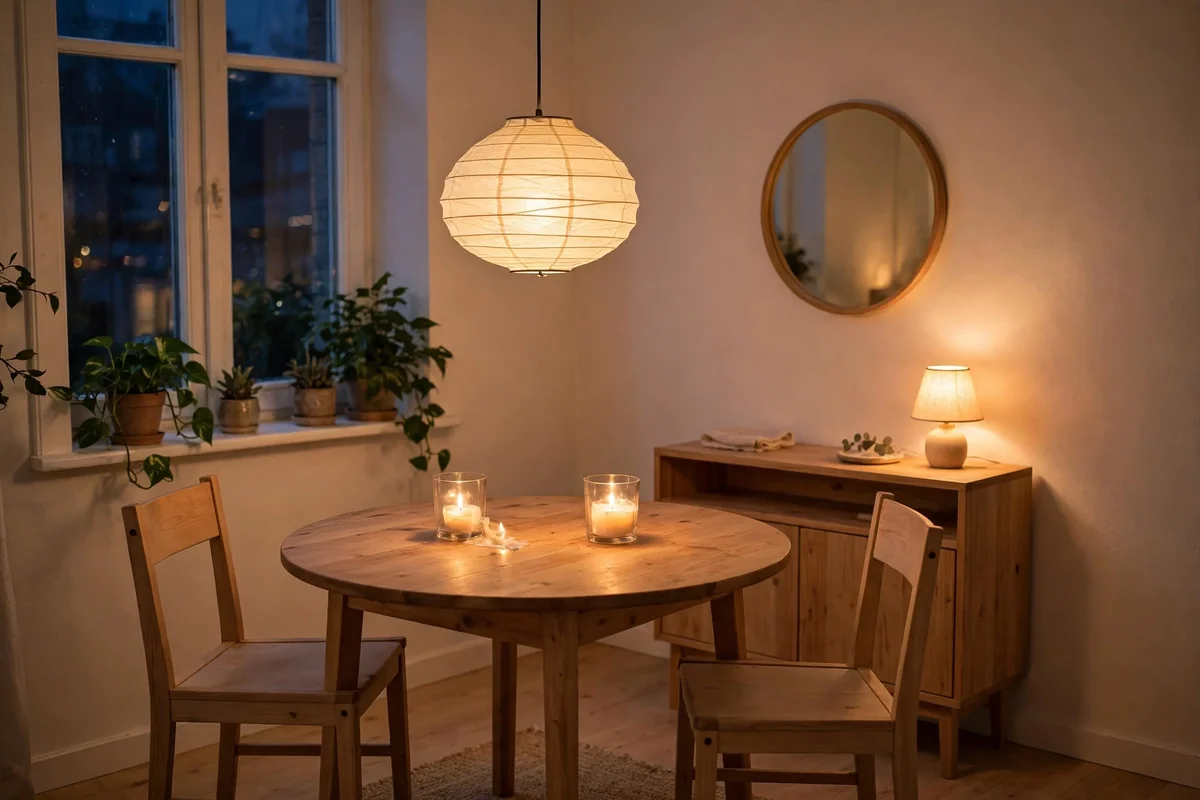
Mine is a paper lantern pendant that cost less than a takeaway, plugged into the ceiling fitting with a simple adapter — no wiring, no electrician. The rule I learned the hard way: the bottom of the shade should sit about 75–90 cm above the table. Too high and it lights the ceiling instead of your plate; too low and you’re ducking under it every time you stand up. My pendant light ideas have the shades that actually work in low-ceiling flats without eating your headroom.
2. Swap the Bulb Before You Buy Anything
I know, I know — every lighting article says this, and it’s boring advice. But my dining corner bulb was a cold white “daylight” one, and it turned every meal into something that felt like a school canteen. I swapped it for a warm 2700K bulb and the exact same table, the exact same chairs, suddenly looked like a place you’d want to linger over a second glass of wine.
Two minutes. A couple of pounds. It’s the highest return-on-effort change in this entire list, and if you do nothing else here, do this. And if your dining light is dimmable — even with a cheap plug-in dimmer — even better, because dinner at full brightness feels like a cafeteria and dinner at half brightness feels like an evening out. My general small apartment lighting ideas start with the same trick, because it works in every room.
3. A Cluster of Small Pendants Instead of One Big One
Here’s where I went wrong the first time: I bought one big statement pendant for a table that seats two. It looked like a chandelier in a broom cupboard. Then I tried the opposite — three small pendants hung at slightly different heights over the table — and it looked like I’d hired someone.
A cluster works in small spaces because it scales down. Three small shades, or even two, spread the light across the table instead of dumping it all in one spot, and the staggered heights give the corner a bit of shape. You can buy ready-made cluster kits that plug into a single ceiling fitting, or hang three cheap paper lanterns at different lengths. Just keep the shades small — a fist-sized shade, not a beach ball.
4. Candles on the Table (Yes, Really — Even on a Tuesday)
I used to think candles were for date nights and power cuts. Then I started lighting two of them for ordinary weeknight dinners, and honestly, I don’t know why I waited so long. Two candles on a small table do more for the mood than any lamp you can buy: the light is low, warm, and flickering, it flatters everyone at the table, and the food looks better by candlelight. It just does. Science can explain it if it wants; I’m busy eating.
Keep it simple: two or three candles in glass holders on a small tray, down the centre of the table. Real ones if your building allows them, LED pillar candles if it doesn’t — the LED ones have got genuinely good lately, and nobody at the table will know. It costs almost nothing, it takes thirty seconds, and it’s the difference between “dinner” and “an evening.”
5. A Table Lamp on the Sideboard (or the Windowsill)
No ceiling fitting over your table? Or a table pushed against the wall where a pendant makes no sense? A small table lamp on the sideboard, a shelf, or the windowsill next to the dining spot does the same warm, low job. I have a tiny lamp on the sideboard beside my table, and on evenings when I don’t want the overhead light at all, it’s the only light on — and the corner looks like a bistro.
The trick is scale: a small shade, a warm bulb, nothing that towers over the table. A lamp that’s too big fights the table for attention; a small one just glows quietly in the corner. My table lamp ideas cover the small shades and low-wattage bulbs that work in tiny rooms without overwhelming them.
6. Dimmers — Because Dinner Has Two Moods and Neither Is “Full Blast”
Here’s a confession: I used to think dimmers were a luxury, something for people with actual dining rooms. Then I bought a plug-in dimmer for the pendant over my table — ten pounds, no wiring, plugs in like an adapter — and I finally understood. A dining table at full brightness at 8pm feels like a staff canteen. The same table at half brightness feels like a restaurant.
Smart bulbs do the same job (and more), but a plug-in dimmer is cheaper and works with the light you already own. Weeknight dinner, friends over, working lunch at the same table: three different lights, all from the same fitting. If your dining corner only has one mood — “on” — a dimmer gives it five.
7. Plug-In Wall Sconces Flanking the Table
Wall sconces sound like something for big houses with electricians on call. Plug-in sconces are the renter’s version, and they’re brilliant beside a dining table because they put warm light at face height — exactly where people are sitting — without taking up a single inch of table or floor space.
I put one on the wall behind my table, plugged into the same socket the lamp used to hog, and the wall stopped being a blank expanse and became the warmest part of the corner. Command strips hold the lighter ones; a small screw holds the heavier ones, and honestly, one tiny screw hole is the least of what a landlord has seen. My wall sconce ideas have the plug-in picks that actually look good and don’t dangle a visible cord everywhere.
8. A Chandelier — But a Small, Honest One
I know what you’re thinking. Chandelier, small apartment, are you serious? Yes, but hear me out: not a crystal palace chandelier, a small one. A little beaded or wooden chandelier, or even a mini sputnik with six small bulbs, hung over a small table looks deliberate and charming instead of ridiculous. The mistake is scale, not the idea itself.
The rule is simple: the chandelier’s width should be about half the width of your table, never wider. My table is 90 cm across, so a 45 cm chandelier is about right, and it makes the corner feel like a proper dining room instead of a table that happens to be near a wall. My chandelier ideas cover the small-scale ones that don’t swallow a tiny room.
9. LED Strips Under a Shelf Above the Table
If you have a shelf above or beside your dining table — and a lot of small flats do, because where else do the plates go — a battery LED strip stuck underneath it is one of the cheapest upgrades going. It throws a soft wash of warm light down onto the table, the shelf above stops being a dark cave, and the whole corner gains a layer of light that costs less than a pizza.
Set it to warm white, not rainbow mode (please, not rainbow mode, this is a dining table, not a nightclub). Battery-powered strips mean no socket hunt and no trailing wire, and they peel off cleanly when you move out. It’s the kind of change nobody notices consciously and everybody feels.
10. Light the Wall, Not Just the Table
Small dining corners with one light directly over the table have a problem: everything outside the pool of light goes black, so the corner feels like a stage. The fix is a second, indirect light aimed at a wall — an uplighter on the floor, a small light on top of a shelf, anything that bounces warm light off a wall or ceiling and fills in the shadows.
I put a slim uplighter behind the sideboard, and the wall behind the table, which I’d never once thought about, suddenly became the thing making the corner feel spacious. If your walls are white or pale, this trick works even better — the wall becomes a giant, soft reflector. If they’re dark, a lighter shade or a coat of white paint on just that wall does more than any lamp ever will.
11. A Floor Lamp Pulled Up to the Table
This one sounds odd until you try it. A slim floor lamp — the kind with an arc or an adjustable arm — pulled up beside the dining table gives you a second layer of light at sitting height, and it costs you nothing because the lamp already lives in the room. I drag my arc floor lamp over from the sofa on evenings when friends come for dinner, and the table goes from “lit” to “glowing.”
The trick is picking a lamp with a slim base that tucks behind a chair without blocking anyone’s knees. An arc lamp is ideal because the light hangs over the table without the base being anywhere near it. My floor lamp ideas have the full rundown on arc lamps and the slim ones that actually fit in tight corners.
12. Match the Light to the Table (Round Table, Round Shade)
This is a small design rule that makes a big difference, and I only learned it after getting it wrong: the shape of your light should echo the shape of your table. Round table, round shade. Long rectangular table, a long linear pendant or two small pendants in a row. It sounds fussy, but when the shapes match, the corner looks considered instead of accidental.
My table is round, so a round paper lantern hangs over it, and the whole setup looks like it was planned. Before that I had a long rectangular shade over a round table and something about it always looked slightly off, like a picture hung crooked. Same light, same table — matching the shape fixed it. My dining table ideas cover the small round and fold-out tables that actually fit a tiny flat.
13. Fairy Lights Along the Window or Shelf (One Strand, Warm White)
I know what you’re thinking, and I was wrong about this too. Fairy lights in a dining corner can look like a student flat — or they can look like the nicest thing in the room. The difference is discipline: one strand, warm white, draped once along a shelf or around a window frame near the table, not zigzagged across the ceiling like a marquee.
I have one strand along the shelf above my table and it does more for the corner’s evening mood than any lamp I own. Battery-powered ones mean no trailing wire and no socket hunt. Just keep it to one strand, warm white only, and put it somewhere it frames something — a shelf, a window, a mirror — instead of floating in the middle of nowhere.
14. A Mirror Opposite the Light (Double the Glow for Free)
A mirror on its own bounces light around a small room. A mirror opposite your dining light doubles the light in the corner — or at least, it looks like it does, which is what counts. I hung a round mirror on the wall opposite my pendant, and the corner genuinely looks like it has two lights instead of one.
The best spot is opposite a window (daylight at lunch) or on the wall facing the pendant (evenings). Don’t put a mirror where it reflects the kitchen mess, unless you enjoy watching the washing-up while you eat. Keep it simple: one good mirror, one warm light, and the corner does the rest. My mirror ideas cover the round and arched mirrors that work best in tiny dining corners.
Frequently Asked Questions
How high should a light hang over a dining table?
About 75–90 cm (30–36 inches) above the tabletop. Lower feels intimate and makes a small table look intentional; higher and the light just washes the ceiling. In a flat with low ceilings, aim for the higher end so nobody stands up into the shade, and keep the shade small.
What colour temperature is best for a dining area?
Warm white, 2700K, for everything — pendant, lamps, strips, the lot. Warm light makes food look appetising and faces look friendly. Cool white over a dinner table makes everyone look tired and the food look grey. Mixed colour temperatures (a cool ceiling bulb with warm candles) make the corner feel off in a way you can’t quite place.
Can I light a dining table with no ceiling light?
Yes. A plug-in pendant on a ceiling hook, a floor lamp pulled close, a table lamp on the sideboard, or a cluster of candles — plenty of small flats have no ceiling fitting over the table at all. Start with a floor lamp beside the table and candles on it, and add a plug-in pendant later. That’s a complete lighting plan with zero wiring.
How do I stop glare on plates and glasses?
Don’t use bare bulbs over the table — a shade that hides the bulb from eye level fixes most glare. Keep the light warm and dimmable, and avoid a bright light directly opposite where people sit. A frosted or fabric shade spreads the light softly instead of throwing a hard spotlight onto every plate.
What’s the cheapest way to improve dining room lighting?
A warm 2700K bulb in the existing fitting, plus two candles on the table. Under ten pounds total, ten minutes of effort, and the difference is honestly embarrassing for how long I waited to do it. If you have a shelf above the table, add a battery LED strip under it for a few pounds more.
Bottom Line
My dining corner went from a single cold bulb and a fold-out table to a warm pendant, two candles, and a dimmer for about the price of a decent takeaway, and I didn’t rewire anything, drill anything, or ask the landlord for anything. I changed the bulb, hung a cheap pendant low over the table, and started lighting candles on ordinary Tuesdays. That was the whole renovation — and dinner has tasted better ever since, which is either the lighting or the placebo effect, and honestly, I’ll take either one.