14 Small Apartment Room Divider Ideas That Carve Out Privacy Without Walls
Quick Answers
- Cheapest divider? A tension-rod curtain — under $30, zero damage, up in 20 minutes.
- Best divider that also stores stuff? An open bookshelf. It splits the room and holds your books, plants, and baskets.
- Best for renters? Anything freestanding: folding screens, curtain rods, bookcases, tall plants. Nothing screwed into the wall.
- Will a divider make my apartment feel smaller? Only a solid one will. Open, sheer, or low dividers actually make a studio feel bigger because every zone finally has a job.
Here’s the thing about studio apartments: you don’t actually live in one room. You live in five rooms that are all pretending to be one. Your bed is in your office. Your office is in your living room. Your living room is where you eat dinner standing up because the table is also your desk. I lasted about three months in my first studio before I admitted the open plan wasn’t “airy” — it was just messy in every direction at once.
The fix wasn’t a renovation. My landlord would have laughed me out of the building. The fix was a divider — something that said, okay, this side is for sleeping, that side is for living, and never the two shall meet at 2 a.m. when I’m staring at my laptop from my pillow. Here’s what I learned, what actually worked, and the ideas I’d steal again in a heartbeat.
1. The Open Bookshelf That Works Overtime
This is my number one, and honestly, it’s not close. A tall open bookshelf — no back panel — splits the room while still letting light through. Mine holds books on the living-room side and a laundry basket, chargers, and the stuff I don’t want guests to see on the bedroom side. It’s a wall that pays rent. Keep the shelves a little messy on purpose; a perfectly styled shelf looks like a showroom, and nobody lives in a showroom.
- Go for open-backed shelving so light still travels across the room
- Anchor it to the wall if you can — a toppling bookcase is nobody’s idea of decor
- Face the prettier side toward guests, and let the bedroom side be honest
2. A Curtain on a Tension Rod (The Renter’s Best Friend)
I was wrong about this one. I thought curtains as dividers would look like a dorm room. Then I hung a linen curtain across my sleeping corner and slept better the first night, because my brain finally stopped treating my bed like a couch. A tension rod means no holes, no landlord drama, and you can take the whole thing down in five minutes when you move. Pick a fabric with some weight — sheer is pretty, but it won’t hide the unmade bed.
3. The Classic Folding Screen, Minus the Fancy Price Tag
Folding screens get a bad rap as the thing your grandmother had. Fair. But a simple wooden or rattan screen folds flat when you want the room open and pops up when your in-laws video-call and you don’t want them seeing your bedroom. I found mine secondhand for less than a dinner out, and it’s the easiest privacy I’ve ever bought.
4. Tall Plants Doing the Job of a Wall
Here’s my favorite cheat: a row of tall plants — a fiddle leaf, a couple of snake plants, a monstera that has frankly gotten out of hand — makes a green wall that breathes. It doesn’t block sound or give real privacy, I’ll be straight with you, but it tells your eyes “this zone ends here,” and that’s most of the battle. Bonus: you can’t kill a snake plant. I’ve tried. Well, almost.
5. A Clothing Rack That Isn’t Just for Clothes
A rolling garment rack with a few nice pieces on it, parked between your bed and the rest of the room, is a divider, a closet, and a conversation piece all at once. Hang a couple of plants off the ends and suddenly it looks intentional instead of “I ran out of closet.” When friends come over, roll it against the wall and the room opens right back up.
6. The Low Bookcase Line in the Sand
Not every divider needs to be tall. A low bookcase — hip height — draws a boundary without cutting the room in half visually. I love this one for separating a studio layout into a living zone and a sleeping zone while keeping the whole place feeling open. Your sightline stays clear, the ceiling still feels high, and you get a shelf for remotes, candles, and the book you’re pretending to finish.
7. Sheer Curtains for Light-Lovers
If your apartment has one good window and you guard it like treasure, don’t block it with a solid wall of anything. Sheer white curtains on a ceiling track let the light pour through while still giving you a soft visual boundary. It feels like living inside a cloud, in a good way. At night, layer a heavier curtain behind them and you’ve got real privacy after dark.
8. A Desk as a Divider (Two Jobs, One Piece of Furniture)
Turn your desk perpendicular to the wall instead of shoving it against one, and congratulations — you now have a home office with a back wall made of your own desk. Your monitor faces one way, your living room faces the other, and you stop working from bed, which, trust me, is a habit worth breaking. Pair it with multifunctional furniture and the whole room starts pulling double shifts.
9. Sliding Barn Doors on a Budget (Yes, Really)
Before you scroll past — no, you don’t need a farmhouse. A single sliding panel on a cheap rail, hung from the ceiling or a high wall mount, glides across to close off a sleeping nook and slides back when you want space. It’s the closest thing to a real wall without actually building one. Measure twice, though. I did not, once, and the door covered half my light switch for a month.
10. Beaded or Macrame Curtains for a Soft Boundary
These are pure vibe, and I mean that as a compliment. A macrame hanging or a beaded curtain won’t block sound, but it marks a doorway where there isn’t one, and it moves when you walk through it, which feels oddly satisfying. Great for separating a reading corner or a dressing area where you want suggestion, not a fortress.
11. A Storage Bench That Draws the Line
A long storage bench placed with its back to your bed creates a boundary you can sit on. Shoes, blankets, and winter coats live inside it; your guests get extra seating; your bedroom gets a border. It’s the rare divider that actually reduces clutter instead of just hiding it. If your budget is tight, this is one of those budget-friendly moves that looks far more expensive than it is.
12. Pegboard or a Slim Room Divider Panel with Art
A freestanding panel — pegboard, slatted wood, even a big framed canvas on legs — gives you a gallery wall that also happens to divide the room. Hang your art, your keys, your headphones on it. The slatted version is my pick: the gaps let light and air through, so the room never feels boxed in, and the shadows it throws in the evening are genuinely beautiful.
13. Lighting as an Invisible Divider
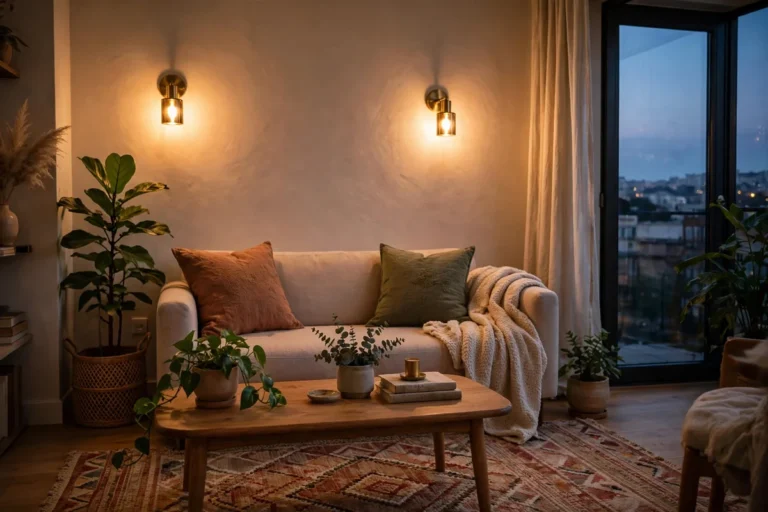
This one sounds like a trick, but it works. Put a warm lamp on the living side and a soft, dim light on the bedroom side, and your brain reads them as two rooms even with nothing between them. I didn’t believe it until I tried it — suddenly my bed corner felt like a different place at night. The right apartment lighting does more zoning work than most furniture, and it costs almost nothing to test.
14. The “Half Wall” of Kitchen Carts and Islands
If your studio’s kitchen bleeds straight into everything else, a slim kitchen cart or a narrow island parked at the edge of the kitchen zone is a divider with a purpose. Cooking stuff stays on one side, living stays on the other, and you’ve gained counter space in the bargain. It’s not glamorous. It is, however, the divider you’ll actually use every single day, which counts for more than glamour.
What I’d Do First (If I Were Starting Over)
Start with the curtain. Seriously. It’s cheap, it’s reversible, and it tells you immediately whether zoning fixes your problem or whether you actually just need to declutter. If the curtain helps, upgrade to the bookshelf when you find one you love. And whatever you pick, keep one rule: the divider should let light through. A dark, solid wall in a small apartment is how you end up with two tiny rooms instead of one good one — and that’s the opposite of what we’re doing here. For the bedroom side of the split, a few small bedroom touches — real bedding, one lamp, nothing work-related — help your brain switch off at night, which is the whole point.
FAQ
What’s the best room divider for a small apartment?
An open bookshelf or a tension-rod curtain. The shelf adds storage; the curtain costs almost nothing and leaves no marks. Both keep light moving, which matters more than anything in a small space.
Do room dividers make a small apartment feel smaller?
Solid, floor-to-ceiling dividers can. Open, sheer, or low dividers usually do the opposite — once every zone has a clear job, the whole place feels calmer and bigger, not cramped.
Can renters use room dividers without losing their deposit?
Yes, if you stick to freestanding options: folding screens, tension rods, bookcases, plants, and rolling racks. Anything that doesn’t need screws or wall mounts is deposit-safe.
How do I divide a studio apartment into a bedroom and living room?
Put your bed in the darkest, quietest corner, then run a bookshelf or curtain across the foot of the bed. Keep work stuff on the living side and sleep stuff on the bedroom side — and don’t let the two mix.
Bottom Line
You don’t need walls to have rooms. You need a line — a shelf, a curtain, a row of plants, a lamp that says “this side is for resting.” Pick the cheapest version first, live with it for a week, and let the room tell you what it actually needs. My studio never got bigger. It just finally started making sense, and honestly, that felt better than square footage ever did.