14 Small Apartment Sofa Ideas That Fit Without Eating the Room
I bought my first apartment sofa the way most people buy a sofa: I sat on it in the shop for about forty seconds, said “oh, this is comfy,” and paid. It was a big, deep, cloud of a three-seater, and in the shop it looked like the answer to all my problems. At home, it ate the living room alive. The front door only opened halfway before it hit the armrest. The walkway to the kitchen became a sideways shuffle. I lived with that mistake for a year because returning a sofa feels like admitting defeat, and honestly, I was too stubborn to admit I’d bought furniture for a flat I didn’t live in.
Here’s what I learned the hard way: in a small apartment, the sofa is not just a seat. It’s the biggest thing in the room, so it decides how the whole room works. Get it right and everything else falls into place. Get it wrong and you’re rearranging your life around a rectangle. These 14 ideas are the ones I actually use now — some I bought, some I wish I’d bought first, and one I learned from a friend whose flat is even smaller than mine and somehow looks twice as big.
Quick Answers
- What size sofa fits a small apartment? Usually 72 to 78 inches wide for a main sofa. Measure your wall, then leave at least 30 inches of walkway in front of it — if you can’t do both, go smaller, not bigger.
- Is a loveseat better than a sofa in a small flat? Often, yes. A loveseat seats two properly and leaves room for a chair or a plant corner, while a cramped three-seater just makes everyone sit shoulder to shoulder anyway.
- What sofa style makes a small room look bigger? Slim arms, raised legs you can see under, and a back that sits lower than your window sill. All three let your eye travel past the sofa instead of stopping dead at it.
1. Tape the footprint on your floor before you buy anything
This sounds fussy. Do it anyway. I skipped it once and paid for it with a year of door-shuffling, so now I’m the person with painter’s tape on the floor and zero shame about it. Mark out the sofa’s width and depth, then live with the tape for a day. Walk past it with a laundry basket. Open the door. Try to get to the window. If the tape makes you do a little sideways dance, the real sofa will be worse, because sofas have arms and cushions and a habit of being two inches bigger than the website said.
- Leave 30 inches minimum for your main walkway, 18 inches between sofa and coffee table
- Check the delivery route too — hallways, lifts and door frames have ended more sofa dreams than bad taste ever did
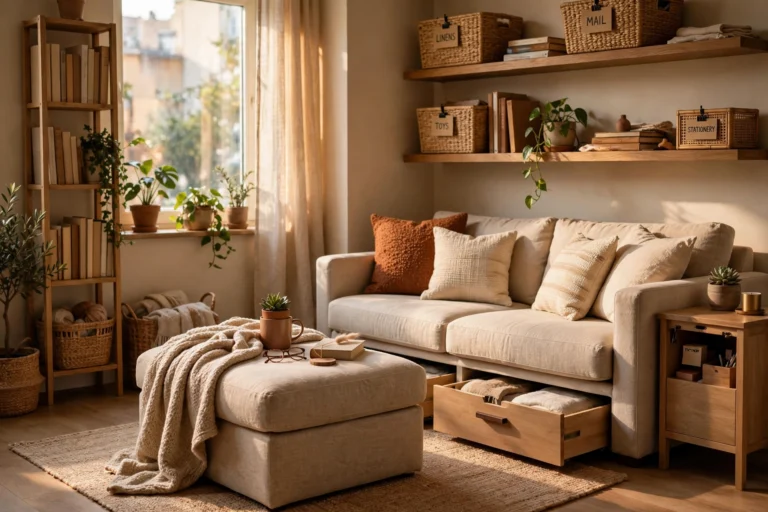
2. The 72-inch apartment sofa is a sweet spot, not a compromise
Somewhere along the way, “apartment sofa” started sounding like “sofa for people who couldn’t afford a real one.” Ignore that. A 72-inch sofa seats three normal humans for a film night and still leaves you a wall for a bookshelf and a corner for a lamp. My current one is 74 inches, and for the first time ever, guests don’t have to climb over the coffee table to sit down. Bigger is not automatically better — bigger is just bigger, and in a small room, bigger is usually in the way.
3. A loveseat plus a proper chair beats a squeezed three-seater
Here’s the thing nobody tells you: a three-seater crammed against a wall with no breathing room seats three people badly. A loveseat with a decent armchair opposite it seats three people well, and the chair can angle toward the window or the TV without a committee meeting. When my sister visits, she takes the chair, I take the loveseat, and nobody’s elbow is in anybody’s ribs. If your room is under about 12 feet wide, this is the layout I’d start with, and it’s one of the easiest wins in any small living room decor plan because it frees up the whole middle of the room.
4. A sleeper sofa that you would actually sleep on
Most sleeper sofas are a lie told in two parts: a sofa that’s fine and a bed that’s an instrument of torture. If guests stay over more than twice a year, test the bed in the shop — lie on it, not just sit on the edge politely. The good ones now have proper mattresses that fold out without a bar in your back, and they turn a studio into a guest room without a second room. I keep spare bedding in the ottoman next to mine, which means a guest bed is about ninety seconds of unfolding away. That’s the whole point of multifunctional furniture: one piece, two real jobs, no apology needed for either.
5. Slim arms are worth more than they look
A sofa with big rolled arms can steal eight inches of seat on each side. That’s sixteen inches of sitting space gone to what is, essentially, decorative elbows. Slim track arms give you that space back, and they make the whole sofa look narrower even when the frame is the same size. I didn’t believe this until I sat on two sofas with the same overall width and realised one felt like a bench and the other felt like a hug. Guess which one had the fat arms.
6. Let a chaise sectional own the corner — and only the corner
Sectionals scare small-flat people, and I get it. A bad one turns your living room into a sofa showroom. But a compact chaise sectional, the kind with one short chaise end instead of a full L, is a different animal. It uses the dead corner — the spot where nothing ever goes except a plant you forget to water — and gives you a place to stretch your legs without a separate footstool. The rule is simple: the chaise goes against the wall, the open side faces the room, and if it blocks a doorway, it’s too big. Full stop.
7. Go low. Your ceiling will thank you
A tall-backed sofa in a small room is like wearing a big hat in a low doorway — technically fine, visually loud. A low back, somewhere around 30 to 34 inches high, keeps your sightlines open and lets the wall and window do their thing behind it. My old sofa’s back was higher than the windowsill, so the room felt like a box with a sofa in it. The low one I have now sits under the sill, and suddenly you can see the whole room from the door. Same flat, same walls, completely different feeling. Pair it with tall curtains and the room genuinely looks taller — the same trick works for awkward corner spots that a big sofa would swallow whole.
8. Legs you can see under are a cheat code
This one is almost unfair. A sofa on short wooden or metal legs, with a few inches of floor visible underneath, looks lighter than the exact same sofa sitting flat on the floor. Your brain reads the gap as floor space, and floor space is what small rooms are always short of. Bonus: the robot vacuum can actually get under it, and so can the cat toy that has been missing since March. I was wrong about this for years — I thought a sofa to the floor looked “neater.” It looked heavier. Legs won.
9. Pick a colour that forgives your life
I love a white sofa in theory. In practice, I drink coffee, own a cat, and sometimes eat pasta on the sofa like a person with no table manners. A mid-tone grey, warm beige or muted green hides a multitude of sins without making the room dark, and if you can get removable, washable covers, you have basically bought yourself a reset button. Dark charcoal looks smart in photos and shows every single pet hair in real life, so unless you enjoy lint-rolling as a hobby, go a shade lighter than you think you should.
10. A modular sofa that splits when your life changes
Modular sofas sound like something for people with showpiece lofts, but in a small flat they’re quietly brilliant. Two pieces that work as a sofa today can become a loveseat and a chair when you move, or a sofa and a spare seat when a friend moves in. I’ve moved twice since buying mine, and both times the same pieces fit a completely different room because I could rearrange them instead of starting over. Buy the pieces you need now, add one later if the room allows — that’s a much kinder budget plan than replacing a whole sofa every move.
11. Build storage into the seat, not next to it
Small flats don’t have a spare cupboard for board games, spare blankets and the throw collection that somehow keeps growing. A sofa with storage under the chaise, or an ottoman that opens up, hides all of that in the footprint you were already using. Mine holds two blankets, a board game and a charger cable graveyard, and the room looks calmer for it. It’s the same logic as good living room storage: if it doesn’t have a home, it lives on the floor, and floors are for walking on.
12. Try the floor model, the outlet and the secondhand route first
Sofas are one of the few things where “used” doesn’t mean “worse.” Floor models are often barely sat on, outlet pieces are last season’s colour (who cares?), and a solid secondhand frame with new covers can cost a third of retail. Check the frame — lift one front corner and see if the other leg lifts too; if it twists, walk away. Check the cushions for sag, and sniff it, honestly, because a sofa keeps the smell of its previous life. My best sofa bargain came from an outlet, and three years on, nobody has ever guessed.
13. A curved sofa can soften a boxy room — in the right size
Small flats tend to be all right angles: square rooms, square tables, square TV. A gently curved sofa breaks that up and makes the room feel less like a storage unit. The catch is size — a big curved sofa is a nightmare to place, so look for a compact two-seater curve, not a sweeping crescent. Put it opposite the TV or angled into a corner and it becomes the thing people notice first, in a good way, instead of the room’s boxy shape.
14. Skip the recliner sofa unless you measure twice
I know, I know. Recliners are wonderful. But a reclining sofa needs clearance behind it to lean back, and in a small room that clearance is usually where the walkway or the bookshelf lives. If you truly want one, get a wall-hugger model that slides forward instead of back, and measure the reclined depth, not just the sitting depth. Otherwise you’ll own a very expensive chair that only reclines halfway before it hits the wall — which is somehow worse than no recliner at all. Spend that money instead on a good rug under the sofa and a lamp you actually like; you’ll use both every single day.
FAQ
How do I choose a sofa for a really tiny living room?
Start with the tape-on-the-floor trick, then pick the smallest sofa that seats the people who actually sit on it most days — usually a loveseat or a 72-inch sofa. Slim arms, raised legs and a low back do more for the look of the room than any colour choice.
Can a sectional work in a small apartment?
Yes, if it’s a compact chaise sectional and the chaise hugs a wall or a corner. A full L-shaped sectional with two long sides usually eats the room; a chaise version gives you the stretch-out spot without the second wall of sofa.
What sofa material is best for pets and kids?
Tightly woven performance fabric or leather you don’t mind ageing. Removable, washable covers are the real winner though — being able to wash a cover beats any “stain-resistant” claim after a muddy-paw incident.
Should the sofa match the rug?
It doesn’t have to match, it has to get along. If the sofa is a solid neutral, the rug can bring the pattern. If the sofa is bold, keep the rug quiet. The front legs of the sofa should sit on the rug, not float beside it, or the whole arrangement looks like it’s drifting apart.
The Bottom Line
My first sofa taught me the most expensive lesson in small-flat living: the biggest piece of furniture makes the rules, so it has to fit your actual life, not the life in the showroom photo. Measure first, go slimmer than your instinct says, and pick legs, arms and a back that let the room breathe. Do that, and your sofa stops being the thing you work around and starts being the place you actually want to sit — which, at the end of a long day, is the entire point.