20 Smart Storage Solutions for Small Homes to Maximize Every Inch
Here’s a truth nobody tells you when you move into a small home: the problem is almost never how much stuff you own. It’s that your home has storage dead zones — square feet that are doing absolutely nothing while your counters overflow and your closets burst.
I’ve spent years in small apartments, and the difference between a cramped one and a calm one came down to finding those dead zones. This guide is a room-by-room map of where your storage is hiding.
The Mindset Shift: Think in 3D
Most people store things at “human height” — the shelves and closets between knee and eye level. But your home has roughly three times that volume. Floor to ceiling, wall to wall, under everything, behind everything, inside everything. The moment you start seeing your home as a 3D grid instead of a floor plan, storage appears everywhere.
1. Walls: Your Biggest Untapped Resource
A standard room has more wall square footage than floor square footage, and most of it is empty. Floating shelves, tall bookcases, wall-mounted cabinets, pegboards, hanging organizers — this is the highest-ROI storage move in any small home. Start with the walls in your most cluttered room and work outward. One afternoon with a drill changes everything.
2. Under the Bed (The Obvious One You’re Probably Wasting)
The space under a bed is roughly the size of a closet, and most people fill it with… nothing, or chaos. Get proper under-bed bins — the flat kind with lids — and assign them categories: off-season clothes, extra bedding, shoes, gift wrap. If you’re buying a new bed, get one with built-in drawers. It’s the cost of a regular frame and it erases an entire dresser’s worth of clutter.
3. Floating Shelves Everywhere
Bathrooms, kitchens, hallways, above desks, beside beds — floating shelves fit where nothing else does. They’re cheap, they’re renter-friendly (small holes, easy to patch), and they turn dead wall into useful storage. Pro tip: keep the bottom shelf for daily stuff, the top shelf for things you grab weekly. Anything higher is decoration only.
4. Furniture That Earns Its Floor Space
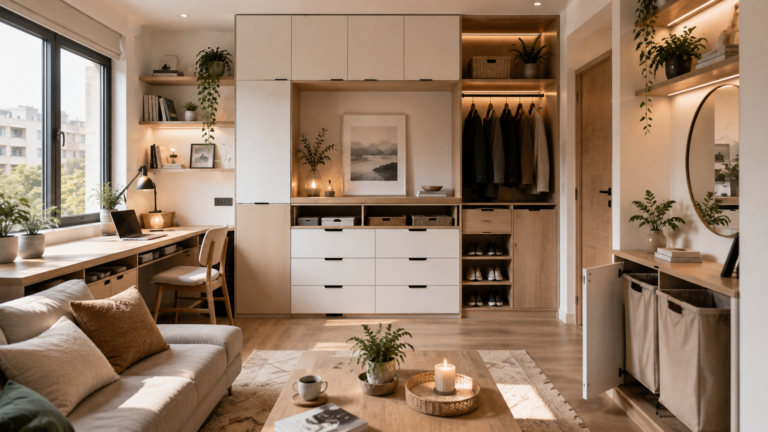
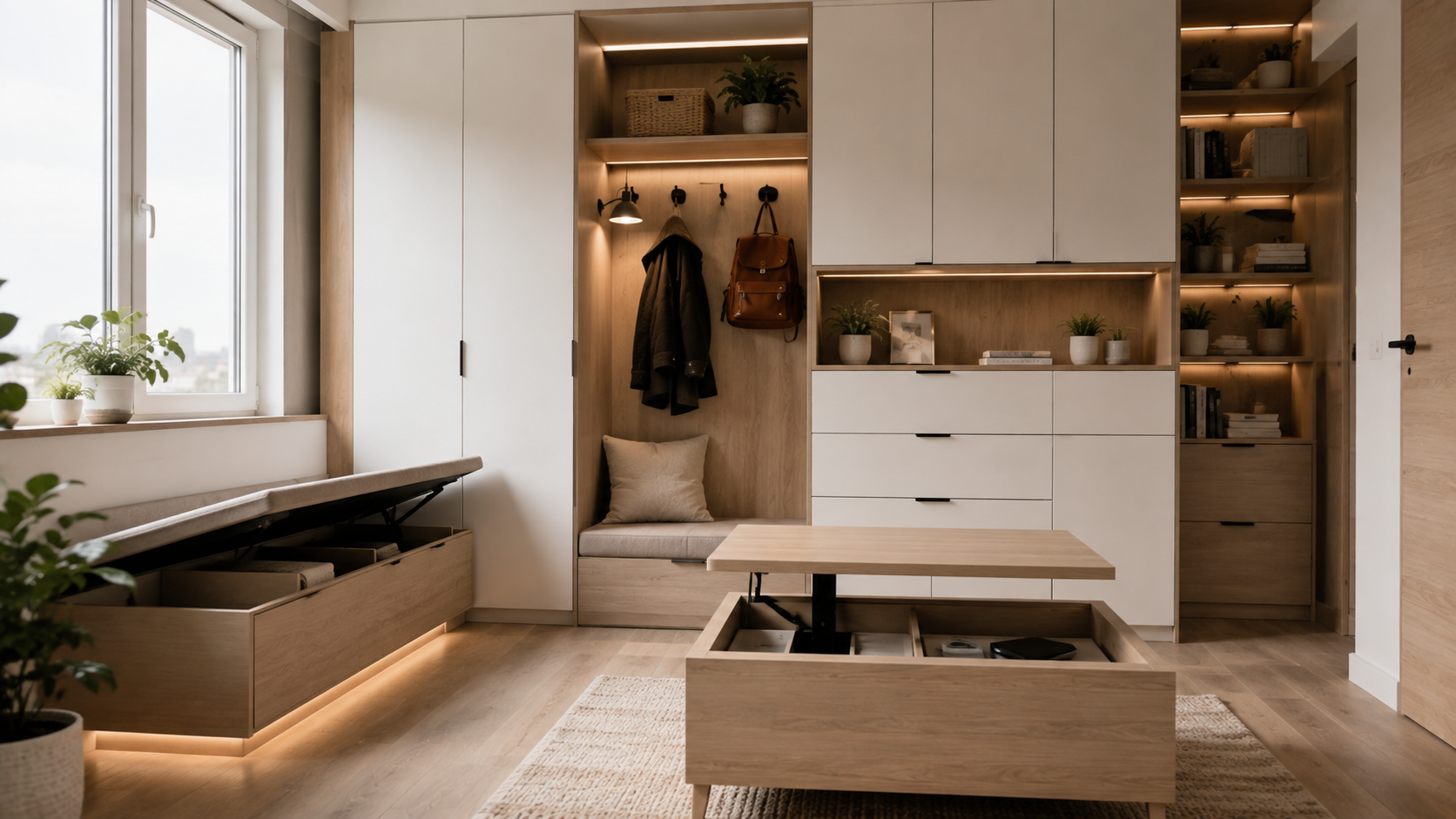
In a small home, every piece of furniture pays rent in square footage. Make sure it’s earning it. Storage ottomans, lift-top coffee tables, benches with compartments, sofa beds, dining tables with leaves — if a piece does only one job, it needs to justify itself. The best small homes I’ve seen look almost empty, but every surface opens, lifts, or hides something.
5. Closets: The 30% You’re Not Using
Most closets waste a third of their space: the gap above the single hanging rod, the floor below the clothes, the back of the door. Fix all three: add a second rod (instantly doubles hanging space), put bins or shoe racks on the floor, and hang an over-the-door organizer. A $50 closet kit from any home store can genuinely double a closet’s capacity.
6. Built-Ins (Even the Fake Kind)
Custom built-ins are expensive, but you can fake the effect. A bookcase flanked by two smaller ones, trimmed with molding, looks built-in for a tenth of the price. Window seats with storage underneath. A wall of IKEA cabinets with unified doors. The seamless look makes storage disappear into the architecture instead of reading as “extra furniture.”
7. The Backs of Doors
Every door in your home is a storage surface you’re ignoring. Over-the-door hooks for robes and bags, narrow racks for shoes or spices, hanging organizers for cleaning supplies or accessories. Bedroom, bathroom, pantry, closet doors — all of them. This is free storage that requires zero floor space and about five minutes to install.
8. Under the Stairs (If You’re Lucky Enough to Have Them)
That triangular void under a staircase is prime real estate. Pull-out drawers, a compact workstation, a reading nook with book storage, or even a tiny powder room if you’re ambitious. Even in apartments, the principle applies: look for the weird dead spaces — the gap beside the fridge, the area above cabinets — and claim them.
9. Clear Bins Beat Pretty Baskets (For Finding Things)
Baskets look great and hide mess, but you can’t see inside them. For storage you actually use — pantry, craft supplies, tools, kids’ stuff — clear containers win. You can see what you have, which means you stop buying duplicates and you actually put things back. Use baskets for the visible “pretty” storage and clear bins for the working storage.
10. Kitchen: The Vertical Frontier
Small kitchens suffer the most from the flat-storage mindset. Magnetic knife strips free a drawer. A rail with hooks holds utensils on the backsplash. Pull-out shelves double cabinet capacity. The inside of cabinet doors holds spice racks and cutting boards. Above the cabinets — that dusty gap — fits baskets for rarely-used items. A small kitchen with vertical thinking outperforms a big kitchen without it.
11. Bathroom Storage Without Remodeling
Renters, this one’s for you: over-the-toilet shelving units, shower caddies that hang from the showerhead, suction-cup organizers inside the shower, a rolling cart that slides beside the vanity. Bathrooms are small but their storage needs are intense — towels, products, cleaning supplies. Go up (shelves), go narrow (carts), and go behind (door organizers).
12. Baskets: Hide the Mess, Keep the Texture
Some clutter you’ll never fully organize — remote controls, chargers, the “miscellaneous” drawer of life. That’s what baskets are for. A few good-looking baskets on shelves and under tables swallow the visual chaos while adding warmth and texture. Woven, seagrass, or fabric — pick one material and repeat it for a pulled-together look.
13. Tame the Entryway or Drown in Shoes
The entryway is where small homes go to die — shoes, coats, bags, keys, mail, all in 20 square feet. Give everything a home: a bench with shoe storage underneath, hooks at two heights (adults and kids), a small tray for keys, a basket for the daily bag. Five minutes of setup saves five minutes of hunting every single morning.
14. Pegboards: The Most Flexible Storage Ever Made
A pegboard is a wall you can rearrange. Kitchens (utensils), offices (supplies), craft rooms, entryways (keys and bags), even bedrooms (jewelry). Hooks move in seconds, so the system evolves with your needs. Paint it to match your wall and it looks intentional, not workshop-y. For under $30, nothing else gives you this much adaptable storage.
15. Hidden Storage: The Minimalist Illusion
The cleanest-looking small homes aren’t owned by minimalists — they’re owned by people with great hidden storage. Lift-up beds, storage coffee tables, ottomans that open, side tables with drawers, mirrors that are secretly cabinets. When the storage is invisible, the home reads as calm and spacious. Our deep dive on hidden storage ideas for small apartments maps out every secret spot.
16. Seasonal Rotation: Store the Calendar, Not Just Stuff
Here’s a question: why is your winter coat taking up prime closet space in July? Seasonal rotation — swapping winter/summer clothes, holiday decor, sports gear — instantly frees 20-30% of your everyday storage. Vacuum bags compress bulky items flat. Store the off-season stuff in the hardest-to-reach spots (top shelves, under beds) since you only touch it twice a year.
17. The Home Office Deserves a System
Remote work turned kitchen tables into offices, and the paperwork spread everywhere. Give work its own contained system: a rolling cart that docks under a desk, wall files for active papers, one drawer or box for supplies. When the workday ends, the whole office should be able to disappear. A tidy work setup genuinely changes how a small home feels after hours.
18. Label Like You Mean It
Unlabeled bins are where organization goes to die. You will forget what’s in the third bin from the left. Labels take thirty seconds and they make the system maintainable — by you, by your partner, by anyone. A label maker is the most boring, most transformative $25 you’ll spend on your home.
19. Declutter Before You Organize
Buying storage for stuff you don’t need is just expensive hoarding. Before any organizing project, do one pass: keep, donate, trash. Be honest about the “someday” items. The best storage system in the world can’t fix too much stuff — but slightly less stuff makes every storage solution work twice as well.
20. Own Less, Store Less, Stress Less
The ultimate storage hack isn’t a product — it’s a habit. One in, one out. Buy the quality version so you don’t need three cheap ones. Borrow the thing you’ll use twice. Every item you don’t own is an item you don’t store, clean, or organize. Minimalism isn’t the goal; intentional is the goal.
Quick Answers
What’s the single best storage upgrade for a small home?
Multifunctional furniture — a storage bed or storage ottoman — because it adds capacity without using any new floor space. Second place goes to going vertical with shelves.
How do I start organizing a cluttered small home?
One room, one category at a time. Pull everything out, sort into keep/donate/trash, then put back only the keeps with a designated home for each. Don’t buy organizers until you know what you’re organizing.
Are storage beds actually worth it?
Yes — unequivocally. The under-bed area is roughly closet-sized, and a storage bed converts it from dead space into your highest-capacity hidden storage.
Related reading: pair this with our clever storage solutions for small apartments, hidden storage ideas, small bedroom decor ideas, and small living room decor ideas for the complete small-space playbook.
The Real Secret
After all these tips, here’s what actually matters: the best storage system is the one you’ll maintain. Fancy systems that take ten steps get abandoned. Simple systems — everything has one obvious home, labels tell you where — survive real life.
Start with your most stressful spot. Fix that one area this weekend. The calm spreads from there — I promise.