14 Small Apartment String Light Ideas That Make a Tiny Room Feel Magical
I’ll be honest: for years I thought string lights were for student flats and teenagers’ bedrooms. You know the look — a tangled mess of fairy lights zigzagged across a ceiling, half of them dead, the rest blinking like a broken slot machine. I was twenty-eight years old before I admitted that the problem wasn’t the lights. It was how I’d been using them.
Then I went to a friend’s flat — a place smaller than mine, honestly — and her bedroom had one single strand of warm white string lights draped in a loose swag above the bed. One strand. That was it. And the whole room felt like a place you’d pay money to stay in. I went home that night, looked at my own bedroom with its one sad ceiling bulb, and ordered a strand of lights before I’d even taken my shoes off.
These 14 small apartment string light ideas are everything I’ve learned since then — the placements that actually work, the mistakes that make a room look like a dorm, and the renter-friendly ways to hang them without losing your deposit. No wiring, no electrician, and most of them cost less than a takeaway.
Quick Answers
- Are string lights safe in a small apartment? LED string lights are — they stay cool to the touch, use almost no electricity, and don’t heat up like old incandescent bulbs. Keep them away from anything that could trap heat, don’t drape them over a heater, and don’t leave any lights on when you’re out or asleep. The battery packs are low voltage and safe, but swap the batteries before they start getting warm.
- How do you hang string lights without damaging the walls? Small clear Command hooks or adhesive light clips — the kind made for fairy lights, with a little channel the wire sits in. They peel off cleanly when you move out. In a rental, never use nails, staples, or tape that pulls paint; the hooks cost a couple of pounds and they’re the whole reason string lights are renter-friendly at all.
- How many strands does a small room need? Usually one. One 3–5 metre strand is enough for a headboard wall, a window, or a shelf. A small bedroom or living room looks best with one or two strands total — the moment you add a third, it stops looking magical and starts looking like a Christmas market.
- Battery or plug-in string lights? Battery for anywhere without a nearby socket — around a bed, on a balcony, inside a jar. Plug-in for the one permanent spot, like the living room wall, because the light is steadier and brighter and you never find them dead at 9pm. If you go battery, get ones with a timer built in; you’ll thank yourself within a week.
1. One Strand Along the Headboard (The Single Best Move)
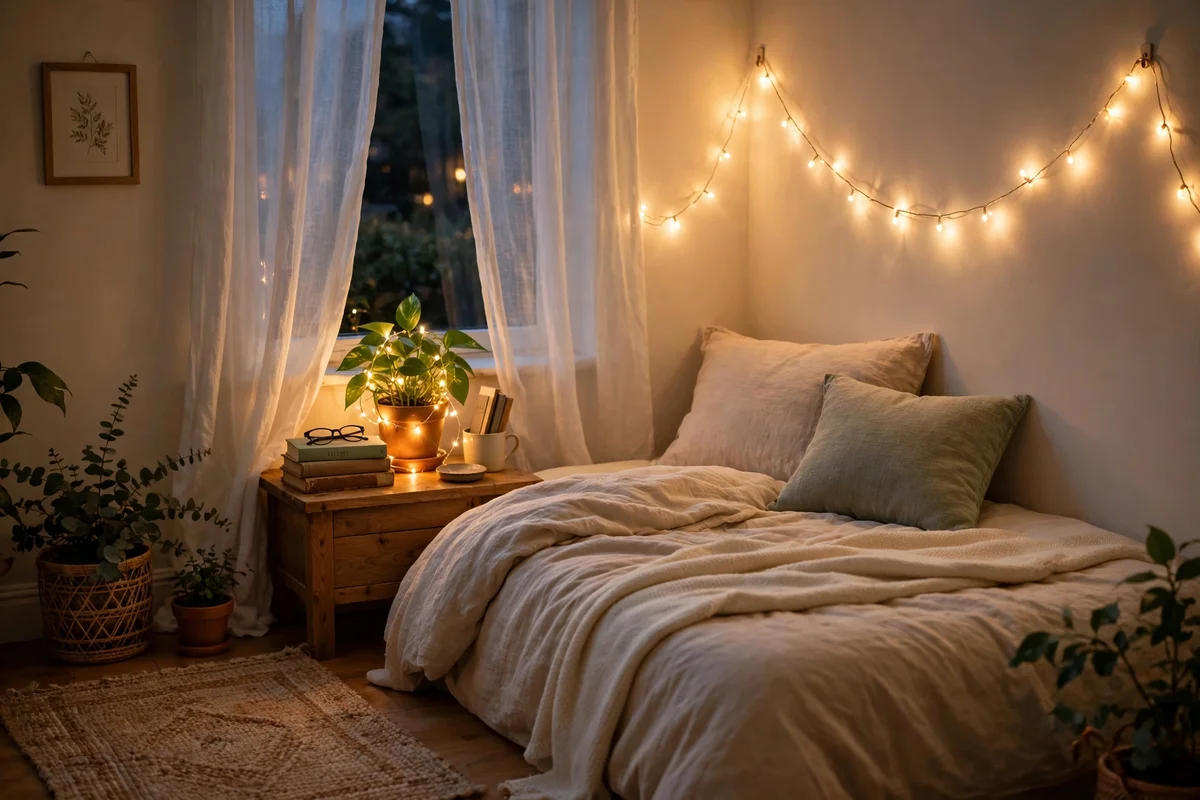
If you do one thing from this list, do this. One strand of warm white string lights draped in a loose swag along the wall above your headboard — or along the headboard itself if you have one — changes a bedroom more than any lamp I’ve ever bought. The light falls softly down the wall behind you, the bed becomes the cosiest spot in the flat, and the whole room glows instead of glaring.
The trick is the drape. Don’t pull the strand tight like a washing line; let it sag gently between two or three hooks, like a smile. Too tight and it looks like a hospital corridor; too loose and it droops onto your pillow. Three small clear hooks, a 3-metre strand, ten minutes. My bedroom lighting ideas cover the rest of the room, but honestly, this one strand does half the work on its own.
2. Drape Them Around the Window Frame
This one I stole from a cafe. The window frame is the best place in a small room for string lights, because the lights frame the view instead of competing with it — and at night, when the window goes dark, the frame becomes the prettiest thing in the room.
Run a single strand around the top and sides of the frame, using clear adhesive clips so the wire disappears against the paint. Warm white only — cool white around a window at night makes the room look like a shopfront. And here’s the part nobody tells you: with sheer curtains in front of the lights, the glow softens and spreads, and the whole window looks like it’s lit from inside the glass. It takes one strand and about fifteen minutes, and it’s the first thing people notice when they walk in.
3. Curtain Lights Behind Sheers (The Full Glow-Up)
Curtain lights — those strands that hang down in a grid, like a waterfall of tiny bulbs — get a bad reputation because people hang them on a bare wall and they look like a bead curtain from the seventies. Hang them behind a sheer curtain instead, and it’s a completely different story.
The sheer fabric diffuses every bulb into a soft, even glow, and the whole window becomes a giant warm lamp. I have these in my living room behind the sheers, and in the evening I don’t turn on the ceiling light at all — the window does the job. One curtain-light panel, a tension rod or two hooks, and the sheer curtain you probably already own. My living room lighting ideas have the rest of the evening setup, but this is the piece guests always ask about.
4. Wrap a Plant or a Branch (The Indoor Tree Trick)
This is the cheapest trick on the list and possibly my favourite. Take a small potted plant — a trailing pothos, a little olive tree, anything with branches — and wind one short strand of fairy lights loosely through it. The leaves catch the light, the shadows go soft and green, and the plant stops being a plant and becomes a feature.
I did this with the pothos on my nightstand: one 2-metre battery strand, wound in a loose spiral, battery pack tucked behind the pot. It takes five minutes and it looks like something out of a boutique hotel. Don’t overdo it — one strand per plant, not three, and if the plant is small, use the tiniest bulbs you can find. A big globe bulb in a small plant looks like a Christmas tree in July.
5. String Lights on the Balcony (The Outdoor Glow)
If you have even a tiny balcony, string lights are the single best thing you can do to it. A small balcony with one strand of warm globe lights strung along the railing goes from “concrete ledge where the bike lives” to “the place I eat dinner every evening in summer.” I’m not exaggerating — I eat out there now, and I never did before.
Use outdoor-rated lights (they’ll say so on the box, and they’re not much more expensive), and hang them with removable hooks or cable ties on the railing — nothing that damages anything, because landlords notice balconies. Battery or solar ones work fine if there’s no socket out there. My balcony decor ideas cover the furniture side of it, but the lights are what make you actually want to sit out there after dark.
6. A Canopy of Lights Over the Bed
This one sounds dramatic and it kind of is, in the best way. Instead of one strand along the headboard, run two or three strands across the ceiling above the bed, from the wall behind you to the wall in front — like a very low, very soft canopy. When you lie down and look up, the whole ceiling glows.
It only works if you keep it disciplined: warm white, evenly spaced, and the strands need to be taut enough not to sag onto your face at 3am. I used clear ceiling hooks — the little adhesive ones — and spaced the strands about 40 cm apart. It cost less than a new duvet cover and my bedroom feels like a tent in the best possible sense. If your ceiling is low, skip this one and stick with the headboard swag; lights two feet from your face are a different experience, and not a good one. My bed ideas cover the low frames and small headboards that leave enough headroom for a canopy of lights without the strands ending up in your face.
7. Along a Shelf or Ledge (Frame What You Own)
A shelf full of books and plants is nice. The same shelf with a single strand of lights tucked along its front edge is the thing people photograph. The lights throw a soft wash down the wall underneath, the objects on the shelf get a warm rim of light, and the whole wall stops being flat.
I have one strand along the shelf above my desk, and it does two jobs at once: it lights the shelf, and it lights the wall below it just enough that I don’t need the overhead light when I’m working late. Battery-powered is the move here — no socket hunt, no wire trailing down the wall. Just tuck the battery pack behind a stack of books and forget about it until the timer switches it off.
8. Globe Bulbs vs Tiny Fairy Bulbs (Scale Matters — I Got This Wrong)
Here’s the thing I learned the expensive way: string lights come in two families, and they do completely different jobs. Tiny fairy lights — the ones on a thin copper wire — are for delicate, close-up work: around a plant, along a shelf, inside a jar. Big globe bulbs — the ones that look like little round cafe lights — are for structure: across a balcony, over a bed, along a ceiling.
I bought globe bulbs for my bookshelf once, and they looked like a row of golf balls. I bought fairy lights for my balcony, and they vanished — you couldn’t see them from inside at all. The rule is simple: if the strand is the decoration, use globes; if the strand is hiding inside something else, use fairy lights. Get it backwards and you’ll wonder why the room looks wrong, and it’ll be the bulbs, not the room.
9. Warm White Only — The One Rule I Won’t Break
I have one non-negotiable rule with string lights, and it’s this: warm white, always. Not cool white, not “daylight,” and — please — not colour-changing rainbow mode, unless it’s a party and the party ends at midnight. Cool white string lights make a small room look like a dentist’s waiting room. Warm white, around 2700K, makes it look like a candlelit cabin.
Every strand I own is the same colour temperature, and that’s not an accident. Mixed colour temperatures — a warm strand on the bed and a cool strand on the window — make a room feel off in a way you can’t quite place, like a photo with the white balance wrong. When you’re buying, check the box for 2700K. If it doesn’t say, and the listing calls it “warm white,” it’s probably right; if it calls it “white,” it’s probably cool, and you’ll be sending it back.
10. Lights in a Jar or a Bottle (The Two-Minute Centrepiece)
Okay, this one is almost too easy to count, but it works every single time. Take a glass jar, a bottle, or a vase you already own. Drop a short battery fairy-light strand inside, tuck the battery pack under the base or behind it, and switch it on. That’s it. You now have a glowing centrepiece that looks like you bought it in a homeware shop.
I have one on my dining table — an old jam jar, a 2-metre strand, done — and it’s the thing that makes an ordinary Tuesday dinner feel like a small occasion. It costs almost nothing, it takes two minutes, and when the batteries die you just swap them. If you want it to look even better, put the jar on a small tray with a candle next to it. The combination of the two lights is absurdly good for something that cost you nothing.
11. String Lights Around a Mirror (Double the Glow for Free)
A mirror on its own bounces light around a small room. A mirror with a strand of lights around its frame bounces twice as much — or at least, it looks like it does, which is what counts. I wrapped a short fairy-light strand around the frame of the round mirror in my hallway, and the hallway — a hallway! — is now the warmest part of the flat.
The trick is keeping the strand tight to the frame so the bulbs sit on the mirror’s edge, not dangling in front of the glass. Clear adhesive clips on the back of the frame hold the wire out of sight, and the battery pack hides behind the mirror. My wall decor ideas cover the mirrors that work best in tiny rooms, and a round one with lights around it is, in my opinion, the best of the lot.
12. The Gallery Wall Glow (Lights That Frame Your Photos)
A gallery wall is a lot of small frames on one wall, and it can look busy — especially in a small room where the wall is doing a lot of work already. One strand of fairy lights woven loosely through the frames, or draped along the top edge of the whole arrangement, ties it together. The lights give the wall a single warm line to follow, and suddenly the frames look like a collection instead of a clutter.
I ran one strand along the top of my gallery wall, with the wire dipping down between two of the frames, and it changed the whole thing. The photos catch the warm light, the wall stops looking like a noticeboard, and in the evening it’s the prettiest wall in the flat. My gallery wall ideas have the layout that works in a small room, and the lights are the finishing touch that makes it look finished.
13. The Reading Nook Glow (One Strand, One Chair, Done)
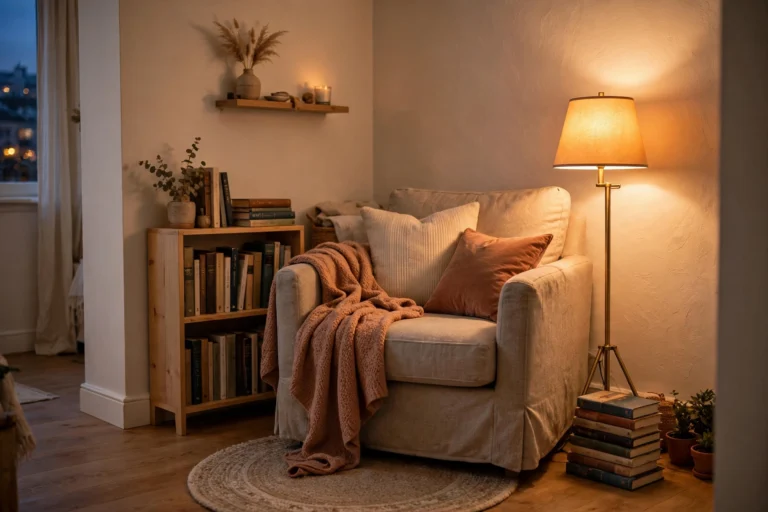
My reading chair sits in a corner that used to be dark by 5pm in winter. A floor lamp helped, but it also took up floor space I didn’t have. Then I ran a single strand of warm lights along the shelf above the chair and down the side of the bookcase next to it, and the corner became a reading nook — a real one, with its own light and its own mood.
The point is that a reading nook doesn’t need a lamp. It needs a pool of warm light at about head height, and a strand on a shelf does exactly that without a base, a cord, or a square foot of floor. If your chair is near a window, one strand around the frame does the same job. Battery-powered, on a timer, so it switches itself on at dusk and off when you’re asleep — which is the closest thing to magic this list gets.
14. Put Them on a Timer (The Move That Makes All the Others Work)
This is the least glamorous idea on the list and the one that matters most. String lights without a timer are lights you forget to switch on, forget to switch off, and eventually stop using because the battery pack is behind a bookshelf and you can’t be bothered. A timer fixes all of it.
Most battery strands now come with a timer built into the battery pack — usually six hours on, eighteen off. Plug-in ones work with a cheap plug timer from any hardware shop. Mine come on at dusk and switch off at midnight, every single day, and I haven’t touched a battery pack in months. It’s the difference between a decoration and a habit. If you buy one thing to go with your string lights, buy the timer — or better, buy the strand that already has one. My general small apartment lighting ideas start with the same principle: the best light in a small flat is the one you don’t have to think about.
Frequently Asked Questions
Are string lights safe to leave on overnight?
LED string lights stay cool and use very little power, so they’re far safer than old-style bulbs — but I still don’t leave mine on overnight or when I’m out. Use the built-in timer so they switch themselves off, keep the strands away from heaters and anything flammable, and check the wire occasionally for damage. If a strand ever feels warm to the touch, stop using it.
Will string lights damage my rental walls?
Not if you hang them properly. Small clear Command hooks and adhesive light clips are made for this and peel off cleanly — I’ve removed them from two flats now with zero paint damage. Avoid nails, staples, drawing pins, and any tape not meant for walls. One hook per metre of strand is about right, and take them down slowly, pulling the tab straight down as the packet says.
What colour temperature looks best for string lights?
Warm white, 2700K, every time. It’s the colour of candlelight and old-fashioned bulbs, and it’s what makes a small room feel cosy instead of clinical. Cool white string lights look harsh and make a room feel like a shop. Keep every strand in the room the same temperature so the light feels consistent.
Can I use string lights on a balcony?
Yes, as long as they’re outdoor-rated — the box will say so. Outdoor strands are sealed against rain and built for temperature changes. Hang them with removable hooks or cable ties on the railing, and use solar or battery ones if there’s no outdoor socket. Bring the battery pack inside in heavy rain if it isn’t sealed.
How do I hide the wire and the battery pack?
Pick strands with thin copper wire — it practically disappears against a wall, especially in warm white. Run the wire along edges, behind frames, and behind plants so you never see a straight diagonal line of it. Tuck the battery pack behind a book, a pot, or a cushion, and use the shortest strand that does the job — a long strand with half of it coiled behind the sofa is the giveaway.
Bottom Line
My flat went from one sad ceiling bulb to a headboard swag, a window frame, a plant with lights in it, and a jar on the dining table — and the total cost was less than one “proper” lamp from a furniture shop. I didn’t rewire anything, drill anything, or ask the landlord for anything. I bought three strands of warm white lights, a packet of clear hooks, and a timer.
Start with one strand, above the bed or around the window, and see what it does to the room at 8pm. That’s the whole test. If it doesn’t make you smile, I’ll eat my words — but I’ve never met a small flat that didn’t get better the moment someone hung a single strand of warm lights in it. Mine did, and I haven’t turned the ceiling light on in the evening since.