14 Small Apartment Rug Ideas That Make Tiny Rooms Feel Bigger (and Warmer)
Here’s my embarrassing rug history: my first apartment had bare floors everywhere, because I was convinced a rug would make the place look smaller. Like, why would I cover up floor space I barely had? Then I visited a friend whose apartment was actually smaller than mine, and hers felt warm, finished, like a real home. The difference was one big rug. I went home, stared at my cold echoey living room, and finally got it — a rug doesn’t eat space. A rug defines it.
Since then I’ve bought the wrong size twice, washed one rug that should never have met a washing machine, and tripped over a curling corner more times than I’ll admit. These 14 ideas are what I wish someone had told me before all that. They’re the ones that actually work in small rooms, not in a furniture showroom the size of a football field.
Quick Answers
- What size rug for a small apartment? Bigger than you think. In a living room, go big enough that the front legs of your sofa and chairs sit on it — a too-small rug is the single most common mistake.
- Should a rug match the floor or contrast it? A little contrast helps. A rug in almost-the-same colour as your floor just disappears; one shade or two away from it, and the room suddenly has shape.
- Best rug if you have pets or kids? Washable, low-pile, and dark enough to forgive a muddy paw. Save the fluffy white one for a home with no living creatures in it.
- Do rugs make a small room look smaller? Only the wrong ones do — tiny floating rugs, or a dark heavy rug jammed into an already dark room. The right size and a lighter colour do the opposite.
1. Go Bigger Than Your Instinct Tells You
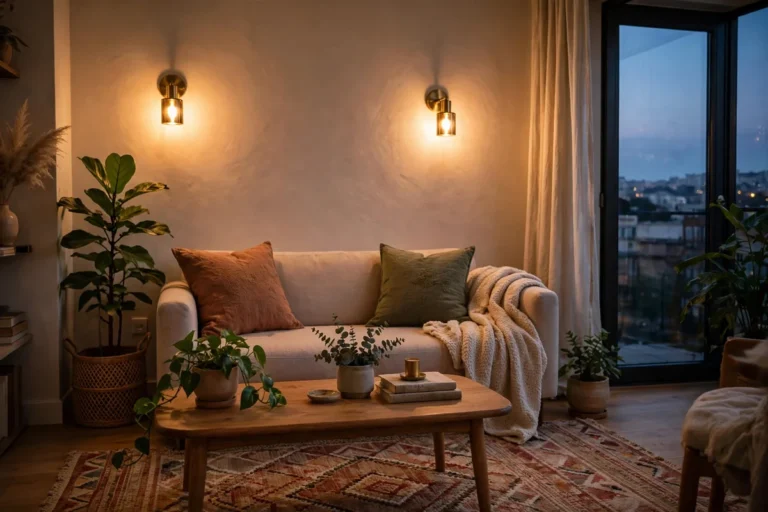
This is the hill I will die on. My first rug was a cute little thing that sat in the middle of the room like a postage stamp, touching no furniture at all, and my living room looked more unfinished with it than without it. Then I sized up — front legs of the sofa on the rug, coffee table fully on it — and the whole room snapped into focus. It looked like a room, not a collection of furniture that happened to be near each other.
- In a living room, the rug should reach under the front legs of every seat around it
- If you’re between sizes, go up — a slightly-too-big rug looks generous, a slightly-too-small one looks like a mistake
- Leave about 15–20 cm of bare floor around the edges so the rug reads as a rug, not wall-to-wall carpet
Yes, bigger costs more. It’s still cheaper than replacing a rug you hate in three months.
2. Let One Rug Do the Zoning
Studio and open-plan apartments have a special problem: everything is one room, so nothing feels like a place. A rug fixes that without a single wall. I put a rug under my sofa and coffee table, and suddenly I had a “living room” — before that it was just the bit of the apartment where the sofa was. Same square metres. Totally different feeling.
- Use a different rug (or no rug) in the next zone, so each area reads separately
- Keep a walkway of bare floor between zones, or the whole place turns into one big carpet
- This trick works for dining corners and reading nooks too, not just living rooms
3. Pick a Light Rug for a Dark Room
I’ll be honest, I love a dark moody rug in theory. In my north-facing living room, in practice, it looked like a hole in the floor. A light rug — cream, soft beige, pale grey — bounced what little light I had back up into the room, and the floor stopped feeling like it was swallowing the furniture. If your room is already bright, you can get away with darker. If it’s not, go light and let the rug do some of the lighting’s job.
- Warm neutrals (oatmeal, sand, warm grey) flatter small rooms better than stark white, which shows everything
- A subtle pattern hides the odd crumb in a way solid white never will
- If your room needs more than a rug to feel brighter, these small living room decor ideas cover the rest of the room too
4. Use a Runner to Rescue a Hallway
Hallways are the most ignored strip of floor in any apartment, and also the one you walk on the most. Mine was bare laminate for a year, loud and cold, and every footstep echoed. A runner changed the whole walk — quieter, warmer, and suddenly the hallway looked intentional instead of like a gap between rooms. It’s the cheapest transformation on this list, and I wish I’d done it first.
- Measure properly: a runner should leave a few centimetres of floor visible on each side, not wall-to-wall
- Low pile is non-negotiable here — thick rugs in a hallway become a trip hazard and a door-jamming nightmare
- If your hallway needs more help than a rug, these small apartment hallway decor ideas pair well with it
5. Layer a Small Rug Over a Big Plain One
Okay, this one sounds fancy, but it’s actually the budget move. A big plain jute or flatweave rug covers the area you need, and then a smaller patterned or softer rug on top adds the personality — and you can swap the top one when you get bored without re-buying the whole thing. I layered a little vintage-style rug over a plain jute base in my bedroom, and guests always ask where the “expensive rug” came from. It’s two cheap ones. Don’t tell them.
- Keep the bottom rug flat and neutral, the top one smaller and more interesting
- A rug pad between the layers stops the top rug from sliding around like it’s trying to escape
- Don’t layer two thick rugs — you’ll be walking uphill in your own living room
6. Put a Soft Rug Beside the Bed (Your Feet Will Thank You)
There is no worse start to a winter morning than bare feet on a cold floor. I lived with it for two winters because I thought bedroom rugs were a luxury, and then I finally put a soft rug on each side of the bed. It’s a small thing. It changed my mornings completely. You step out of bed onto something warm, and the whole room feels like it cares about you, which is a weird thing to say about a rug, but here we are.
- Two runners, one on each side, work better than one rug shoved half under the bed where nobody sees it
- If the bed is against a wall, one runner on the open side is plenty
- More bedroom warmth here: these small bedroom decor ideas go beyond the floor
7. Choose Washable Rugs for Real Life
I learned this the hard way, with a coffee spill on a rug that was, in hindsight, wildly impractical for a person who drinks coffee on the sofa every single morning. Washable rugs have come a long way — they don’t all look like gym mats anymore. If you have pets, kids, a clumsy streak, or just a normal life, a machine-washable rug is not a compromise. It’s the only sane choice, and it means a spill is an annoyance instead of a tragedy.
- Check the washing instructions before you buy, not after the first spill — some “washable” rugs only mean spot-clean
- Low pile dries faster and fits in a normal machine; thick shaggy ones often don’t
- Keep a spare washable rug if you can, so the room isn’t bare while one is in the wash
8. Try a Round Rug to Break Up the Rectangles
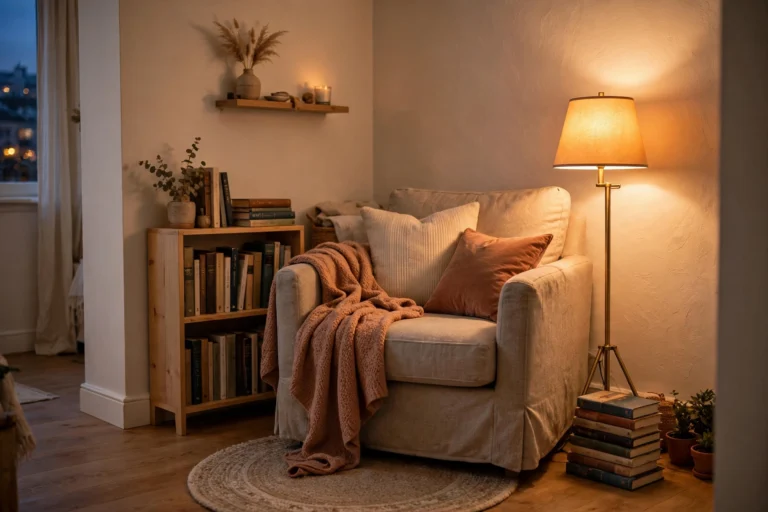
Small apartments are aggressively rectangular. Rectangular rooms, rectangular sofa, rectangular table, rectangular rug — after a while your eye gets bored and doesn’t even know why. A round rug under a round coffee table, or in a reading corner, breaks the pattern in the best way. I put one in my corner chair spot and that corner went from “dead space with a chair in it” to the place everyone sits. Round softens everything around it.
- Round rugs work best in corners and under round tables, not as the main living-room rug
- Make sure the furniture on it is balanced — a chair half-on, half-off a round rug looks drunk
- If that corner needs the full treatment, these small apartment corner decor ideas finish the job
9. Use a Rug to Anchor a Dining Table
A dining table floating on bare floor in a small apartment looks temporary, like you’re about to move out. A rug under it says “this is a dining area, meals happen here.” The catch — and it’s a big one — is that chairs need to stay on the rug when you pull them out, or you’ll be bumping over the edge every single meal. Measure with the chairs pulled out, not pushed in. I measured pushed in. I bumped for a month. Learn from my laziness.
- Add at least 60 cm beyond the table on all sides so pulled-out chairs stay on the rug
- Flatweave or low pile only — chair legs and thick pile are enemies
- Pick something wipeable or washable; food lands on dining rugs, it’s just a fact of life
10. Put a Doormat-Style Rug in the Entryway That Actually Works
Your entryway rug has one job: catch the dirt before it gets to the rest of your apartment. Mine used to be decorative — pretty, useless, and sliding all over the tiles. Then I got a proper coarse, grippy entryway rug with a rubber backing, and the amount of grit reaching my living room rug dropped overnight. Pretty matters less here than grip and dirt-trapping. Your floors will thank you, and so will your vacuum cleaner.
- Rubber or non-slip backing is mandatory on hard floors, or the rug becomes a skating rink
- Coir or a rough textured mat traps dirt far better than a soft decorative rug
- If your entryway is a whole project, these small entryway decor ideas sort the rest of it
11. Don’t Forget a Rug Pad (The Boring Hero)
Nobody gets excited about rug pads. I didn’t, until my rug started bunching up under the coffee table and I nearly went flying across my own living room. A rug pad stops sliding, stops bunching, adds a bit of cushion, and protects your floor underneath. It’s the least glamorous purchase on this list and possibly the most important one. Buy the pad. Your ankles will thank you.
- Felt pads add cushion; rubber-grip pads stop sliding — many do both, get one of those
- A pad also makes a thin rug feel twice as expensive underfoot
- Cut it slightly smaller than the rug so it doesn’t peek out at the edges
12. Keep the Pattern Calm in a Busy Room
Here’s the thing about pattern: in a room that’s already full — patterned cushions, art on the walls, open shelves with stuff everywhere — a loud rug tips the whole thing into chaos. I made this mistake with a bold geometric rug in a room that was already doing a lot, and the room just shouted at me. A calm rug, solid or subtly textured, lets everything else breathe. If your room is minimal and quiet, that’s when a bold rug gets to be the star. Match the rug’s energy to the room’s energy, not to your mood in the shop.
- Busy room = calm rug; quiet room = bold rug is allowed
- One strong pattern per room is a good rule of thumb — rug, curtains, or cushions, pick one
- If you can’t decide, a textured solid (jute, wool, chunky weave) is almost never wrong
13. Use Natural Fibres Where They Make Sense
Jute, sisal, wool, cotton — they each have a personality, and picking the wrong one for the room is how you end up with a rug you resent. Jute looks gorgeous and earthy but hates damp, so keep it out of bathrooms and damp entryways. Wool is warm and durable and the one I’d pick for a bedroom if budget allows. Cotton is soft, washable, and perfect for kitchens and kids’ corners where mess is guaranteed. Match the fibre to the room’s real life, not just the photo in your head.
- Jute/sisal: living rooms and bedrooms, dry areas only, lovely texture
- Wool: bedrooms and living rooms, warm, durable, worth the price if you can stretch to it
- Cotton: kitchens, kids’ spaces, anywhere washability beats luxury
14. Rotate and Rest Your Rugs (Yes, Really)
Last one, and it’s the one nobody does until their rug has a permanent dent shaped like a sofa leg. Sunlight fades one side, foot traffic wears one path, and furniture leaves dents that become permanent if you never move anything. Rotating a rug every few months evens all of that out, and honestly it also makes the room feel slightly different, which is a free refresh. I rotate mine when the seasons change — it’s on my calendar now, next to “clean the oven,” which tells you how seriously I take it, but the rug genuinely lasts longer.
- Rotate 180 degrees every 3–6 months, more often in a sunny room
- Move furniture a few centimetres when you rotate, so dents don’t just form in a new spot
- Vacuum both sides occasionally — the underside collects more dust than you’d think
FAQ
What size rug should I get for a small living room?
Big enough for the front legs of your sofa and chairs to sit on it. In most small living rooms that’s around 160×230 cm, but measure your seating area — the furniture decides the size, not the room’s dimensions alone.
Can I put a rug on carpet?
Yes, and it works well for defining a zone on wall-to-wall carpet. Use a low-pile rug and a proper rug pad, or it will bunch and slide. Keep the top rug’s pattern calm so the layers don’t fight each other.
Are washable rugs actually good quality?
The good ones are. Look for low pile, a non-slip backing, and clear machine-wash instructions — not just “easy clean.” The best washable rugs survive dozens of washes; the bad ones go lumpy after two.
How do I stop a rug from sliding on hard floors?
A rug pad with grip, or a non-slip backing on the rug itself. Tape and grippers help as a backup, but a proper pad is the fix that actually lasts, and it protects your floor too.
Bottom Line
My apartment didn’t get bigger when I finally got rugs right. It got warmer, quieter, and a lot more like a home — and the rooms stopped looking like furniture waiting for someone to live in them. Start with the living room rug, and get it bigger than you think you need. That’s the one purchase that changes everything else. Then do the hallway runner, because you’ll wonder why you walked on bare floor for so long. The rest — the layering, the round rug in the corner, the washable one for real life — you can add as you go. Just don’t buy the postage-stamp rug. I did, twice, and I’m still slightly annoyed about it.