14 Small Apartment LED Strip Light Ideas That Make a Tiny Room Glow
Here’s a confession: I bought my first LED strip on a whim, stuck it behind my TV, and then stood there in the dark like an idiot, genuinely surprised at how different my living room looked. One thin line of light — maybe twelve pounds, maybe fifteen minutes of my evening — and suddenly my flat didn’t look like a box with furniture in it. It looked like a place someone actually lived in on purpose.
That was three years ago. Since then I’ve stuck LED strips in places I’m almost embarrassed to admit — under the kitchen cabinets, along the back of my wardrobe, behind the headboard, inside a bookshelf — and I’ve learned which spots make a small apartment glow and which ones make it look like a nightclub that lost its licence. These 14 small apartment LED strip light ideas are the ones that survived. No wiring, no electrician, nothing your landlord can complain about.
Quick Answers
- Are LED strip lights safe in a small apartment? Yes — the LED strips themselves run cool and use very little power, which is why they’re fine in small rooms. The thing to watch is the power supply: buy a decent branded one, don’t overload a cheap adapter, and never trap a strip against something that gets hot, like a radiator or a hob. Stick them to clean, dry surfaces and they’ll stay put for years.
- Do LED strips damage walls in a rental? Not if you stick them to the right surface. The adhesive backing is fine on painted wood, metal, and the underside of shelves and cabinets — places where nobody sees the strip itself anyway. On painted walls it can pull paint when you peel it off, so use the strip’s own adhesive only on hidden spots, and use removable mounting clips or Command strips anywhere visible.
- Warm white or colour-changing strips? Warm white, every time, for a small apartment. Colour-changing strips are fun for about a week and then you end up leaving them on warm white anyway — and the warm white on a cheap RGB strip is usually a sickly yellow-green. Buy a dedicated warm white strip (2700K) for the main spots, and keep one colour strip for the fun corner if you really want it.
- How much do LED strips cost to run? Almost nothing. A 5-metre strip uses roughly the same electricity as a single old light bulb, and most people only run a couple of metres at a time. Leaving one behind the TV for a few hours an evening costs pennies a month — genuinely less than the takeaway you’ll order while sitting in front of it.
1. Behind the TV (The One That Started It All)
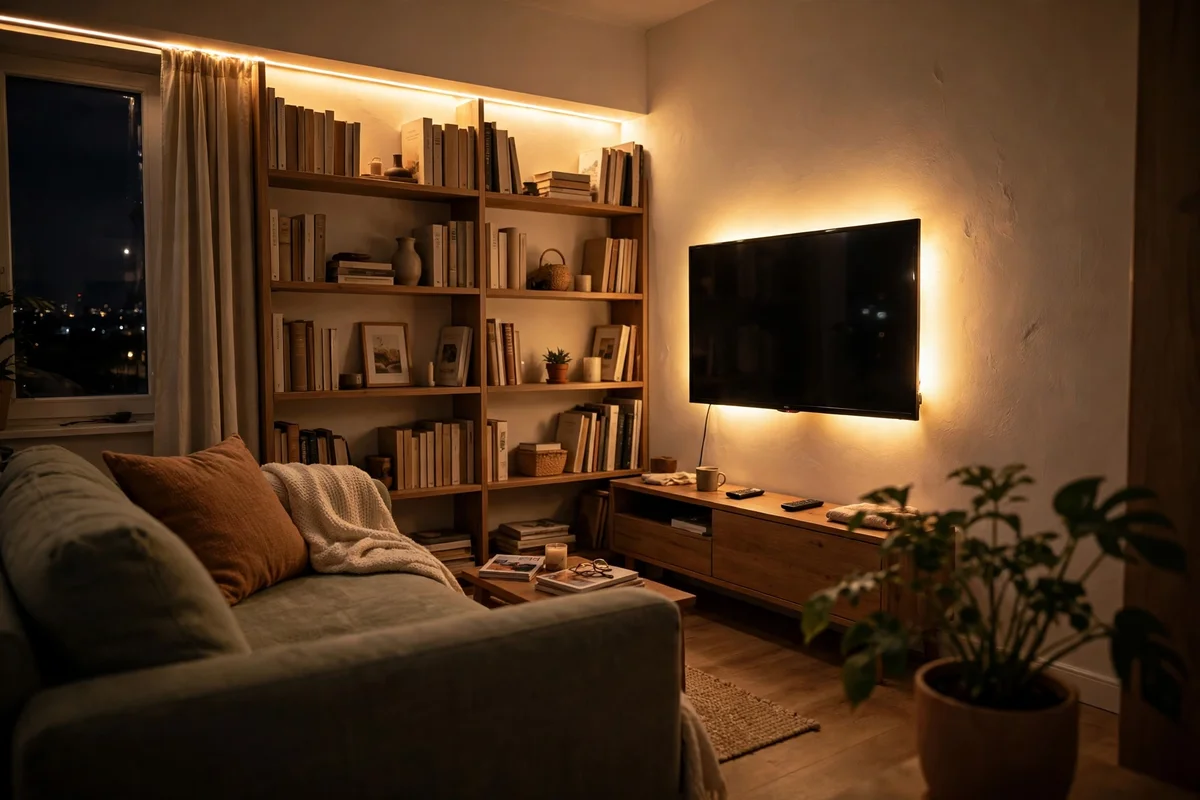
This is where everyone should start, because it’s the easiest win in the whole list. Stick a strip along the back edges of your TV, plug it in, and the wall behind it glows. That’s it. That’s the whole trick — and it makes the TV look bigger, the wall look intentional, and the whole room feel softer at night.
The reason it works is simple: your eyes stop seeing a black rectangle hanging on a wall and start seeing a screen floating in light. It also kills that horrible glare you get watching TV in a dark room, because the wall behind the screen is no longer pitch black. Warm white is the move here — a soft 2700K glow, not blue, not purple. I tried the colour-changing mode once for a film night and spent the whole film distracted by my own wall.
Hide the power cable behind the TV stand and you’re done. Ten minutes, and guests will ask what you did to the room. If you liked the glow idea here, my string light ideas use the same trick in the bedroom, just with a softer, lazier kind of light.
2. Under the Kitchen Cabinets (The Most Useful Strip You’ll Ever Stick)
Forget mood lighting for a second — this one is actually useful. A strip stuck to the underside of your wall cabinets lights up your worktop, and suddenly you can see what you’re chopping instead of working in your own shadow. I lived for two years with a kitchen where the ceiling light was behind me, which meant every evening I was cooking in a silhouette. One strip fixed it.
Use a bright warm white or neutral white here (3000K–4000K), not the cosy dim stuff you use behind the TV — you want to see what you’re doing. Run it along the front edge of the cabinet underside so the light falls forward onto the counter, not back onto the wall. And if your kitchen has a little gap between the top of the cabinets and the ceiling, stick a second strip up there too — it bounces light off the ceiling and makes the whole kitchen feel taller. For more on getting the kitchen right, these small apartment kitchen lighting ideas cover the rest of the room.
3. Along the Top of a Bookshelf (Instant Library Vibes)
A bookshelf with a strip along its top edge is the cheapest way I know to make a room look expensive. The light spills up onto the wall and down across the books, and suddenly your £40 flat-pack shelf looks like something from a boutique hotel. It’s pure theatre and I love it.
The trick is hiding the strip itself. Stick it on the top face of the shelf, set back a centimetre from the front edge, so you see the glow and never the strip. If your shelf is tall, run a strip vertically down one side too — it lights the spines and makes the whole thing look curated, even if half the books are ones you’ve never read. (Mine are. I am not proud. I am also not moving them.)
4. Behind the Headboard (The Bedroom Glow-Up)
If your bedroom has one sad ceiling light — and if you live in a small apartment, it does — a strip behind the headboard is the fix. The light washes up the wall and over the pillows, and the whole bed becomes this warm little cave. It’s the closest thing to a hotel room you’ll get without paying for one.
Keep it warm and dim. This is not the place for bright white; you want the kind of light that makes you sleepy, not the kind that makes you feel like you’re in an office. A strip with a dimmer is worth the extra few pounds here, because full brightness behind a headboard at 11pm is genuinely unpleasant. Pair it with one of these small apartment table lamp ideas on the nightstand and you’ve got a bedroom that actually feels finished.
5. Under the Bed (Yes, Really — It Looks Brilliant)
I know. Under the bed sounds weird. It sounds like something a teenager does. But hear me out: a strip along the underside of the bed frame makes the bed look like it’s floating, and at night it throws this soft pool of light onto the floor that doubles as a night light. You can get up at 3am without switching on the ceiling light and waking yourself up properly.
It works best with a low bed frame and a dark floor, where the contrast is strongest. Use warm white, keep it dim, and stick the strip to the inside of the frame so it’s invisible from standing height — you should only see the glow, never the strip. The first time I did this, my friend walked in and said my bedroom looked like a spaceship. I have decided to take that as a compliment.
6. Inside the Wardrobe (So You Can Actually See Your Clothes)
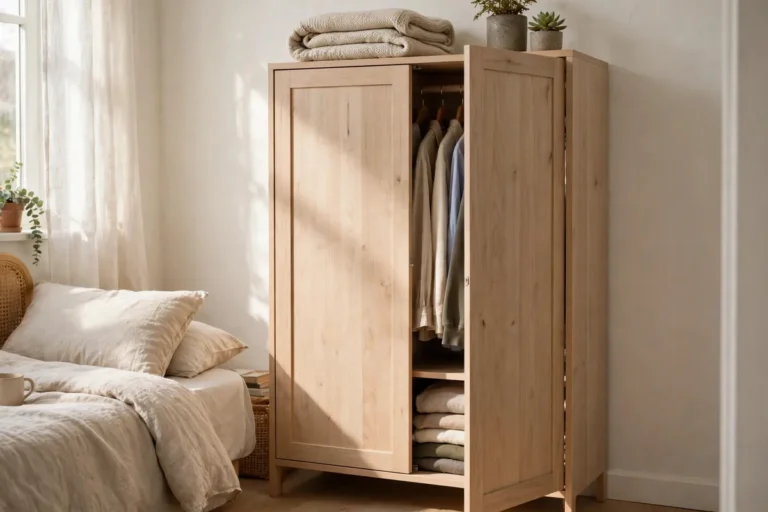
Every small apartment wardrobe has the same problem: the light is in the middle of the room, the wardrobe is against the wall, and the inside of it is a cave. You end up holding jumpers up to the window to check the colour. A strip inside the wardrobe — along the top, or vertically down the sides — ends that.
A battery-powered strip with a motion sensor is perfect here, because it only switches on when you open the door. No wiring, no plug, no cable trailing across the floor. Stick it along the top inside edge and it’ll light the hanging rail; stick a short one vertically and it’ll light the shelves too. For more on making the wardrobe work harder, my bedroom lighting ideas cover the rest of the room.
7. Along the Ceiling Edge (The Fake Cove Light)
This is the one that makes people think you spent money. A strip tucked into the corner where the wall meets the ceiling — or along the top of a picture rail, if your flat has one — throws light up across the ceiling and makes the room feel taller. It’s the same trick fancy hotels use with cove lighting, except yours cost twenty pounds and a Saturday afternoon.
It works best in the living room, where you spend the most time. Run it along one wall only — the wall behind the sofa is usually the best — because all four walls at once is too much and starts looking like a showroom. Warm white, dimmed to about half, is the sweet spot. And here’s the thing nobody tells you: this is the strip that hides every scuff and uneven bit of paint on your ceiling, because the light is indirect. Landlord’s dodgy paint job? Gone. Well — hidden. Same thing.
8. Under Floating Shelves (The Shelf Glow)
Floating shelves already look good in a small apartment. Add a strip underneath each one and they look like they were designed by someone who charges for the privilege. The light pools on whatever’s underneath — the shelf below, the worktop, the desk — and the shelves themselves look like they’re glowing.
This is my favourite spot for strips in the bathroom, where a strip under a shelf above the sink gives you soft light for brushing your teeth without the full horror of the ceiling light at 6am. Keep it short — a 30cm strip is plenty — and use warm white. A little goes a long way here; the whole point is a gentle wash, not a floodlight.
9. Behind the Bathroom Mirror (The Hotel Mirror Trick)
Every hotel bathroom has a backlit mirror and every single one of us has stood in front of one thinking “why doesn’t my bathroom look like this?” The answer is a strip of LEDs stuck to the back of your mirror. That’s the whole secret. Hotels aren’t magic, they just have better lighting.
Stick the strip around the back edges of the mirror — a mirror that’s slightly off the wall works best, so the light has somewhere to spill out. Warm white, not cool white, unless you enjoy looking like you’re under interrogation. It won’t replace your main light for shaving or makeup, but it makes the room feel twice as nice, and at night it’s the perfect low light for a 2am bathroom trip. If your mirror is glued flat to the wall, stick the strip to the wall around it instead — same glow, no gap needed.
10. Along the Staircase or Hallway (The Safety Strip That Looks Good)
If your flat has stairs — a split-level, a maisonette, even just two steps down into the living room — a strip along the edge of each step or along the skirting board is both practical and pretty. It lights the way at night without you fumbling for a switch, and it looks genuinely smart.
In a hallway, run a strip along the top of the skirting board on one side. It throws a low line of light along the floor and makes a narrow hallway feel wider, which is the opposite of what you’d expect but it’s true — the light draws your eye along the space instead of letting it stop at the walls. Motion-sensor strips are ideal here; they switch on when you walk past and off when you don’t. No switch, no thinking, no tripping over the cat.
11. Inside Glass Cabinets and Display Shelves (Make Your Stuff Look Like a Museum)
You know that cabinet where you keep the nice glasses, or the shelf with the plants and the one vase you actually like? A strip inside it turns your stuff into a display. The light bounces off the glass, the shelves glow, and suddenly your £12 vase looks like it belongs in a gallery.
Run the strip vertically down the inside back corner, or along the underside of each shelf if the cabinet is deep. Warm white for ceramics and glass, and keep the strip hidden behind the shelf edge — you want to see the objects glowing, not the strip itself. This is also the best place for your one colour-changing strip, if you insist on having one: a soft amber inside a display cabinet at Christmas looks genuinely lovely, and you can switch it back to warm white on Boxing Day.
12. Around the Desk (The Work-From-Home Upgrade)
If you work from home in a small apartment, your desk is probably in a corner with terrible light. A strip along the back edge of the desk, or under a shelf above it, gives you a pool of light exactly where you need it — on the keyboard, on the notebook, on the screen — without a desk lamp eating half your workspace.
Use neutral white (4000K) here, not warm white: you want to stay awake, not drift off. Stick the strip under the shelf above the desk so the light falls forward onto your work, and if your monitor sits on the desk, a strip behind the monitor does the same eye-strain trick as the TV — the wall behind the screen glows instead of being a black hole. My pendant light ideas cover the bigger statement lighting, but for day-to-day working, this strip does more than any pendant ever will.
13. On the Balcony (Outdoor Glow, Renter-Friendly)
Balconies in small apartments are usually lit by one harsh bulkhead light or nothing at all. A weatherproof strip (look for IP65 on the box — it means it can handle rain) along the balcony railing or under the ledge turns it into an actual evening spot instead of a place you only use in daylight.
Stick it under the top rail so the light washes down the wall, not out into the neighbours’ windows — nobody likes the flat that glows purple at midnight. Warm white again, obviously. A solar-powered strip works if there’s no socket outside, though in my experience they’re dimmer and die by 10pm; a plug-in one run through a window gap (there are flat cables made for exactly this) is steadier. And if your balcony already has string lights, the two together are genuinely lovely — the strip gives the structure, the string lights give the sparkle.
14. The TV Stand and Media Unit (The Finishing Touch)
Last one, and it’s the one that ties the whole room together. A strip along the back of the TV stand, or under the bottom shelf of the media unit, makes the furniture look like it’s floating — same trick as under the bed, same payoff. The light pools on the floor, the cables disappear into the glow, and the whole corner looks intentional instead of “this is where the TV lives because there’s nowhere else to put it.”
Match the colour temperature to the strip behind your TV so the two glows blend into one instead of fighting each other. And hide the power supply — the little white box — behind the unit, because nothing ruins the effect like a glowing white brick on the floor. For the rest of the room, my living room lighting ideas and TV stand ideas will finish the job.
Frequently Asked Questions
How do I hide LED strip lights so you can’t see the strip itself?
Stick the strip on a surface that faces away from where you sit — the back of the TV, the underside of a shelf, the top of a cabinet. The rule is simple: if you can see the strip, it’s in the wrong place. You should only ever see the glow it throws onto the wall or floor. Aluminium channels with a frosted cover are the neatest option if you want a really clean look; they cost a few pounds a metre and make the light perfectly even.
Can I cut LED strips to fit my space?
Yes — almost every strip has little scissor marks printed on it every few centimetres, and you can cut along those lines without breaking it. Measure twice, cut once, and if you need to join two pieces, use clip-on connectors rather than soldering — they’re cheap, they work, and they don’t require you to own a soldering iron or know what one is.
Why do my LED strips keep falling off the wall?
Almost always because the surface was dusty or greasy. Wipe it down with a damp cloth, let it dry completely, and then stick the strip on — the adhesive needs a clean surface to grip. In warm rooms or on textured paint, the factory adhesive gives up eventually; that’s normal. Stick it back with a few small clear mounting clips or a dab of removable mounting tape and it’ll stay put for years.
Do LED strips work with Alexa or Google Home?
Most smart strips do, and it’s genuinely useful — “turn the kitchen lights on” while your hands are covered in flour is a small joy. But honestly, a strip with a little remote control or a simple dimmer switch does 90% of the same job for half the price. Buy smart only for the strips you use every day; the rest can be gloriously dumb.
How long do LED strip lights last?
A decent strip lasts years — the LEDs themselves are rated for tens of thousands of hours, which at a few hours a day is longer than you’ll live in the flat. What fails first is usually the cheap power supply, so if a strip starts flickering or one section goes dim, replace the adapter before you blame the strip. And keep a spare metre or two in a drawer; nothing is more annoying than a gap in the glow because you ran out mid-project.
Bottom Line
LED strips are the closest thing to cheating that small apartment decor has. They’re cheap, they don’t need an electrician, your landlord can’t object to them, and they make every room they touch look like someone thought about it. Start behind the TV — that’s the one that hooks everyone — and then, when you catch yourself eyeing the underside of your kitchen cabinets at 11pm, you’ll know you’re one of us now. If you want the full picture, my small apartment lighting ideas round up everything else that works in a tiny room. The glow is addictive. The only real risk is that you’ll end up sticking a strip somewhere you swore you wouldn’t, and then wondering why you didn’t do it a year ago.