14 Small Apartment TV Wall Ideas That Make a Tiny Living Room Feel Like a Cinema (Without Eating the Wall)
My TV lived on a wobbly stand for two years. Not a nice stand — one of those flat-pack things that leans slightly to the left no matter how many times you tighten it. The cables hung behind it like a crime scene, the remote disappeared into the sofa at least once a week, and every time I watched a film I was staring at a black rectangle floating above a pile of chargers. It worked, technically. It also made my living room look like a storage unit with a sofa in it.
Then a friend came over, looked at my wall, and said the thing nobody had said out loud: “Why is the biggest screen in your flat sitting on the cheapest furniture you own?” Fair point. I wall-mounted the TV that weekend, hid exactly one cable (the rest took a second weekend, let’s be honest), and the room changed completely. Same flat, same sofa, same square footage — but suddenly there was floor space, and the wall looked intentional instead of accidental. These 14 ideas are everything I learned doing it, plus the mistakes I made so you don’t have to.
Quick Answers
- How high should a TV be mounted in a small apartment? Eye level from your sofa — usually the centre of the screen about 42 to 48 inches off the floor. If your neck tilts up, it’s too high; the classic mistake is mounting it like a pub TV.
- Can you wall-mount a TV in a rented apartment? Often yes, with a no-stud mount or a small number of fixings you fill before moving out — but check your lease first, and keep the filler and touch-up paint for move-out day.
- What size TV suits a small living room? Measure your sofa-to-wall distance in feet, then roughly that number in tens of inches works well — 6 feet away, a 55-inch is plenty. Bigger is not better when the screen fills your whole field of vision.
- How do you hide TV cables without drilling? A paintable cable channel, a hollow shelf, or routing them behind a leaning console — all three beat the spaghetti look, and none of them need a drill.
1. Mount it at eye level, not pub height
Here’s the thing nobody tells you until your neck hurts: the TV does not go high. It goes where your eyes already are when you flop onto the sofa. Sit down, look straight ahead, and that’s your centre line. Mine ended up lower than every photo on Pinterest suggested, and it’s the single best decision I made — films feel bigger when you’re not craning up at them, and the wall above the TV stays free for something else. If you’re mounting above a fireplace, honestly, reconsider — or get a pull-down mount, because “above the fireplace” height is how you end up watching everything like you’re in the front row of a cinema.
- Mark the centre with painter’s tape and sit on the sofa before drilling anything
- Leave 6 to 8 inches between the TV and a console below it, so it doesn’t look glued on
- Tilt mounts forgive a slightly high placement; fixed mounts don’t
2. A slim floating shelf instead of a bulky unit
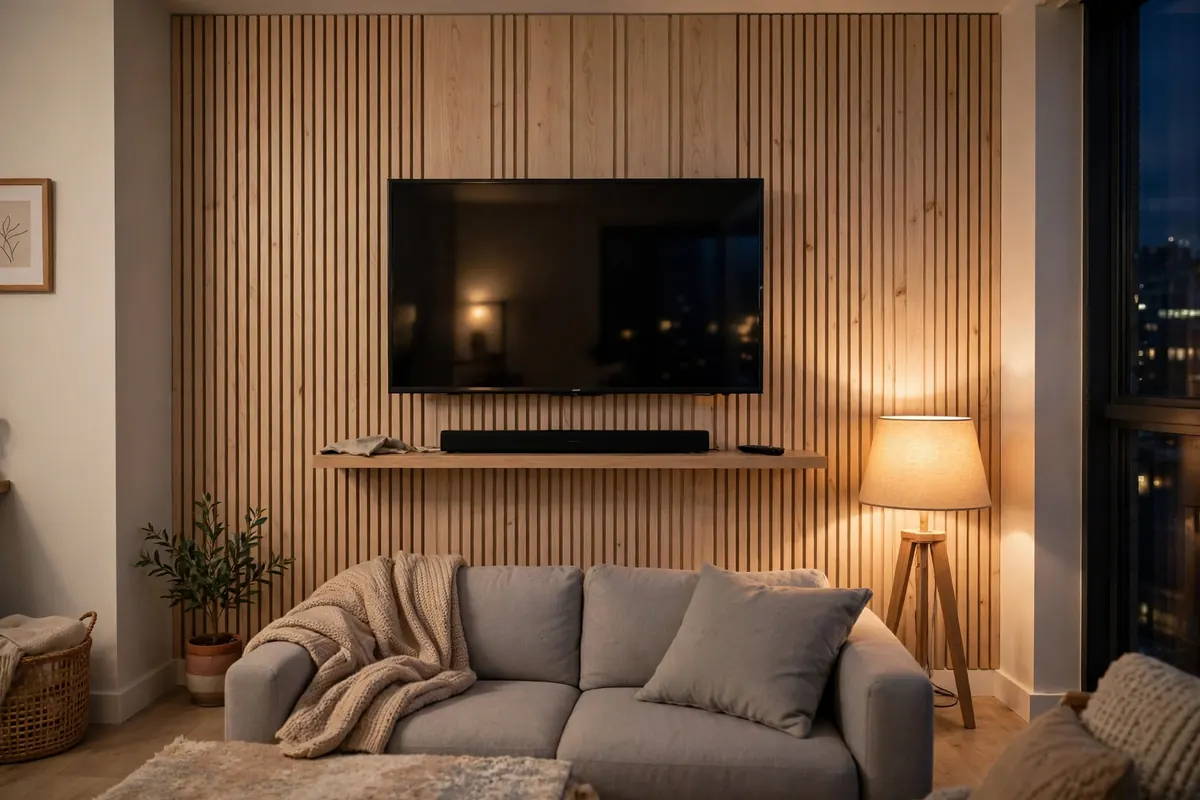
The day I took the old stand out, my living room gained about a square metre of floor. That’s not an exaggeration — that’s what a deep TV unit steals from you. A slim floating shelf under a mounted TV holds the soundbar, the streaming box and one remote, and the floor underneath stays open, which makes the whole room feel bigger. I picked a shelf barely deeper than the soundbar itself, and suddenly the rug could actually be seen instead of disappearing under furniture. The trick is discipline: if the shelf starts collecting candles, books and three remotes you never use, you’ve just rebuilt the clutter at a higher altitude.
3. Hide the cables properly, once, and be done with it
I will confess something: my first cable-hiding attempt was a strip of black tape. It lasted a week and looked worse than the cables. What actually worked was a paintable channel that runs straight down from the TV into the shelf — painted the same colour as the wall, it basically vanishes. If you’re renting and can’t drill, a channel stuck with adhesive strips does the same job, and a hollow floating shelf hides the last bit of mess. Do it once, do it properly, and stop thinking about it forever. Your future self, watching a film without staring at a dangling HDMI cable, will be grateful.
4. A wood slat panel behind the TV
This is the one that makes people ask what changed, because they can’t quite place it. A few vertical wood slats behind the TV turn a blank wall into a feature without taking a single centimetre of floor space. I used lightweight slats stuck to the wall — no framing, no builder, one Saturday afternoon — and the TV suddenly looked mounted on purpose rather than bolted on as an afterthought. Warm wood also softens the big black rectangle when the TV is off, which matters more than you’d think, because the TV is off most of the day and that’s when you’re actually looking at the wall.
5. Paint the wall behind it dark
I was scared of this one. Dark paint in a small room felt like a rule I was breaking. But a single dark accent wall behind the TV does two lovely things: it makes the screen blend in when it’s off, and it makes colours pop when it’s on — like a cinema wall, basically. The rest of the room stays light, so the flat doesn’t feel smaller; it feels like it has a focal point. I went with a deep green, and friends now describe my living room as “the cosy one,” which is a much better review than “the one with the big TV.”
6. Flank it with shelves, not furniture
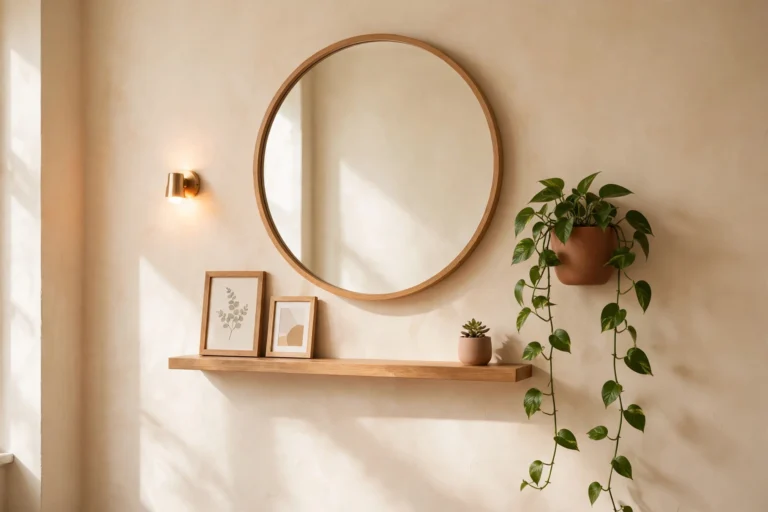
Two narrow floating shelves on either side of the TV — books on one, a plant and a framed photo on the other — and suddenly the TV is part of a wall, not a hole in it. The key word is narrow: chunky bookcases on both sides turn a small room into a corridor. Keep the shelves shallow, keep them uneven on purpose (matching pairs look like a showroom), and leave some empty space. Empty shelf space is what makes a wall look styled instead of stuffed, and it’s free.
7. The corner TV setup that actually works
Corner TVs get a bad reputation because most of them are mounted at a weird angle and watched from one sad chair. But if your room genuinely has no good flat wall — mine didn’t, thanks to a door and a radiator conspiring against me — a corner mount with a swivel arm is a proper solution. Angle it toward the sofa, not toward the middle of nowhere, and put a small plant or floor lamp in the dead corner space underneath so it doesn’t look like a void. Our corner decor ideas cover this in more detail, and the principle is the same: corners aren’t wasted space, they’re just awkward until you give them a job.
8. A console that earns its footprint
If you don’t want to wall-mount — renting, solid concrete walls, or just not feeling like drilling — pick a console that works for its living. Mine has closed doors (cables and consoles vanish), a drawer for remotes and controllers, and legs that lift it off the floor so the rug pattern still shows underneath. Open shelving looks great in photos and becomes a dust museum in real life; doors are the honest choice. And measure twice: a console wider than the TV by a few inches looks balanced, while a tiny stand under a huge TV looks like a hat on the wrong head.
9. Soundbar on the wall, not on the shelf
This sounds fussy until you hear the difference. A soundbar sitting on a shelf fires sound at your knees; mounted just under the TV, it fires it at your ears, and dialogue stops sounding like mumbling. Most soundbars come with wall brackets in the box that nobody uses. Use them. It also frees the shelf for the one streaming box you actually use, instead of a soundbar plus two boxes plus a tangle of remotes fighting for space.
10. Gallery wall around the TV — done lightly
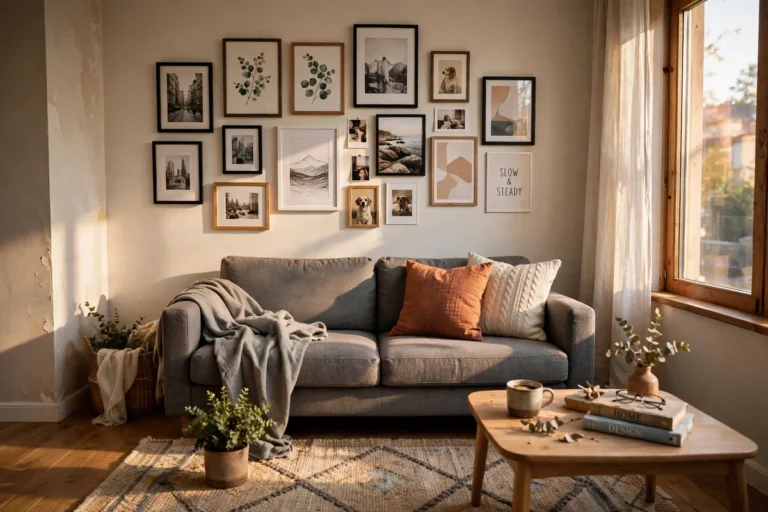
Yes, you can hang art around a TV without it looking like a teenager’s bedroom wall. The rule I learned after one very chaotic attempt: keep the frames small, keep the palette tight, and leave a clear border of empty wall around the screen itself so the TV can breathe. Three or four pieces, not fourteen. The TV is the big rectangle; the art is the supporting cast, not a rival gang. When guests come over now, they notice the prints first and the TV second, which is exactly the right order for a living room.
11. A TV that disappears when it’s off
Some TVs now have an art mode or a frame-style design that shows photos when idle, and honestly, for a small flat this is genius — the biggest black rectangle in the room stops being a black rectangle. If a new TV isn’t in the budget (it wasn’t in mine), the cheap version works nearly as well: a sliding panel, a nice piece of fabric on a rail, or even a large framed print leaned in front of it when you’re not watching. I did the lean-a-print trick for a year and it genuinely changed how the room felt during the day.
12. Backlighting behind the screen
A strip of warm LED light stuck to the back of the TV, glowing softly onto the wall behind it, is the closest thing to a free upgrade I’ve ever bought. It costs less than a takeaway, takes ten minutes to fit, and makes evening films feel like a cinema while reducing eye strain — your eyes aren’t jumping between a bright screen and a dark room anymore. Stick to warm white, though. I tried the rainbow colour-cycle mode once, felt like I was living inside a nightclub, and turned it off within an hour.
13. Match the TV wall to the sofa, not the other way round
People rearrange sofas around TVs; do it the other way. The sofa is where you live — it’s where you read, nap, eat noodles and ignore your phone — so the TV wall should serve the sofa’s position, not dictate it. When I finally picked a sofa that fit the room properly, the TV wall sorted itself out in an afternoon: mount height, viewing distance and angle all fell into place because the seating was right first. If your neck hurts or you’re always sitting at an angle, the sofa is probably in the wrong spot, not the TV.
14. One remote, one box, one less headache
Final idea, and it’s not about the wall at all: simplify what’s plugged into it. I went from four remotes and two boxes to one streaming stick and a universal remote, and the TV wall instantly looked calmer because there was less stuff to hide. Small rooms punish every extra object — every box needs a cable, every cable needs hiding, every remote needs a home. Cut the setup down to what you actually watch, and the whole wall breathes. For more on furniture that pulls double duty in a small flat, our multifunctional furniture ideas are worth a look, and our small living room decor guide ties the whole room together.
FAQ
Is it safe to mount a TV on a plasterboard wall?
Yes, with the right fixings — use fixings rated for your TV’s weight, and find a stud where you can. If you’re unsure, a no-stud mount rated for the weight, or a professional fitting, is money well spent; a TV falling off the wall is a much more expensive problem.
What if my landlord says no drilling?
Go with a console, a leaning shelf unit, or adhesive cable channels — you can get 90 percent of the look without a single hole. Keep the receipt for any removable fixings so move-out day is painless.
Should the TV go above the fireplace?
Only with a pull-down mount, in my opinion. Standard height above a fireplace puts the screen too high for comfortable viewing, and heat isn’t kind to electronics either. If it’s your only wall, pull-down is the honest compromise.
How far should the sofa be from the TV?
Roughly 1.5 to 2.5 times the screen’s diagonal — so a 55-inch TV wants about 7 to 11 feet, but in a small flat, sit where you’re comfortable and don’t overthink the maths. Comfort beats a formula.
Bottom Line
Here’s what two years of a wobbly stand taught me: the TV wall isn’t about the TV. It’s about everything around it — the height, the cables, the floor space underneath, and whether the wall looks like someone thought about it for five minutes. You don’t need a new television or a renovation. Mount it at eye level, hide one cable properly, and give the wall a single intentional detail — a panel, a dark colour, a shelf — and the room stops looking like a storage unit and starts looking like somewhere you actually want to sit. Start with the mount. The rest can wait for next weekend.