14 Small Apartment Gallery Wall Ideas That Make a Tiny Wall Look Like a Gallery
My living room wall was blank for eight months. Not artfully blank. Just… blank. A big white nothing above the sofa that made the whole room feel like a waiting room. Every time I sat down to watch TV, there it was, staring back at me, and every time I thought “I’ll deal with the wall this weekend,” and then I didn’t, because gallery walls looked like something people with actual taste and actual money did.
Then my friend came over, looked at the wall, looked at me, and said “you know you can just put pictures up, right?” So I did. Fifteen dollars of thrift-store frames, some prints I’d been hoarding in a drawer, one Saturday afternoon, and that blank wall became the thing people compliment first when they walk in. Not the sofa. Not the rug. The wall.
Here’s the thing nobody tells you: a gallery wall is the highest-impact, lowest-cost move in a small apartment. It fills a wall without a single piece of furniture, it makes the room feel finished, and it costs less than a takeaway dinner if you do it right. These 14 small apartment gallery wall ideas are the ones that actually work in real, small, rented spaces — no art degree, no landlord fights, no holes you’ll regret.
Quick Answers
- How do I hang a gallery wall without drilling? Picture-hanging command strips rated for the frame’s weight, or lean frames on a picture ledge. Both come off clean when you move out.
- How far apart should gallery wall frames be? Two to three inches between frames. Any tighter and it looks cramped; any wider and it falls apart into random pictures.
- How high should a gallery wall hang? The center of the whole arrangement at about eye level — roughly 57 inches from the floor. Above a sofa, start 6 to 8 inches above the back of the sofa.
- What if my frames don’t match? That’s fine — either commit to all matching frames for a tidy look, or commit to fully mismatched frames for an eclectic one. The awkward middle is what looks messy.
1. Start With One Wall, Not the Whole Apartment
The reason most people never start a gallery wall is they try to plan the whole apartment at once. Don’t. Pick one wall — the one above the sofa, the one you see from the front door, the one that’s been blank since moving day — and just do that one.
One wall done well changes the whole room. It gives your eye somewhere to land, it makes the furniture look intentional, and it gives you the confidence to do the next wall later. Or not. One great gallery wall beats three half-finished ones every time. My first wall took a Saturday. My second wall took another six months, and honestly, the apartment looked finished after the first one.
2. Paper Templates First — Trust Me on This One
Before a single nail or strip touches the wall, trace every frame onto kraft paper or old newspaper, cut the shapes out, and tape them to the wall. Live with the paper version for a day. Move pieces around. Step back. Squint at it from the sofa.
I skipped this step the first time because it sounded fussy, and I ended up with four holes in the wrong places and a frame that hung crooked for a year out of pure spite. The paper trick takes twenty minutes and saves you from every mistake I made. When the paper layout looks right, mark the nail spots through the paper, then hang the real frames one by one.
- Trace each frame, label the paper with what’s inside it
- Painter’s tape holds the paper up without marking the wall
- Photograph the paper layout before you take it down, so you remember the plan
3. One Big Piece, Then Small Friends Around It
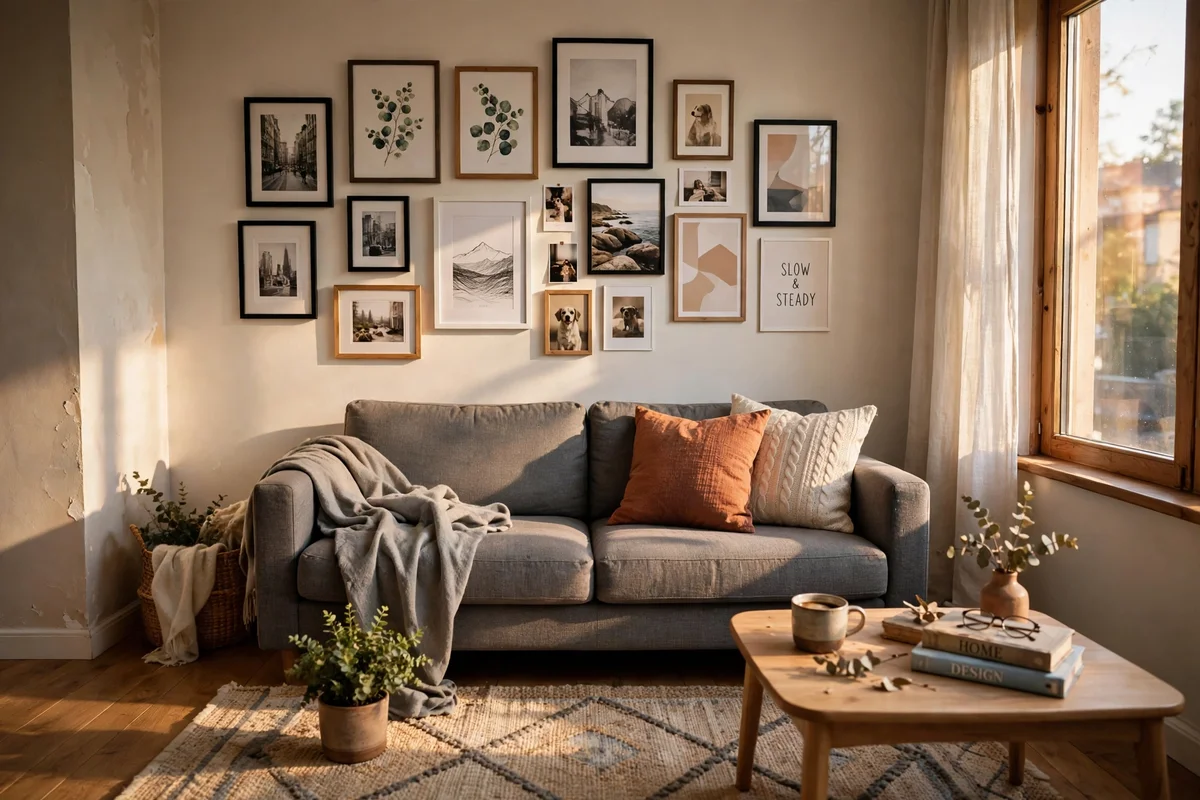
The easiest gallery wall formula ever: one big piece in the middle, smaller pieces orbiting around it. The big piece anchors everything — your eye goes there first, and the small frames feel like they belong instead of floating randomly.
The big piece doesn’t have to be expensive. A large print from a budget shop, a poster in a cheap frame, even a piece of fabric stretched over a canvas. Mine is a $12 print of a coastline that I found in a discount bin, and people assume it’s the expensive part of the wall. It’s not. It’s just the biggest.
4. Same Frames, Different Art
If you want a gallery wall that looks pulled-together with almost no effort, buy identical frames and put completely different art in them. Same frame, same size, same color — the matching frames do all the unifying work, so the art inside can be as chaotic as you like.
This is my go-to advice for anyone who says “I have no eye for this.” You don’t need one. Four matching black frames in a row with four totally unrelated prints looks intentional. Four random frames with four random prints looks like a jumble sale. The frames are the outfit; the art is the personality. If you want the full picture on dressing up bare walls, my small apartment wall decor ideas covers the rest of the tricks.
5. Mismatched Frames on Purpose
Or go the opposite way: deliberately mismatched frames. Thrift-store gold next to plain black next to light wood next to a white frame you painted yourself. It works — but only if you commit to it fully. The trick is variety in the frames but consistency somewhere else: all black-and-white photos, or all prints in the same color family, or all the same subject.
Half-matching is what looks accidental. A wall with three matching frames and one random one looks like you ran out of frames. A wall where nothing matches but the photos are all black and white looks curated. Pick one thing to keep consistent and let everything else run wild.
6. Go Vertical in Narrow Spots
Small apartments are full of skinny, awkward walls — the strip beside the front door, the bit of wall between the kitchen and the hallway, the narrow space next to a window. A horizontal gallery wall won’t fit there. A vertical one will, and it looks incredible.
Stack three or four frames in a single column, same width, two inches apart, running floor to ceiling. It draws the eye up, makes the ceiling feel higher, and turns a dead strip of wall into a feature. I have a vertical stack of four prints in my hallway and it’s the most-photographed corner of my apartment, which is ridiculous because it’s a hallway, but there it is.
7. The Picture Ledge Gallery (Zero Holes, Total Flexibility)
If the thought of committing to nail holes makes you sweat, get a picture ledge. It’s a narrow shelf that mounts with two screws — or even heavy-duty strips — and you just lean frames on it. Swap the art whenever you want, layer frames in front of each other, add a small plant or a candle at the end.
This is the gallery wall for commitment-phobes and renters, and honestly, it’s the one I wish I’d started with. I rearrange my ledge every few months when I get bored, and it takes five minutes. Try doing that with forty nail holes.
- Two or three ledges stacked gives you a full gallery wall with almost no holes
- Lean the biggest frame at the back, smaller ones in front, slightly overlapping
- A ledge above the sofa or the bed works exactly like a hung gallery wall, minus the regret
8. Mix Photos With Other Stuff
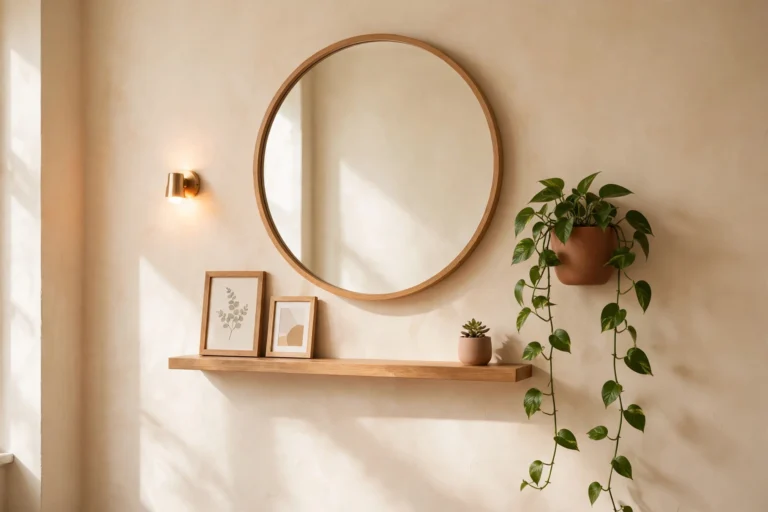
A gallery wall doesn’t have to be all pictures. Some of the best ones I’ve seen mix in a small mirror, a woven basket, a decorative plate, a hat, a wall hanging. The non-frame pieces break up the grid and make the wall feel collected over time instead of bought in one afternoon.
The rule is the same as with mismatched frames: keep one thing consistent. If the frames are all black and rectangular, a round mirror and a round basket still fit, because the color ties them in. One odd piece is a statement. Five odd pieces with nothing in common is clutter. Speaking of mirrors, my small apartment mirror ideas has a whole section on using them to bounce light around a small room — and a mirror inside a gallery wall does exactly that.
9. Black-and-White Photos Fix Everything
If your prints clash, your frames don’t match, and the whole thing feels chaotic, convert the photos to black and white. I’m serious. Black-and-white is the great unifier — suddenly a phone photo from 2019, a postcard, and a proper art print all look like they belong together.
Print them at home or at a cheap print shop, keep them all the same tone — warm black-and-white or cool, not mixed — and the wall instantly looks like someone who knows what they’re doing lives here. It did for me, anyway, and I very much did not know what I was doing.
10. The Grid — For People Who Like Things Tidy
Not everyone wants the organic, salon-style jumble. Some of us want a grid. Same-size frames, equal spacing, straight lines — a 3-by-3 or 2-by-4 grid of identical frames looks calm, orderly, and honestly kind of expensive.
The grid works best above a sofa or a bed, where the furniture below gives it a frame of reference. Measure carefully — the grid only looks good if the spacing is genuinely even, so use a level and a tape measure and don’t eyeball it. Two inches apart, every time. My grid is nine frames above my bed and it’s the tidiest thing in my apartment, which isn’t saying much, but visitors think I’m a very organized person now.
11. Build It on the Floor First
Here’s the unglamorous truth about my first gallery wall: I laid it all out on the living room floor before anything went on the wall. Every frame, face up, arranged and rearranged until it looked right, then I took a photo of the floor arrangement and copied it onto the wall one frame at a time.
It felt silly. It worked perfectly. The floor doesn’t care if you move things twelve times, and you can see the whole arrangement at once without craning your neck. Do this especially if your gallery wall has more than six pieces — above that number, planning in your head stops working and the floor saves you.
12. The Above-the-Bed Gallery Wall
The wall above the bed is the most underused wall in a small apartment. A headboard fills some of it, but the space above the headboard usually sits empty, and a gallery wall there makes the whole bedroom feel designed instead of just slept in.
Keep it calm — this is where you sleep. Three to five pieces, a simple color palette, nothing too loud. Hang the bottom of the arrangement about 6 inches above the headboard so it reads as one unit, not a floating collection. And keep the frames light, because the last thing you want is a heavy frame above your head. Command strips are your friend here — no drilling above a bed, ever, if you can avoid it. If the bedroom needs a fuller rethink, my small bedroom decor ideas has the rest of it.
13. Tiny Gallery Walls Count Too
A gallery wall doesn’t have to cover half the room. Three small frames in a bathroom, two prints in a hallway nook, a pair of frames flanking a mirror — small clusters count, and in a tiny apartment they’re often the right scale.
My smallest gallery wall is three 5×7 frames in the hallway, and people notice it more than the big one in the living room, probably because it’s at eye level and you can’t walk past it without looking. Small walls deserve art too. Don’t save all your good prints for the big wall and leave the little corners bare.
14. The $40 Gallery Wall Formula (My Actual Formula)
If you take nothing else from this article, take this: a gallery wall costs less than a dinner out if you build it the scrappy way. Here’s the formula that worked in my apartment.
- Thrift-store or discount frames, 6 to 9 of them, mixed sizes — about $15 to $20 total if you hunt a bit
- Free printables or cheap prints from a budget shop, or your own photos printed at a drugstore — about $10
- A pack of picture-hanging strips and a roll of kraft paper for templates — about $8
That’s it. Three shopping trips, one Saturday afternoon, forty-ish dollars, and the blank wall that stared at me for eight months is now the best thing in the room. My living room went from waiting-room white to actually feeling like mine, and the only thing I bought new was the strips. If the budget is tight across the whole apartment, my small apartment decorating ideas on a budget piece has the rest of the cheap wins — and my small apartment rug ideas covers the other half of making the floor match the walls. If you want the wall to work with the rest of the room instead of fighting it, my small living room decor ideas ties it all together.
FAQ
How many frames do I need for a small apartment gallery wall?
Three is the minimum for it to read as a gallery wall — one frame is just a picture. Five to nine frames is the sweet spot for a small apartment: enough to feel full without overwhelming a small wall. Above a sofa, aim for the arrangement to span about two-thirds of the sofa’s width.
Can renters hang a gallery wall without drilling?
Yes. Picture-hanging command strips hold most frames up to several pounds each — check the weight rating on the pack. For heavier frames, use a picture ledge mounted with heavy-duty strips, or lean frames on furniture. Your deposit stays safe as long as you use strips rated for the weight and remove them properly.
How do I plan a gallery wall layout without making extra holes?
Trace each frame onto kraft paper, cut the shapes out, and tape them to the wall with painter’s tape. Rearrange the paper until the layout looks right, then mark the hanging points through the paper. You get the whole plan with zero holes.
What size frames work best in a small room?
A mix of sizes works better than all one size — one large anchor piece (16×20 or bigger) with medium (11×14, 8×10) and small (5×7) frames around it. If you prefer a tidy look, identical 8×10 or 11×14 frames in a grid are the safest bet.
How do I keep a gallery wall from looking cluttered?
Keep two to three inches of space between frames, stick to one consistent element — same frame color, same photo tone, or same subject — and leave some breathing room around the edges of the arrangement. If it still feels busy, remove one piece; a gallery wall with one piece too few looks better than one with one piece too many.
Bottom Line
A gallery wall is the cheapest way to make a small apartment feel like yours. It costs less than a takeaway dinner, it needs no landlord permission, and it turns the blank wall you’ve been ignoring into the first thing people notice when they walk in.
Start with one wall. Trace the frames on paper, pick one thing to keep consistent, and hang the big piece first. Live with it for a week — I guarantee you’ll be planning the next wall by the weekend. My wall sat blank for eight months because I thought gallery walls were for other people. They’re not. They’re for anyone with a blank wall, a few frames, and a Saturday afternoon. That was me. It can be you too.