14 Small Apartment TV Stand Ideas That Actually Earn Their Floor Space
Here’s the thing nobody tells you when you move into a small apartment: the TV stand is the piece of furniture you’ll stare at the most and think about the least. It’s just… there. Holding the telly, collecting dust, and quietly hoarding a tangle of cables behind it like some kind of electronic spaghetti monster. I lived with a TV balanced on a wobbly old dresser for my first year in my flat, and every time I walked past it I thought, “I should fix this.” It took the dresser nearly tipping over — don’t ask — for me to finally admit the TV needed a proper home.
A good TV stand in a small apartment isn’t just a table for the telly. It’s the thing that hides the router, the console, the remotes, the DVDs nobody watches anymore, and the charging cables for three different devices. And it has to do all of that in about a metre of wall, without making the room feel like a showroom. These 14 ideas are the ones that actually held up in real flats where the sofa is two metres from the screen and the “media centre” is a shelf and a prayer.
Quick Answers
- What size TV stand fits a small apartment? For a 43–55 inch TV, look for a stand 110–140 cm wide, 35–40 cm deep, and 45–55 cm tall. The stand should be at least 10 cm wider than the TV on each side, and the screen’s centre should sit at eye level when you’re on the sofa — about 100–110 cm from the floor.
- Should I wall-mount the TV or use a stand in a small apartment? A stand wins if you rent or rearrange often — no holes, no landlord conversations, and you can move the whole setup in ten minutes. Wall-mounting wins if floor space is genuinely scarce, but you lose the storage a stand gives you, so most small flats are better off with a stand.
- How do I hide cables behind a TV stand? Run them through the stand’s cable holes, bundle them with velcro ties (not zip ties — you’ll change something within a month), and stick a cable channel or a simple fabric sleeve down the back. A power strip with a short cord inside the cabinet keeps the plug mess out of sight entirely.
1. The Low and Wide Classic (The One That Just Works)
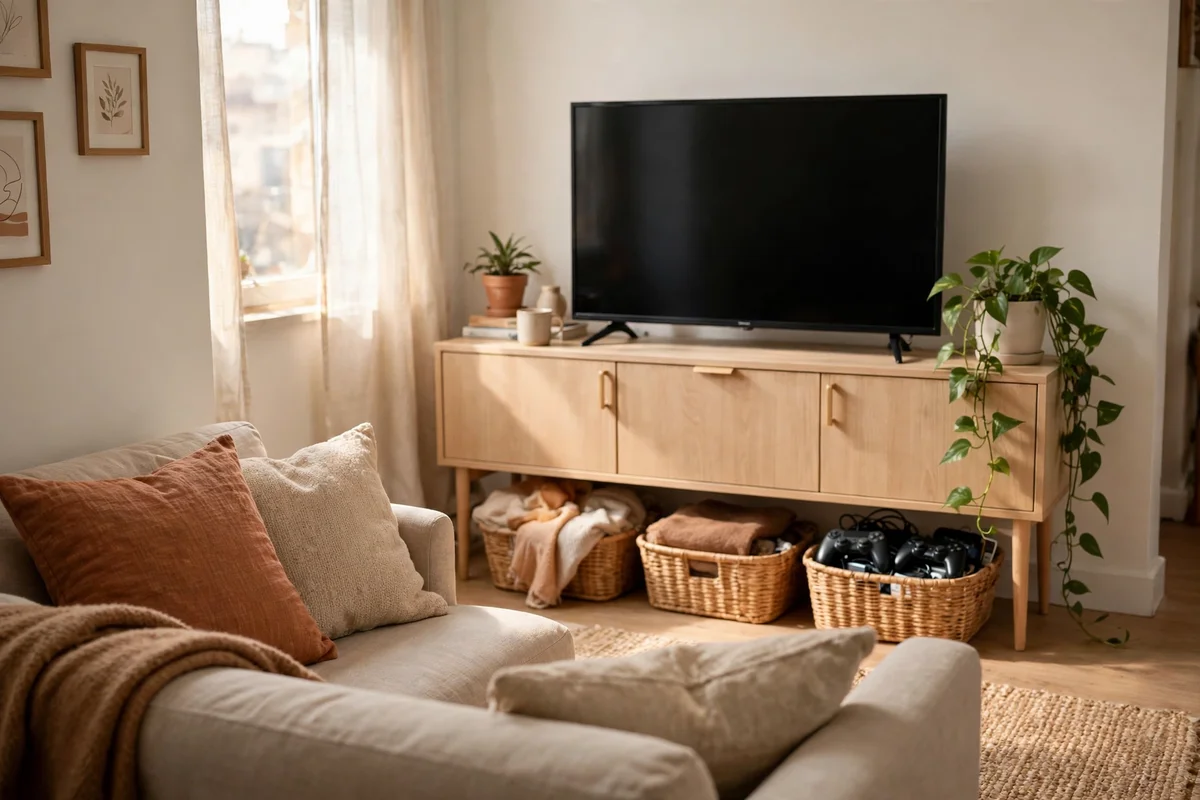
Start with the obvious one, because it’s obvious for a reason. A low, wide stand — about 120 cm across, no taller than your knee — fits under almost any TV, keeps the screen at the right height, and gives you two or three closed cupboards for everything you don’t want to look at. Mine holds the console, the router, the remotes, and a drawer of cables I refuse to throw away because “one of these is probably important.” If your TV is currently sitting on something that was never meant to be a TV stand, my small apartment TV wall ideas will help with the wall around it, but honestly, a proper low stand might fix half the problem on its own.
2. The Stand With Closed Doors (Because Nobody Needs to See the Router)
Open shelves look great in photos. In real life, open shelves behind a TV show every cable, every blinking light, and every dusty box you’ve ever owned. Closed doors change everything. The router hides, the console hides, the tangle of chargers hides, and all anyone sees is a tidy piece of furniture with a TV on top. It’s the same thinking behind my 20 clever storage solutions for small apartments — in a small flat, closed storage beats open display for the stuff that’s ugly but necessary. Leave the pretty stuff on top, hide the rest behind doors.
3. The Floating Stand (Floor Space You Can Actually See)
A wall-mounted floating stand is the closest thing to magic in a small living room. It holds the TV and the boxes, and underneath it there’s… nothing. Just floor. You can see the floorboards, the robot vacuum can get under it, and the room feels bigger because your eyes keep travelling past it. The catch is the fixing: it needs proper wall plugs and ideally a stud or a solid wall, so check what’s behind the plaster before you drill. Renters, ask first — or skip to the freestanding options below, because a floating stand that’s falling off the wall is worse than no stand at all.
4. The Stand That Doubles as a Room Divider
In a studio, the TV stand can do a job nobody talks about: it can split the room. Put a low, long stand back-to-back with the sofa and suddenly you’ve got a living room on one side and a sleeping area on the other, with the TV facing the sofa and the back of the stand facing the bed. The back of the stand becomes a shelf for books or a plant, and the room feels like two rooms instead of one big one. It only works if the stand is low — anything above waist height blocks the light and makes the flat feel chopped up. Keep it low, keep it long, and let the furniture do the dividing.
5. The Corner Stand (For the Awkward Corner Nobody Uses)
Every small flat has one: a corner where the sofa doesn’t quite fit and nothing else goes. A triangular corner TV stand turns that dead space into the TV’s home, angles the screen towards the sofa, and frees up the whole long wall for something else — a bookshelf, a desk, a plant that finally gets some light. The screen sits at a diagonal, which feels odd for about a day and then feels completely normal. Just measure the corner properly, because a stand that’s too deep will stick out and you’ll be bruising your shins on it at 2 a.m. Ask me how I know.
6. The Stand With a Fireplace Slot (Cozy Without the Chimney)
Okay, this one is a little bit extra, and I love it. Some TV stands come with a built-in electric fireplace — a little glowing panel under the TV that throws out heat and makes the whole room feel like a cabin in December. In a small flat it does two things at once: it’s the TV stand and it’s the heater, which means one less appliance taking up floor space. The flame effect is fake, obviously, but on a cold evening with the lights low, nobody cares. If your flat runs cold in winter, this is the stand that earns its keep twice.
7. The Narrow Stand for the Wall That’s Barely a Wall
Some living rooms have a TV wall that’s really just a strip of wall between a door and a window — maybe 90 cm wide, if you’re lucky. A narrow stand, 80–100 cm across, is made for exactly that spot. It holds a 43-inch TV without a centimetre to spare, the shelves underneath hold the one console and the one box that matters, and the rest of the room stays free. Don’t try to squeeze a wide stand into a narrow wall — the overhang looks wrong and you’ll catch your hip on it every single day. Measure the wall, then buy the stand that fits it, not the one you wish would fit.
8. The Stand With Drawers (For People Who Hate Open Shelves)
Drawers are the underrated heroes of TV stands. A drawer holds the remotes, the controllers, the batteries, the instruction manuals, and the HDMI cable you bought in 2019 and have never used — all of it out of sight, all of it reachable in two seconds. Open shelves show everything; drawers hide everything. And in a small living room, where the TV stand is in your eyeline every single evening, hiding everything is worth a lot. One drawer per category, no digging, no mess. If your living room always looks cluttered no matter how much you tidy, my small living room decor ideas have more fixes, but the drawers are where I’d start.
9. The Ladder Shelf Stand (Storage That Goes Up, Not Out)
When the floor is full, the only way left is up. A TV stand with ladder shelving on the sides — or a low stand with tall open shelves flanking the TV — gives you display space for books, plants, and the nice things, without taking another centimetre of floor. The TV sits in the middle, the shelves climb up either side, and suddenly the wall looks designed instead of empty. Keep the shelves light, though: a ladder shelf loaded with heavy books on a small stand is a tipping risk, and the whole point is that it looks airy, not like a warehouse.
10. The Repurposed Dresser (The Stand That Wasn’t a Stand)
Here’s the one that saves the most money: a low, wide dresser makes a brilliant TV stand. It’s already got drawers, it’s already the right height, and second-hand ones are everywhere for a fraction of what a “TV stand” costs. I bought a solid wood dresser at a charity shop for less than a takeaway, put the TV on top, and the drawers swallowed the console, the games, the DVDs, and the cables. The only rule is the width — the dresser needs to be wider than the TV, or the screen overhangs and it looks like it’s about to fall. If it’s sturdy, it’s a TV stand. Don’t overthink the label.
11. The Stand With a Soundbar Shelf (Because the Soundbar Has to Go Somewhere)
Soundbars are the awkward houseguests of small flats: too wide for a shelf, too low for the wall, and always in the way. A TV stand with a dedicated soundbar shelf — a shallow slot just under the TV, or a raised top shelf — solves it in one move. The soundbar sits at the perfect height, the cables run straight down into the cabinet, and you don’t lose a whole shelf to a long black rectangle. If you’re buying a stand and you already own a soundbar, measure the soundbar first and buy the stand that fits it. The other way round ends in tears and a soundbar balanced on a stack of books.
12. The Minimalist Slab (For Flats Where Less Is the Whole Point)
Some people don’t want cupboards, drawers, or shelves. They want a slab — a clean, low bench of wood or matte black, just big enough for the TV and one small box, and nothing else. And honestly, in a very small flat, that can be the right call. A slab stand takes up almost no visual space, it doesn’t fight with the rest of the room, and it forces you to keep the media clutter to a minimum because there’s literally nowhere to hide it. The trade-off is real: you lose storage. But if your console lives in a drawer somewhere else and you stream everything, a slab might be all you need. It’s the same logic as my small apartment multifunctional furniture ideas — the best piece is the one that fits how you actually live, not the one with the most compartments.
13. The Stand on Wheels (For People Who Rearrange Monthly)
I rearrange my living room roughly every three months. I know, it’s a problem. A TV stand on castor wheels is the only reason this habit hasn’t ended in a ruined floor or a dropped television. Wheels mean you can pull the whole setup out to clean behind it, angle the TV towards the dining table for a film night, or shove it against the wall when guests come over. Get locking wheels, though — a TV stand that rolls when you bump it is a disaster with a remote control. And if the wheels make the stand too tall, take them off and use felt pads instead. The point is the flexibility, not the wheels themselves.
14. The Rule That Keeps Every TV Stand Working (Cables In, Clutter Out)
If every stand in this list has one thing in common, it’s this: a TV stand only looks good if what’s behind it is under control. The moment the cables spill out the back and the shelves fill up with things that have nothing to do with the TV, the stand stops being furniture and becomes a junk pile with a screen on top. So here’s the rule: every cable goes through a hole, every device has a home, and once a year you pull the stand out, dust behind it, and throw away the cables that belong to devices you no longer own. I did this last month and found four chargers for phones I haven’t had since 2021. Four. The stand has looked better ever since.
FAQ
What size TV stand do I need for a small apartment?
For a 43–55 inch TV, look for a stand 110–140 cm wide, 35–40 cm deep, and 45–55 cm tall — at least 10 cm wider than the TV on each side, with the screen’s centre about 100–110 cm off the floor when you’re sitting on the sofa.
Can I put a TV stand in a rented apartment?
Yes — a freestanding stand needs no fixings at all, which makes it one of the most renter-friendly pieces of furniture there is. Only wall-mounted or floating stands need screws, so check your tenancy agreement before drilling anything.
How do I hide the cables behind my TV stand?
Run them through the stand’s cable holes, bundle them with velcro ties, and use a cable channel or fabric sleeve down the back. A short-cord power strip inside the cabinet keeps the plug mess out of sight completely.
Should the TV stand be wider than the TV?
Yes — at least 10 cm wider on each side. A stand narrower than the TV looks unstable and genuinely is less stable, especially if anyone bumps into it in a small room.
What do I do with the space under a floating TV stand?
Leave it empty, or use it for one low basket of blankets. The whole point of a floating stand is the visible floor underneath, so don’t fill it with clutter — that defeats the purpose. If you need the storage, my small apartment console table ideas have slimmer options that keep the floor clear.
Bottom Line
A TV stand in a small apartment isn’t just a table for the telly — it’s the piece of furniture that decides whether your living room looks calm or chaotic. Pick one that’s wider than your TV, hides the cables and the boxes, and fits the wall you’ve actually got, not the one you wish you had. The best one isn’t the biggest or the fanciest in the shop. It’s the one that’s still holding your TV steady, your router hidden, and your remotes in a drawer three years later, in a living room that finally feels like a room instead of a storage unit with a sofa in it.