13 Small Kitchen Organization Ideas That Actually Work in Tiny Kitchens
My old kitchen had exactly two drawers, one cabinet that smelled permanently like onions, and counter space the size of a cutting board. Cooking dinner meant playing Tetris with pots, and finding the garlic press felt like a scavenger hunt every single time.
I lived like that for two years before I finally snapped. Not in a glamorous “I’m renovating everything” way — more of a “I dropped the olive oil behind the stove and cried a little” way. That’s when I started treating my tiny kitchen like an engineering problem, and honestly? It worked better than I expected.
Here’s the thing nobody tells you: small kitchen organization isn’t about buying matching containers. It’s about giving every single item a job and a home, then being ruthless about what doesn’t earn its spot. These are the ideas that survived contact with my actual kitchen.
1. Mount a Rail on the Wall and Hang Half Your Cooking Tools
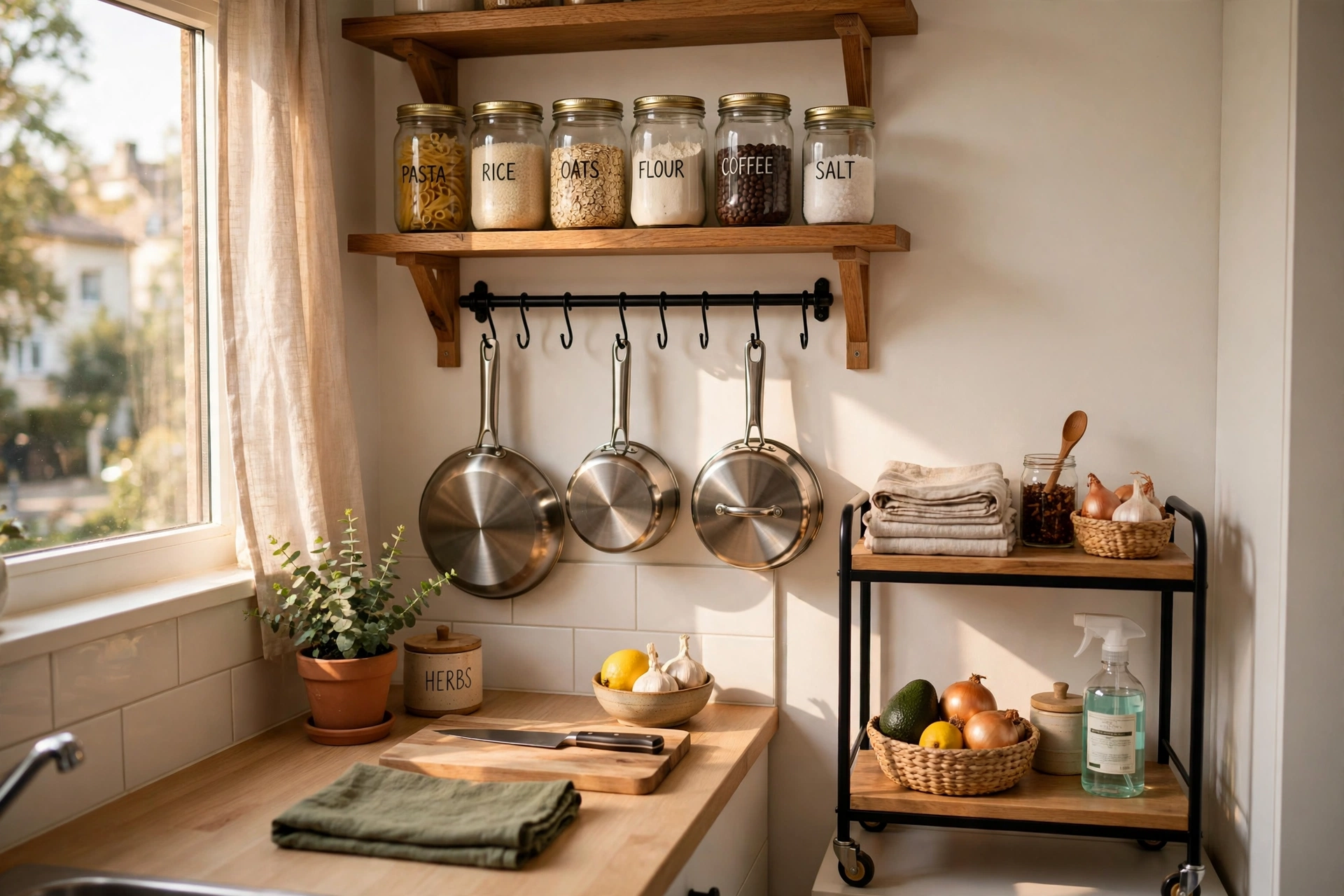
This one sounds almost too simple, and that’s exactly why I ignored it for a year. Then I put up a stainless rail with S-hooks and hung my spatulas, ladles, scissors, and the colander. Instant drawer freedom.
The real win isn’t the space — it’s the visibility. When you can SEE your tools, you stop buying duplicates. I owned three potato peelers before the rail. THREE. Hang the rail next to the stove and your daily tools are always one grab away.
2. Give the Inside of Cabinet Doors a Job
The inside of cabinet doors is pure wasted real estate in most kitchens. Mine now holds spice racks, a measuring-cup hanger, and the cutting board I use daily. Nothing that hangs there swings more than half an inch when the door closes, so it never clatters.
Here’s what I learned the hard way: use thin-mount organizers only. The bulky basket-style ones I tried first kept the doors from closing, and I lived in denial about it for weeks. Thin rack, flat hooks, low-profile — that’s the formula.
If you liked the cabinet-door approach, the cabinet-door tricks I used for budget kitchen storage go deeper on renter-safe mounts.
3. Put Your Most-Used Items Between Hip and Eye Level
I read this rule somewhere and rolled my eyes, then tried it and shut up. The stuff you reach for every day — oil, salt, the pan you use four times a week — should live in the “golden zone” between your hips and your eyes. Everything else goes high or low.
This one reorganization took me an afternoon and cut my cooking frustration roughly in half. The blender I used twice a year had been sitting at eye level. The olive oil I used daily was on the floor. No wonder everything felt hard. Fix the golden zone first, then organize around it.
4. Use a Rolling Cart as a Kitchen Island You Can Steal Back
My kitchen has no room for an island, obviously. But a slim rolling cart? That fits in the 8-inch gap between the fridge and the wall, rolls out when I need prep space, and parks itself when I’m done.
I keep my baking supplies on it — flour, sugar, the rolling pin, parchment. When it’s time to bake, I wheel the whole station to the counter. When it’s not, it’s invisible. It’s the closest thing to having a second kitchen, and if you rent, it moves with you. For more on rolling carts and multifunctional kitchen furniture, I have a whole breakdown of which ones are actually worth the money.
5. Decant Into Matching Jars (Yes, It Actually Helps, Not Just for Instagram)
I used to think the whole “decant everything into jars” trend was pure performance. Then I did it for my flours, grains, and beans, and I have to admit: finding things got genuinely faster. Labels face forward, you can see at a glance what’s running low, and bags of half-open rice stop avalanching off the shelf.
But here’s my honest rule — only decant the things you actually reach for weekly. I decanted quinoa I’d opened once out of guilt, and that jar sat there for eight months mocking me. High-turnover items only. The pretty-jar people on the internet won’t arrest you for skipping the lentils.
6. Hang Your Pots and Pans (Your Cabinets Will Thank You)
A pot lid cabinet is where kitchen dreams go to die. I hung a wall-mounted pot rack — not the ceiling kind, my ceiling is exactly where I didn’t want holes — and suddenly my lower cabinet had room for actual food.
Wall-mounted pot racks are the move for small kitchens because they turn dead wall space into storage without stealing any floor or counter. Mine holds three pans and two pots with room to spare. Pro tip: hang the heaviest pan closest to the mount points. Learned that one when a skillet migrated off its hook at 2am and scared me half to death.
7. Create a “Breakfast Station” So Mornings Stop Being Chaos
Every morning used to start with me opening five cabinets to make coffee and toast. Then I gathered the kettle, the French press, the mugs, the coffee, and the toaster onto one small tray on the counter. One zone, one morning, zero searching.
This is my favorite trick because it applies to anything you do on repeat — a tea station, a snack station for kids, a smoothie station. The tray keeps it looking tidy instead of cluttered, and everything returns to the same spot automatically. Mornings in a small kitchen get about 40% less annoying. That’s a real statistic from my life.
8. Use the Side of the Fridge Like It’s a Whole Wall
Magnetic spice tins. A magnetic knife strip (safer than it sounds, genuinely). A slim magnetic paper towel holder. The side of your fridge is a free wall that’s just standing there doing nothing.
I avoided this for ages because I thought it would look messy. It looks fine, honestly — way better than the spice chaos I had before. The key is restraint: fridge side is for the ten things you grab constantly, not your entire spice collection of forty. Curate it like a tiny store shelf.
9. Stack Vertically Inside Cabinets With Shelf Risers
Most cabinet shelves are tall enough to waste half their vertical space. Shelf risers — those cheap wire or bamboo platforms — instantly double your stacking surface. My mug cabinet went from a precarious leaning tower to two neat rows.
Don’t skip the pan organizer either if your pots live in a cabinet. The vertical file-style dividers changed my life more than I’d like to admit — lids in front, pans behind, no more avalanche. Check the clever vertical storage ideas for small apartments for more ways to think in three dimensions.
10. Corral the Under-Sink Chaos With a Tension Rod and Bins
The cabinet under the sink is every small kitchen’s shame. Mine was a swamp of half-used cleaning products lying sideways. Two things fixed it: a tension rod across the top to hang spray bottles by their triggers, and two narrow bins — one for dish stuff, one for cleaning stuff.
That’s it. The tension rod cost almost nothing and took four minutes to install. The bins mean I pull out ONE thing to reach the back instead of twelve. If your under-sink cabinet currently makes you want to move out, start here tonight.
11. Keep a “Use It or Lose It” Box for Kitchen Gadgets
Small kitchens cannot afford a gadget graveyard. So here’s my rule: anything I haven’t used in three months goes in a box by the door. If I don’t open the box for another month, it leaves the apartment — donated, gifted, gone.
The avocado slicer lasted two weeks. The spiralizer lasted three days (I have regrets and also pasta). The waffle maker I use every Sunday stays, obviously, because it’s earned. This system works because it’s gentle — nothing gets thrown out in a rage, everything gets a fair trial. Be honest with yourself: does the garlic press spark anything other than guilt?
12. Label the Deep Dark Corners (Even the Ones You Can See)
Deep corner cabinets are where tupperware goes to have secret meetings. Mine had containers I’d forgotten owning. So I pulled everything out, grouped by type — lids with lids, containers with containers, no exceptions — and put the least-used items in labeled bins at the very back.
The labels sound excessive until you’re reaching into a dark corner at 7pm with wet hands. “Baking pans” and “takeout containers” save you from the excavation ritual. Stackable square containers nest better than round ones, by the way — I learned that from a hidden-storage guide I trust and it holds up.
13. Do a 10-Minute Nightly Reset (The Only Habit That Matters)
All the organizers in the world won’t save a kitchen that never gets reset. My rule: ten minutes after dinner, counters clear, dishes in the rack, everything back to its zone. Ten minutes. That’s the whole system.
The first week I hated it. By week three it was automatic, and my kitchen started staying organized on its own because everything already had a home. Organization isn’t a project you finish — it’s a ten-minute daily habit wearing a project costume. Start tonight. Your tomorrow-morning self will be weirdly grateful.
Quick Answers
What’s the fastest way to organize a small kitchen?
Fix the golden zone first — move daily-use items between hip and eye level, push rarely-used items high or low. Then add one wall rail for hanging tools. Those two moves alone transform most tiny kitchens in an afternoon.
How do I organize a small kitchen on a budget?
Tension rods, S-hooks, shelf risers, and magnetic strips cost very little and create real storage. A rolling cart is the one bigger purchase worth making — it works as extra counter space and moves with you when you relocate.
How can renters organize a kitchen without drilling?
Use adhesive hooks rated for the weight, over-the-door racks, tension rods, magnetic organizers on the fridge, and freestanding rolling carts. Everything here except the wall-mounted rail has a no-drill alternative.
What’s the best way to store pots in a tiny kitchen?
Wall-mounted pot racks free up an entire cabinet, or use vertical file-style dividers inside a cabinet so lids and pans stand upright instead of nesting into a stuck-together mess.
The Bottom Line
A small kitchen isn’t a broken kitchen — it’s just one that punishes disorganization faster. Every idea here survived in my real kitchen because each one follows the same rule: give every item a visible home at the height where you’ll actually use it, and evict everything that doesn’t earn its spot.
Pick three ideas from this list and do them this weekend. The rail, the golden-zone reshuffle, and the nightly reset would be my top three if I had to start over. And if you already tackled budget kitchen storage, think of this as part two — the organization layer that makes storage actually work.